Summarize and analyze this article with:
U.S. technology leaders are hiring most aggressively in the second half of 2026. Yet 65% of technology hiring managers say finding skilled IT talent is more challenging than it was a year ago.
For IT staffing firms, this is both an opportunity and a challenge. Closing that talent gap is what turns you into your client’s indispensable partner. But every day a role that sits vacant increases your unbillable costs, with an extra week of vacancy costing nearly 5x more than an additional interview round.
Add new requisitions on top of the ones already unfilled, and your internal recruiters are left burnt out trying to cover both.
To solve these exact challenges and hire talent faster, many IT staffing firms in the U.S. are now turning to recruitment process outsourcing services. In this article, we’ll discuss everything you need to know about the IT RPO model, so you can choose the right one for your business.
Hire Niche IT Talent Faster with 24/7 Offshore Staffing Support
What is IT Recruitment Process Outsourcing?
IT Recruitment Process Outsourcing (RPO) is a hiring model where you delegate parts or the entire IT recruitment process to an external partner under agreed service levels and performance metrics.
This is different from hiring contract recruiters, as here you outsource the entire recruitment workflow to a specialized team, rather than you having to oversee every step.
IT RPO can include, but is not limited to, the following services:
- Candidate sourcing and pipeline building
- Screening
- Credentialing and compliance
- Administrative work (e.g., CV formatting, ATS/VMS updates, etc.)
- End-to-end recruitment delivery
Why Are US Staffing Firms Outsourcing IT Recruitment?
Here are some of the major reasons why leading US IT staffing firms outsource recruitment:
- Recruiter burnout and limited internal capacity: Internal recruiters juggling multiple open reqs at once see longer time to fill and higher drop-off, which is why multiple firms route overflow requisitions to an outsourced team.
- Increasing technology talent shortages: Nearly 1.1 million technology job openings were posted last year in the U.S. However, there’s not enough candidate supply, which is increasing recruiter load and hiring delays. As a result, staffing firms are turning to RPO solutions to improve role coverage and find niche talent faster.
- Reaching passive candidates: IT RPO providers maintain pre-built talent pools and outreach campaigns, which shortens the sourcing cycle for candidates who aren’t actively applying.
- Shrinking staffing margins: High operational spend and growing dependency on VMS/MSP channels have been compressing margins for IT recruitment firms. This has made a variable-cost RPO model more attractive than fixed internal overheads.
- Fluctuating client demand: RPO lets you scale your recruiter capacity up for a hiring surge and back down when volume drops, without layoffs or idle bench cost.
Also Read: The 9 Biggest IT Recruitment Challenges & How to Solve Them
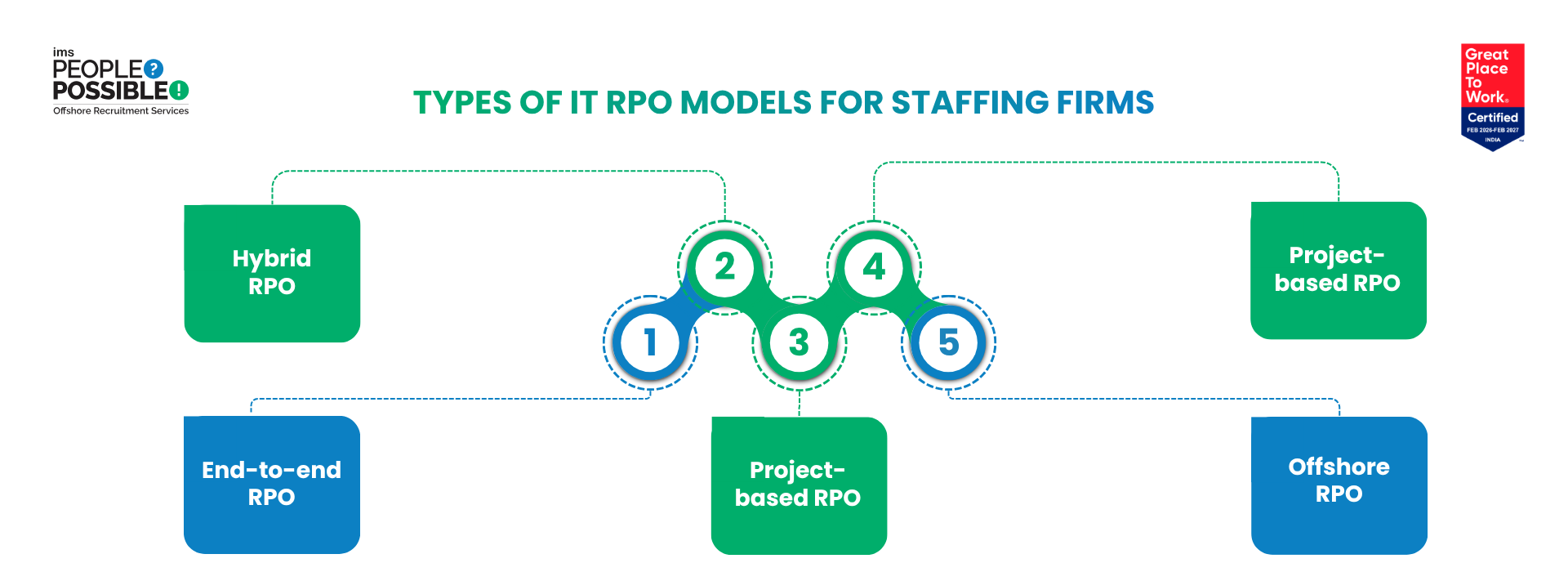
Five Types of RPO Models for IT Staffing Firms
Before you choose to outsource your recruitment processes, it’s important to understand the different types of IT RPO models that exist.
Let’s look at each one of them in detail.
1. End-to-End RPO Model
In this model, the provider manages the full recruitment lifecycle (e.g., from requisition intake and sourcing to screening, interview coordination, and onboarding support) under one SLA.
Best if: you’re handling consistently high hiring volume across multiple client accounts.
2. Hybrid Recruitment Process Outsourcing Model
Here, the RPO team and your internal recruiters split responsibilities. For example, the provider handles sourcing and initial screening while you manage client-facing interviews and offers.
Best if: you want to retain control of key relationship touchpoints while offloading volume-heavy recruiting work.
3. Project-Based RPO Model
In project-based RPO, support is scoped to a defined hiring initiative (e.g., a new client contract or a product launch) with a fixed start and end date.
Best if: you want recruitment process outsourcing support without the volume to justify an ongoing long-term engagement.
4. On-Demand Recruiter Model
The on-demand RPO model is similar to a project-based RPO and is often used interchangeably. However, unlike project-based outsourcing, here you can scale recruiter headcount up or down month to month based on requisition load, with no fixed end date tied to a single initiative.
Best if: you want to outsource recruitment to a contract recruiter who functions as an instant extension of the internal team.
5. Offshore Recruitment Process Outsourcing Model
In the offshore RPO model, your IT recruitment functions are delivered by a team based in a different country, offering cost savings and extended time-zone coverage.
IMS People Possible, for example, operates with a team of 3,000+ recruitment professionals across India and the Philippines supporting US-based staffing agencies under this model.
Best if: you’re looking to create 24/7 pre-vetted pipelines, outsource high-volume administrative work beyond local working hours, or get access to high-quality recruitment professionals while improving profit margins.
| RPO Model | RPO Scope | Best-fit use case | Level of control | RPO Pricing Trends | Main limitation |
| End-to-End RPO | Full recruiting lifecycle | High, sustained hiring volume | Low to moderate (provider-led) | Monthly management fee | Requires tight SLA governance to maintain quality |
| Hybrid RPO | Shared sourcing/screening + internal client management | Firms wanting to keep relationship control | Moderate to high | Blended fee + per-hire | Coordination overhead between two teams |
| Project-Based RPO | Defined initiative, fixed timeline | New projects with specific timelines | Moderate | Fixed project fee | May not be cost-effective for ongoing volume |
| On-Demand RPO | Dedicated
contract-based recruiters |
Variable demand surges | High | Per-recruiter fee | Ramp time when headcount flexes |
| Offshore RPO | Flexible scope (e.g., only sourcing, administrative tasks, compliance, or full-cycle recruitment) | Operational cost reduction + 24/7 role coverage | Moderate to High | Cost-per-hire or dedicated-team fee | Time-zone differences may allow less oversight. |
Benefits of Recruitment Process Outsourcing for IT Staffing Firms
Once you’ve chosen an RPO model, the next question is simple: what changes for your business?
To break it down, let’s look at some of the top benefits of choosing the right IT RPO partner:
- Extended role and time-zone coverage: An offshore RPO team working India/Philippines hours gives you coverage outside the standard 9-to-5, building a 24/7 recruiting model.
- Faster hiring for niche IT positions: Your RPO partner can deliver a pre-vetted, compliant technical talent pool, which can significantly reduce your sourcing time, especially for hard-to-fill roles.
- Access to larger passive-talent pipelines: A dedicated outsourced sourcing team maintains a refreshed candidate database for you at all times, so you never have to start from scratch.
- Lower cost per hire: SHRM estimates the average U.S. cost per hire at $5,475 for non-executive roles and $35,879 for executive positions. Recruitment process outsourcing helps you control those costs by scaling recruiter capacity without adding permanent overhead.
- Improved quality of hire: Wider passive-candidate access plus structured technical screening widens the pool you’re submitting from instead of compressing to whoever applies first.
Want to See How We Can Help You Scale Your IT Recruitment?
How Does the IT RPO Process Work?
Here’s the sequence you’d actually run through with an RPO provider, from start to finish:
1. Requirement Assessment
Before the actual hiring operations begin, the first step is to review your current requisition volume, your internal recruiter’s bandwidth, and the technical skill areas causing you the most delay.
2. Solution and SLA Design
Once the challenge is assessed, your RPO partner designs curated solutions, including the candidate sourcing strategy and hiring workflows. This is also when you and your provider agree on scope (e.g., RPO model, outsourced hiring tasks, the required tech skills), turnaround-time SLAs, and the KPIs you’ll use to measure performance.
3. Candidate Sourcing and Screening
Once both parties agree on the deliverables, your RPO partner recruiters start the actual talent hunting. This can include job postings, refreshing existing databases, Boolean searches, and outreach campaigns to build a pipeline for your open requisition.
4. Documentation and Compliance
The RPO recruiters vet candidates against the role’s technical requirements and regional compliance before they’re submitted. So, your recruiters spend more time on strategic tasks and not on unqualified submissions.
5. Interview, Offer, and Onboarding Support
At this point, your RPO can submit the compliant, shortlisted candidates to you, so you can take them forward. Or, depending on the scope, they can continue to coordinate candidate interviews and provide offer and onboarding support while you focus on the client communication.
6. Recruitment Reporting
The RPO partner must provide transparent reporting against your agreed KPIs and coordinate with your account manager at all times for seamless collaboration.
7. Continuous Process Improvement
The end goal is to improve your hiring process and quality of hire. The right RPO provider turns continuous reporting and analytics into data-driven decisions that ultimately help you achieve the goal.
Also read: How we implemented fraud-proof candidate screening and 142% more starts for this IT staffing firm
How to Choose the Right Recruitment Process Outsourcing Provider
To help you choose the right IT RPO provider for your business, we’ve listed an evaluation checklist that you can consider:
- Does your RPO provider have the particular IT or niche-role expertise that you are looking for?
- Do they have any previous experience supporting US-based IT staffing firms similar to yours?
- What are the actual metrics that they’ve achieved for previous businesses?
- What is the expected turnaround time if you need sudden scalability assistance?
- Do they have compliance tools or experts specific to the USA region?
- Do they have data security certifications, and what practices do they follow to ensure your data remains safe?
- How’s their reporting structure, and how are missed SLAs handled?
- Can they integrate their workflows with your existing VMS/ATS and other tech stack?
- How will they ensure real-time collaboration with your internal team without delays?
- What are the exit and transition provisions?
- How does their pricing model look like, and does it protect or improve your profit margins?
Recruitment Metrics and KPIs for Measuring IT RPO Performance
So, you’ve evaluated the RPO provider and are ready to boost your hiring operations. But you can’t improve what you don’t measure.
To ensure you achieve the maximum ROI, here’s what to track once your RPO engagement is live:
| Primary KPIs | Calculation | Why It Matters for You |
| Time to Fill | (Offer acceptance date) − (Requisition open date) | Compare it against your internal metrics before engaging with the RPO to measure improvements |
| Time to Hire | (Offer acceptance date) − (Candidate sourced date) | Isolates process speed from how long your req sat unfilled before sourcing began |
| Cost per Hire | (Internal costs + External costs) ÷ Total hires | Helps you evaluate your ROI and any increase in profit margins |
| Quality of Hire | Performance + Retention + Client satisfaction | Indicates whether your placements succeed after hiring |
| Offer Acceptance Rate | (Accepted offers ÷ Total offers) × 100 | Measures your RPO provider’s talent sourcing and candidate engagement quality |
| Submission-to-Interview Ratio | Candidates interviewed ÷ Candidates submitted | Reflects directly on your provider’s technical screening accuracy |
Additional Staffing RPO Metrics to Monitor
Beyond the primary KPIs listed above, here are a few additional metrics to track with your RPO partner:
- Interview-to-offer ratio: Highlights how effectively candidates are being screened.
- Candidate response rate: Measures sourcing effectiveness, especially for passive talent.
- First-year or assignment retention: Reflects long-term placement success and candidate fit.
- SLA compliance: Shows whether recruitment commitments are consistently being met.
- Hiring manager or account manager satisfaction: Typically tracked via a post-placement survey score.
- Source-of-hire performance: Measures which sourcing channels perform the best for sourcing IT talent.
It’s important to note that a shorter time to fill means little if the quality of hire drops. Likewise, a lower cost per hire isn’t a win if placements don’t last. In short, the strongest recruitment outsourcing providers balance speed, quality, cost, and client satisfaction.
Conclusion: Turn IT Recruitment Process Outsourcing into a Long-Term Growth Strategy
Demand for skilled IT professionals isn’t likely to slow down anytime soon. As clients expect faster hiring without compromising quality, you’ll need a recruitment model that helps you scale efficiently without increasing fixed costs.
That’s where recruitment process outsourcing can create long-term value for your business. At IMS People Possible, we’ve spent over 20+ years partnering with 300+ US-based staffing firms to deliver offshore IT RPO solutions.
Whether you need dedicated recruiters, sourcing support, or end-to-end recruitment management, we become an instant extension of your team so you can deliver faster and grow with confidence.
To learn how we can help scale your IT recruitment delivery or know the results we’ve achieved for staffing firms like yours, get in touch with us.
FAQs
1. What is recruitment process outsourcing?
Recruitment Process Outsourcing (RPO) is a strategic hiring model where you delegate specific hiring tasks or the entire recruitment to an external partner under agreed SLAs and performance metrics.
2. What are the benefits of recruitment process outsourcing?
The main benefits of the recruitment process outsourcing model include scalable recruiter capacity without fixed overhead, faster time to fill on hard-to-fill roles, lower cost per hire, and access to specialist technical sourcing without you having to oversee every step of the recruitment.
3. Which RPO model is best for an IT staffing firm?
The right RPO model for your staffing firm completely depends on your hiring volume, role complexity, existing internal recruiter capacity, and whether you need continuous or project-tied support. For example, high, sustained volume favors end-to-end or offshore models, while a project-based RPO model works great for one-time hiring needs.
4. What is the difference between time to fill and time to hire?
While the time-to-fill measures the full period from when your requisition opens to when an offer is accepted, time-to-hire reflects a narrower window (from when a candidate enters your pipeline to when they accept an offer), isolating process speed from how long the req sat unsourced beforehand.
5. How do you measure the quality of hire?
To measure quality of hire efficiently, combine the new hire’s performance rating, retention over time, hiring-manager or client satisfaction, and time to achieve full productivity.