
Summarize and analyze this article with:
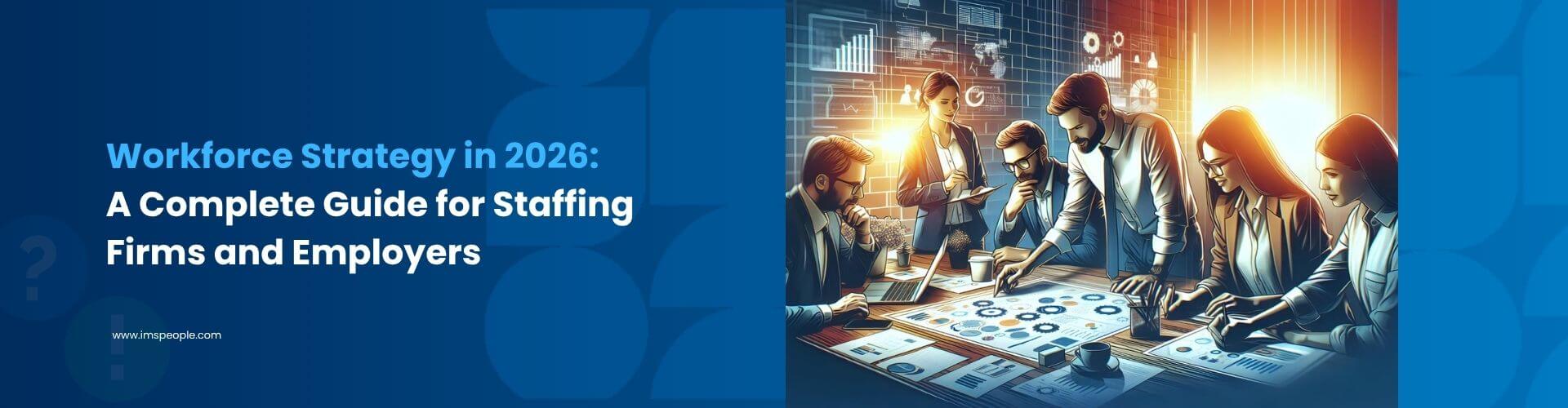
If you still treat workforce strategy as next year’s hiring plan, 2026 is going to be a hard year.
Skills are shifting faster than job descriptions can keep up. AI is rewriting half the roles you hire for. The contingent workforce is no longer the side door for many companies; it’s the main part of the building. In fact, the gap between firms that plan their talent and firms that react to vacancies is now visible in the revenue.
This is a guide for the firms considering workforce strategy planning for 2026, why boards suddenly care, which are the four pillars that hold a real strategy together, the commonly seen mistakes, and where offshore recruitment fits.
What Is Workforce Strategy? (And What It Isn’t)
Workforce strategy is a comprehensive framework that aligns talent acquisition, development, and deployment with an organization’s strategic goals. It answers critical questions, namely:
- What skills will we need in 12, 24, or 36 months?
- How should we balance permanent, contingent, and offshore talent?
- Where are our capability gaps, and how do we close them before they become business constraints?
It is neither a headcount spreadsheet nor an annual ritual that HR runs in January and files away by March. And it is definitely not a recruitment calendar dressed up in nicer language.
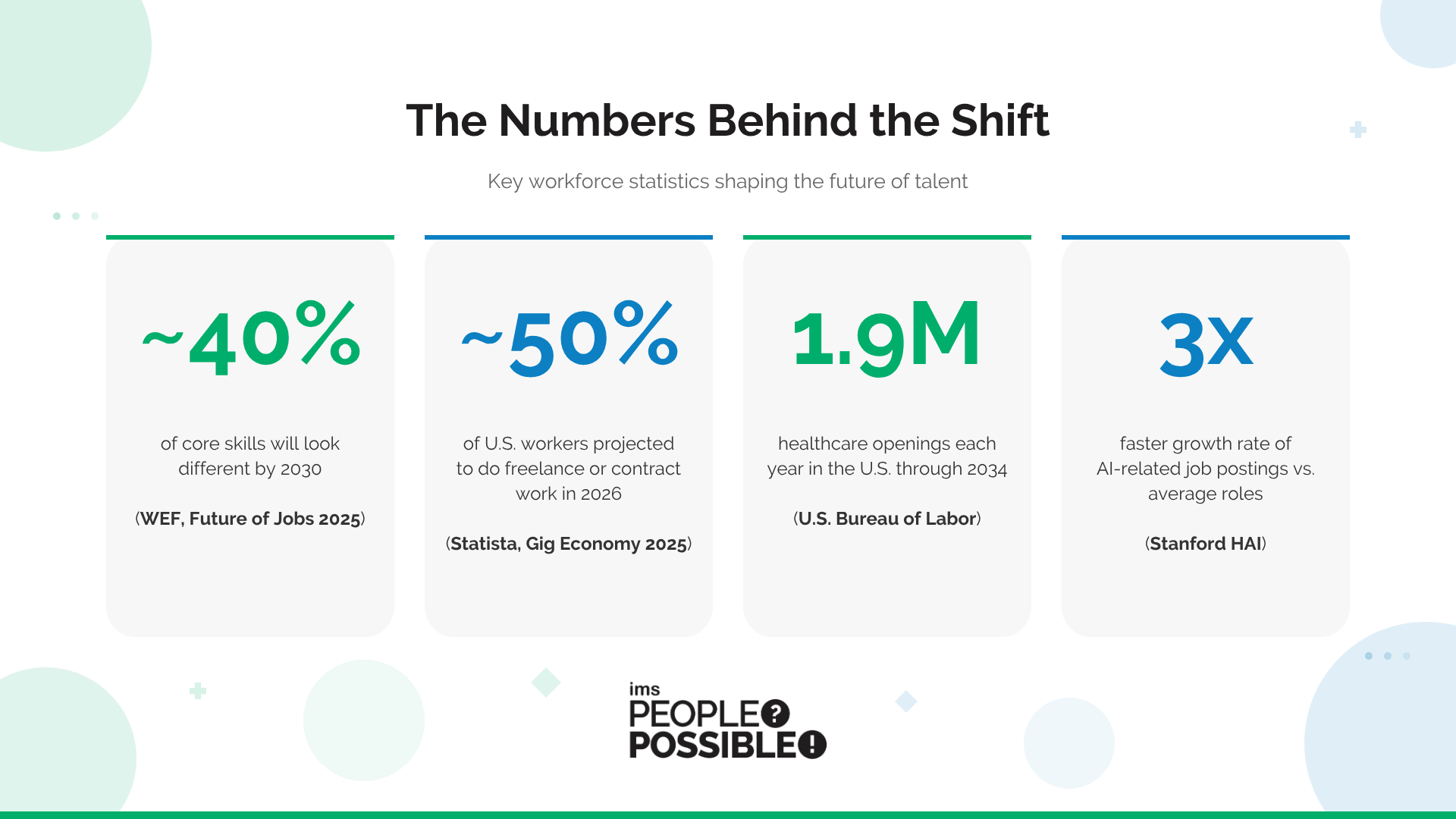
It’s an ongoing conversation between HR, finance, and the people running the business that gets refreshed as forecasts change, as technology shifts the work, and as the labor market moves under you. With nearly 40% of core skills expected to look different by 2030, a once-a-year planning cycle can’t keep pace.
Why Workforce Strategy and Planning Is Now a Board-Level Priority
The contingent side of work alone makes that clear. Roughly half of the U.S. workforce is already enrolled in some form of freelance or contract work in 2026, and the gig economy is moving from about $580 billion in 2025 toward more than $2 trillion by the mid-2030s. In healthcare, the demand side keeps stretching too, as per the U.S. Bureau of Labor Statistics, projects around 1.9 million healthcare openings each year through 2034, most of them backfills rather than new roles.
That changes what boards ask. They’ve moved past “Are we hiring enough?” The harder questions are different:
- Do we actually see our contingent workforce clearly?
- Can we scale talent supply as fast as demand moves?
- Where is our classification and compliance exposure hiding?
Then there’s AI sitting on top of all of it. Postings tied to AI skills are growing roughly three times faster than the average role, but only around 3 in ten U.S. workers have had any formal AI training. Companies that haven’t built pipelines for these skills will end up competing on price for whoever is left in the market.
The 4 Pillars of an Effective Workforce Strategy
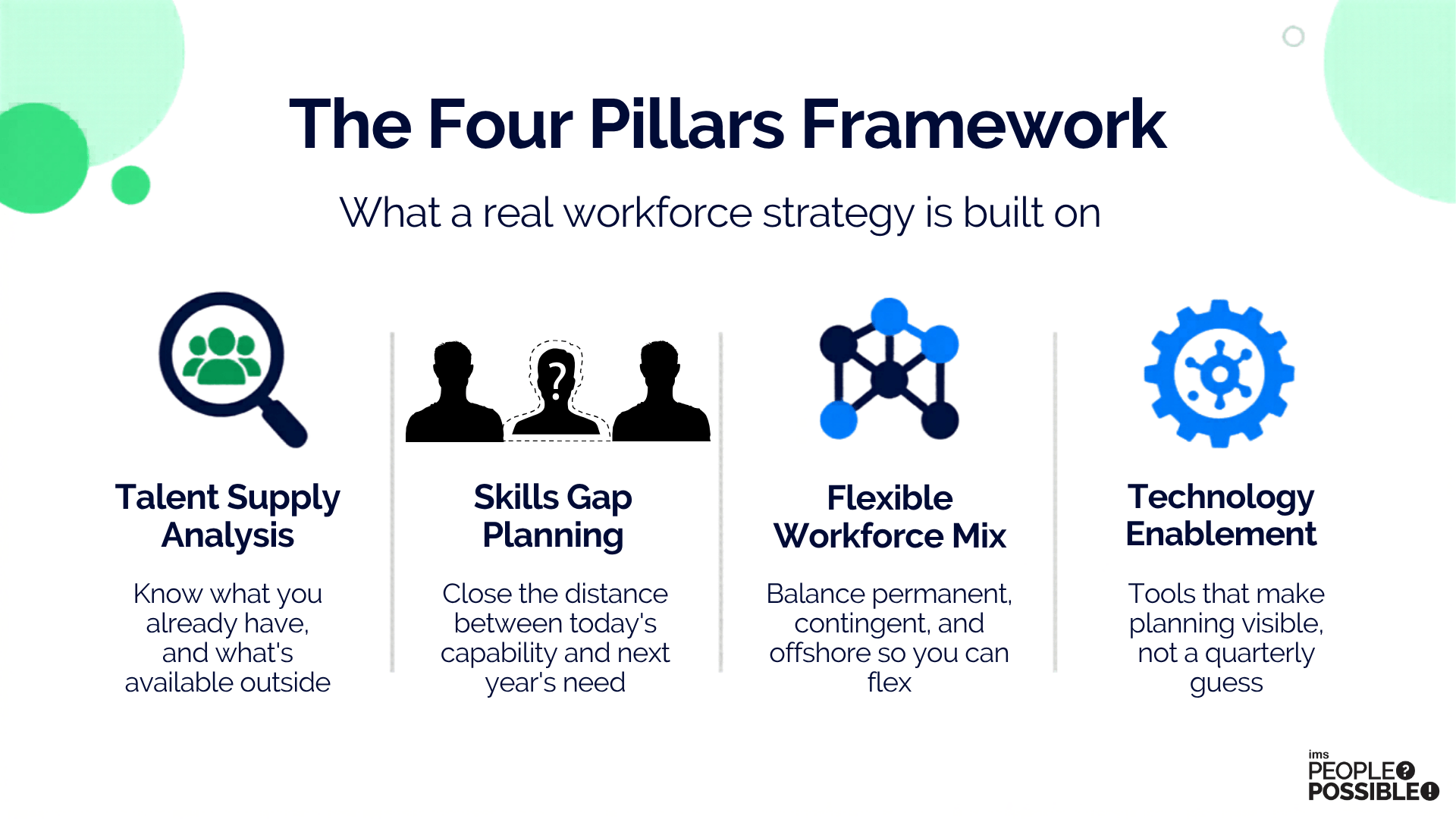
Workforce strategy today goes far beyond filling roles; it’s about building a resilient, future-ready talent engine. The difference between reactive hiring and scalable growth often comes down to four core pillars.
1. Talent Supply Analysis
Before planning, understand what you have and what’s available externally.
Talent supply analysis maps internal capabilities, external talent pools by skill and geography, and real hiring dynamics in your markets. While data is more accessible than ever, it’s still underused.
A strong analysis answers:
- What skills do we currently have and where?
- Where are the best external pools for critical roles?
- What are our actual hiring timelines by role?
Offshore recruitment partners play a key role here, handling market mapping, pipeline building, and sourcing that often gets deprioritized internally. An evergreen pipeline for hard-to-fill roles is more valuable than reactive hiring.
2. Skills Gap Planning
Once you understand supply, plan the gap.
This is the difference between current capabilities and what the business will need in the next 24 months. With skills evolving rapidly, hiring to static job descriptions is no longer effective, organizations must think in skills, not just titles.
In practice, this requires:
- Frequent skills audits
- Clear visibility into emerging skills tied to business strategy
- Focused upskilling aligned to real gaps
Skills-first hiring brings this to life through assessments, micro-credentials, and competency-based evaluation, especially critical in fast-evolving fields like AI, cloud, and cybersecurity.
3. Flexible Workforce Mix
The advantage today isn’t just cost; it’s agility.
A flexible workforce mix balances full-time employees, contractors, and offshore teams to scale with demand. Not every need justifies a permanent hire, whether it’s a product launch, seasonal surge, or short-term specialization.
The talent landscape has also shifted, with many professionals choosing independent work for autonomy. Treating this pool as secondary means missing top talent.
A strategic approach includes:
- Scenario-based workforce planning
- Clear decisions on what stays in-house vs. outsourced
- Strong governance across vendors, compliance, and performance
- Done right, this delivers both speed and cost efficiency.
4. Technology Enablement
None of this works without the right infrastructure.
Technology makes workforce planning visible, scalable, and predictive. Core systems like VMS, ATS, and HRIS must be integrated to provide a clear view of talent.
The real advantage lies in balance:
- AI handles high-volume, repeatable tasks like sourcing
- Humans focus on judgment-driven work—relationships, negotiation, and candidate experience
Get this right, and your recruiters spend more time on high-impact work that technology can’t replace.
Common Mistakes Organizations Commonly Make
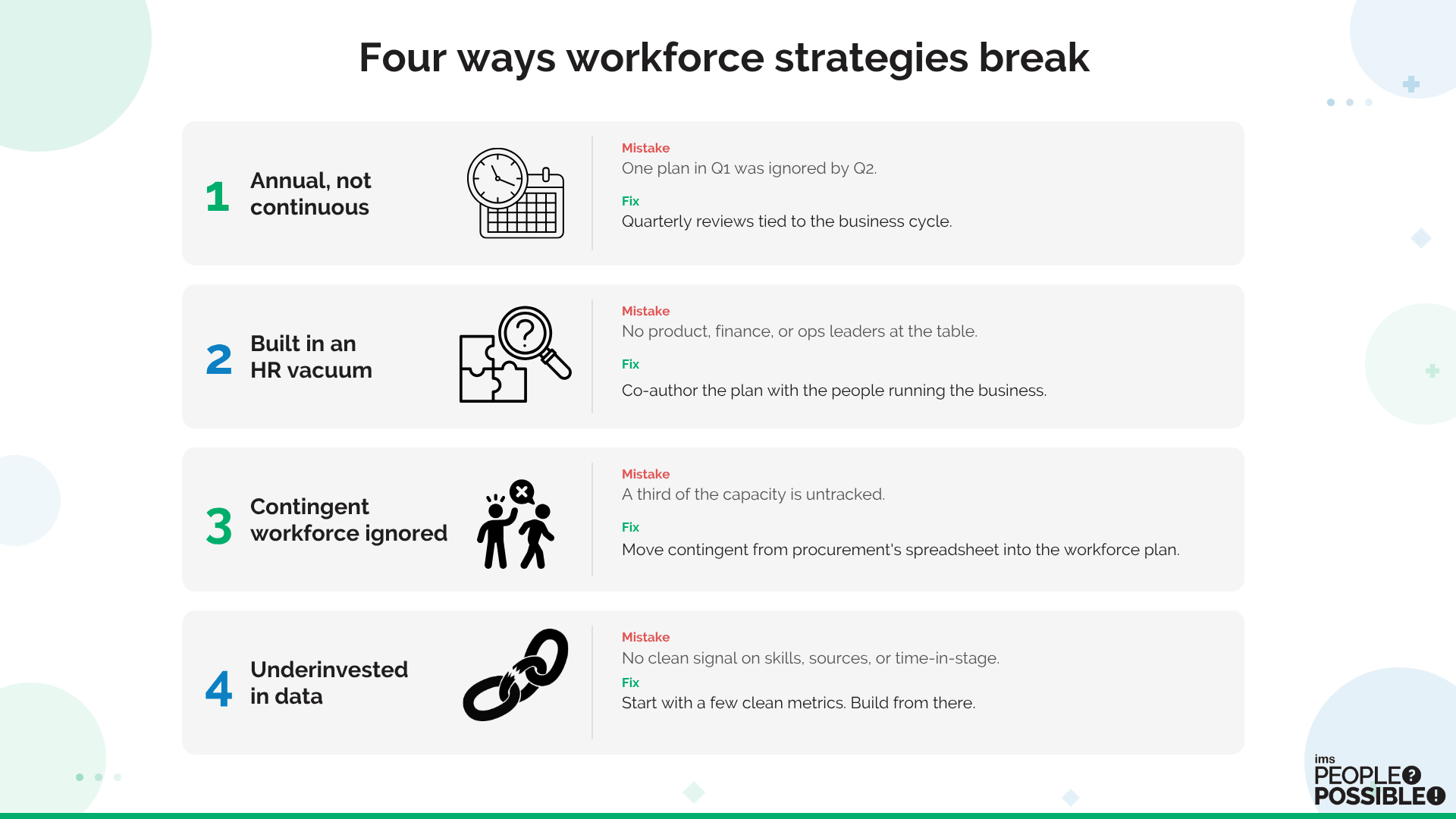
- Treating workforce planning as an annual event.Q1 plan, filed by Q2, back to reactive hiring by Q3. The fix is unromantic: quarterly reviews tied to business performance cycles, not a yearly offsite.
- Building the plan in an HR vacuum.If product, finance, and operations leaders aren’t in the room, the plan will be technically clean and strategically irrelevant. Workforce strategy has to be co-authored with the people who actually know what the business is trying to do next quarter.
- Ignoring the contingent workforce entirely.When contingent workers are a third or more of total capacity but aren’t tracked, measured, or planned for, you’ve lost sight of a big chunk of your talent. Procurement can handle the contracts, but the strategy has to live with talent acquisition.
- Underinvesting in workforce data.No clean data on current skills, source effectiveness, time-in-stage, or rejection reasons means every plan is partly a guess. The basic recruitment analytics, i.e., conversion rates by stage, structured rejection codes, and candidate experience scores, are the difference between fixing problems in weeks and noticing them in years.
How Offshore Recruitment Fits Into a Modern Workforce Strategy
Offshore recruitment used to be a cost play. That framing is dated.
In 2026, the staffing firms and employers getting the most out of offshore aren’t treating it as a vendor. They’re treating it as an extension of their own talent acquisition team — integrated into sourcing, database management, credentialing, compliance, and candidate engagement.
Offshore teams tend to be best at the work that’s high-volume and process-intensive: maintaining pipelines for recurring roles, initial screening, credentialing and compliance paperwork, and the administrative side of placement tracking. In healthcare, education, and tech, where credentialing is complex and talent is genuinely scarce, operational capacity is often the difference between scaling and stalling.
There are three honest reasons it works.
- First, the time zones. Pipelines stay active overnight, which compresses time-to-fill on urgent roles.
- Second, the depth of recruiting talent in markets like India is real, particularly for domain-heavy sectors. You’re not just buying hours; you’re buying expertise.
- Third, it frees onshore recruiters to do the work that genuinely needs a person in the room, i.e., client conversations, complex negotiations, and the long relationships that compound over years.
If you’re evaluating a partner, the questions worth asking are about industry depth, technology stack fit, compliance rigor around classification and data privacy, and whether they actually think about candidate experience the way you do. A useful rule of thumb: the partnerships that work tend to look like alliances with shared metrics. The ones that don’t are measured purely on cost per hire — and they deliver exactly what you measure.
Key Takeaways and Next Steps
Four moves, in order. Each one builds on the last.
- Run a real skills audit. Map actual skills, not job titles. You can’t plan a gap you can’t see.
- Model your workforce mix function by function. Match next year’s forecast to the right blend of permanent, contingent, and offshore. Skip the company-wide average — it hides everything that matters.
- Get your data honest. Clean numbers on a few metrics — time-to-fill, source effectiveness, skills coverage — beat messy data on twenty.
- Bring in an offshore partner for the work that’s eating your calendar. Sourcing, screening, credentialing, pipeline maintenance. Free your onshore team for the work that needs a person in the room.
For staffing firms, this matters twice over. Workforce strategy is both how you run your own business and what you sell to clients. Firms that can walk a client from reactive hiring to a real talent pipeline get to have a different kind of conversation — and command a different kind of margin.
The IMS People Possible Advantage
If you’re ready to move from reactive recruiting to a real workforce capability, IMS People Possible works with staffing firms and employers across healthcare, education, technology, and professional services, from sourcing and database management to credentialing and full-cycle recruitment support. The firms winning in 2026 aren’t the ones with the biggest recruiting team. They’re the ones with the clearest plan, the best data, and the right partners around it.