
Summarize and analyze this article with:
After three years of contraction, light industrial staffing is turning a corner. According to SIA’s May 2026 Pulse Survey, industrial staffing tied for the highest median revenue growth across all staffing segments at 5% year-over-year.
For staffing agencies, that recovery presents both an opportunity and a challenge.
As manufacturers, warehouses, and assembly operations ramp up hiring again, staffing agencies must fill growing order volumes in a labor market that hasn’t expanded at the same pace.
So, how do you solve the skill shortage in a market that’s growing faster than its talent pool?
Let’s find out.
The Growing Light Industrial Talent Shortage
Light industrial employers are all competing for a shrinking pool of skilled labor. The U.S. alone could see 1.9 million manufacturing jobs go unfilled by 2033, while 33% of new hires leave within their first 30 days.
Part of the problem is structural. Light industry, by its nature, can’t go remote. You can’t operate a forklift from your living room. So post-pandemic, when younger workers started looking for remote flexibility, light industrial employers simply couldn’t offer it.
Compounding this, the average manufacturing worker is relatively old, and the industry is bracing for a wave of retirements over the next ten years.
On the ground, this shows up as a lack of active candidates, no-shows, and increasing turnover.
Here’s a realistic cost of early turnover for a light industrial staffing agency serving just one client.
| Parameter | Value | Notes |
| Annual placements | 100 workers | Example staffing account |
| First 30-day turnover | 33% | Industry average |
| Early replacements | 33 workers | 100 × 33% |
| Average recruiter hours per replacement | 6–8 hours | Sourcing, screening, onboarding, coordination |
| Onshore Recruiter cost | $40–$60/hour | Average cost |
| Recruiting cost per replacement | $240–$480 | Recruiter time |
| Compliance & onboarding cost | $75–$150 | I-9, E-Verify, payroll setup, PPE, documentation |
| Lost gross margin during vacancy | $400–$800 | Delayed fill/replacement period |
| Total agency cost per replacement | $715–$1,430 | Combined costs |
| Annual cost of early turnover | $23,600–$47,200 | 33 × $715–$1,430 |
Now multiply that across multiple clients and consider other challenges like finding skilled labor in the first place, recruiter productivity, and the time that cannot be billed.
The takeaway is clear: for staffing agencies, the cost of the light industrial talent shortage isn’t measured by unfilled jobs alone. It’s measured by the time, margin, and your agency’s reputation.
Why the Old Staffing Methods are No Longer Enough
Posting a requisition and waiting for applicants assumes a labor market that no longer exists for light industrial roles. Here’s the simple reason: job boards reach active job seekers only.
A few other structural mismatches compound the skill shortage problem:
- Demand and scalability mismatch: Internal recruiter capacity doesn’t always scale with seasonal surges. So, when an employer suddenly needs 40 light industrial roles filled in 10 days, your existing recruiting team can struggle to keep pace.
- Backfills take up recruiter bandwidth: With no-shows and turnovers becoming routine in light industrial roles, your recruiters end up spending their time backfilling the same shifts rather than building a pipeline ahead of demand.
- Compliance overheads: Form I-9 requirements, OSHA compliance, payroll records, safety documentation, PPE assessments add administrative load on your recruiters, especially when hiring volume spikes seasonally.
- Wage discrepancies: If your staffing agency relies on annual compensation reviews, you may often discover mid-cycle that competitors have already moved their hourly rates up.
These are structural mismatches between how the traditional hiring model was built and what the current high-volume, time-sensitive light industrial staffing demands.
Want Expert Advice on How to Deliver Consistently for Light Industrial Roles?
How Light Industrial Staffing Agencies Can Solve the Skill Shortage
Some agencies have responded to the shortage with a blunt fix: overhiring. While this may increase the chances of 100% coverage, it drastically reduces your margins.
A more durable approach is to create a solid light industrial workforce strategy that accounts for the industry nuances – and addresses the talent shortage at its source.
Here are eight ways the strongest light industrial staffing agencies are doing exactly that.
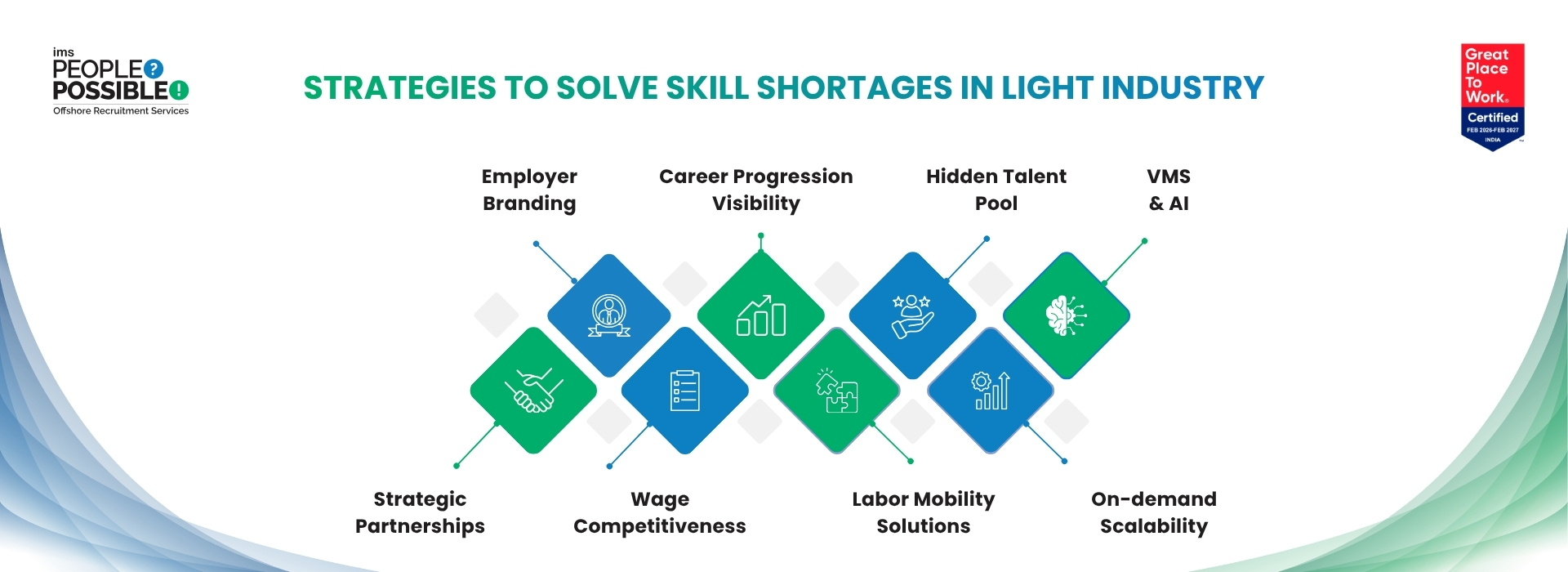
#1 Employer Branding
How your client’s roles and their company are positioned to candidates often becomes the deciding factor when workers choose between near-identical openings.
For an open role, rewrite job descriptions around the details that actually matter to candidates: shift flexibility, your safety record, the equipment they’ll use, and the team they’ll join.
It’s also important to ensure your recruiters have a strong grasp of the employer and can clearly convey its advantages to candidates.
#2 Career Progression Visibility
One of the biggest reasons workers leave light industrial roles is the belief that the roles are dead-end or unstable. So, when you’re reaching out to a candidate, you must provide them with a realistic timeline of six to twelve months as a reason to stay.
Better yet, agencies that track conversion data can show candidates exactly what percentage of temp placements move to permanent roles and what their pay looks like a year, boosting candidate confidence.
#3 Leverage Hidden Talent Pool
Hidden talent pools are candidates who aren’t traditionally considered for light industrial roles but can excel in them with the right training and support.
For example, gig workers who already have experience working independently, candidates transitioning from industries like retail, or from overlooked geographies may also fit certain light industrial settings.
#4 Take Advantage of Technologies Like VMS & AI
A Vendor Management System (VMS) helps you centralize and monitor your hiring data such as fill rates, time to start, and cost per hire in real time, so you can identify bottlenecks early.
You can take this a step further by using AI to automate candidate matching and prioritize applicants based on factors such as shift availability, proximity to the worksite, certifications, and relevant experience. Finally, leverage predictive analytics to identify future hiring needs and build talent pipelines before demand peaks.
Also Read: The 9 Biggest Challenges in IT Recruitment & How to Solve Them
#5 Structured Partnerships & Curriculum Involvement
The strongest agencies actively shape the talent coming into the pipeline. That can mean co-funding a certification course in machine operation or warehouse management systems at a local technical college, or running a pre-placement orientation that walks candidates through the exact equipment and safety protocols they’ll encounter on the floor.
Candidates who arrive through a structured training pipeline reach full productivity faster than those hired cold, and they’re significantly less likely to leave within the first 90 days.
#6 Wage Competitiveness & Working Conditions
If you operate across multiple light industrial clients in a region, you can collect the market intelligence to show a client that the market rate for a specific role moved in the last quarter and what their competitors are currently offering. This lets you position yourself as a strategic advisor, not just a headcount vendor.
Beyond base pay, flag the low-cost working condition improvements that show up most in retention data like:
– more predictable scheduling
– better break facilities
– attendance bonuses, etc.
These are changes your clients can make quickly, and they give candidates a reason to accept the role.
#7 Labor Mobility Solutions
If your client’s facility is located in an area with a limited labor pool, address the challenge early. Discuss expanding the search to nearby markets, explore transportation support or travel allowances, and, where feasible, consider relocation assistance or temporary housing for skilled workers.
#8 Leverage On-demand Scalability
No two months look the same in light industrial staffing. Your client may need 20 workers in January and 200 in October.
If your internal recruiting capacity is built for the average demand, you’ll consistently fall behind at the peaks, and peaks are exactly when your clients are watching most closely.
A good way to solve this is to structure your delivery model in a way that can scale during surges without breaking :
- Embed an RPO partner to absorb high-volume hiring cycles at variable cost instead of carrying full-time overhead year-round.
- Bring in contract recruiters for experienced sourcing muscle during demand windows without long-term commitments.
- Use offshore recruiting support to handle the operational layer at a fraction of the onshore cost while allowing you to focus on building relationships.
The agencies that win the largest light industrial contracts are the ones that can match any volume their clients require and also consistently deliver without burning out the people doing the work.
Where IMS People Possible Fits in Your Hiring Process
At IMS People Possible, we understand the hiring pressures staffing agencies face in the current light industrial market. And to support you best, we work just like your offshore extension — which means every process we’ve built, every tool we use, and every recruiter we deploy is calibrated specifically for the demands of your agency.
This is also how one of our partner U.S. staffing firms has achieved $1.07M ROI and 3,000+ starts across light industrial staffing in just 12 Months.
If your current approach isn’t keeping up with your clients’ demand, or if your fill rates are slipping in ways that are putting contracts at risk, book a call now and let’s discuss how we can fix it together.