


Summarize and analyze this article with:
After three years of decline, the US IT staffing industry is back in growth mode, with revenue expected to grow 2% by 2026-end.
For your staffing firm, this means an opportunity to capture new demand and fill more IT roles. But growing through that demand requires enough recruitment capacity without letting operating costs eat into your margins.
Increasing your permanent headcount is one solution to scale. Another is to build an offshore recruitment team that handles sourcing, screening, or even full-cycle recruiting, so you can scale on demand.
But does the investment pay off? What is the return on investment (ROI) of offshore recruitment for your IT staffing firm? And more importantly, how do you calculate the offshore ROI for your business?
To answer this, this guide explains everything from direct ROI like cost savings to more hidden ROI factors, and how you can assess it for your firm.
The breakdown of your fully loaded costs in the USA vs. offshore
The headline salary of your permanent employee doesn’t represent your total operating costs. Instead, consider their fully loaded costs (or loaded rate) which include the base salary, benefits, taxes, equipment and tools costs, and other indirect overhead expenses like IT infrastructure, rent, HR support, etc.
Formula:
Fully loaded costs of in-house recruiter = base salary + benefits + employer taxes + tech costs + indirect overhead expenses
As an example, let’s take a US IT recruiter with a median annual salary of $75,940. Now, as per U.S. Bureau of Labor, benefits and taxes make up about 31.5% of the total employer contribution. This brings their total salary to $110,000+.
If we assume $8,000 for ATS, CRM, sourcing licenses, and AI recruiting tools, and another $10,000 for rent, infrastructure, and HR support, the total annual cost comes to $128,840 per recruiter, or approximately 1.7 times the base salary.
Now, let’s compare this with an offshore recruitment resource, where all these costs are bundled up as one, flat fee.
| Annual Cost Component | US-based IT Recruiter | Offshore IT Recruiter |
| Salary | $75,940 (average) | $36000 (average) |
| Benefits & Taxes | $34,900 | Included in the above fee |
| Tooling Costs | $8000 (assumed) | Included in the fee or shared |
| Indirect Overheads | $10000 (assumed) | Not required |
| Churn | Re-hiring and training costs | Managed by the provider |
Note: The $36,000 offshore fee is a hypothetical example, not an industry average.
Request a quote to know the actual offshore fees based on your requirements.
Understanding the ROI of offshore recruitment services for your IT staffing
Use a simple formula to calculate your return on offshore investment:
ROI = (cost savings + incremental gross profit – program cost) ÷ total offshore costs
For example, suppose your offshore team costs $60,000 annually and delivers $90,000 in measurable financial benefits. Your net benefit is $30,000, giving you an ROI of 50%. Typically, five pillars drive your offshore IT recruitment ROI. Let’s look at each one of them in detail.
#1 Cost savings: The direct ROI
Start with the tasks your offshore team handles, such as candidate sourcing, database management, resume formatting, initial screening, or full-cycle recruitment.
Then, calculate the cost of completing those tasks internally, then compare it with the offshore service cost and any additional management or technology expenses.
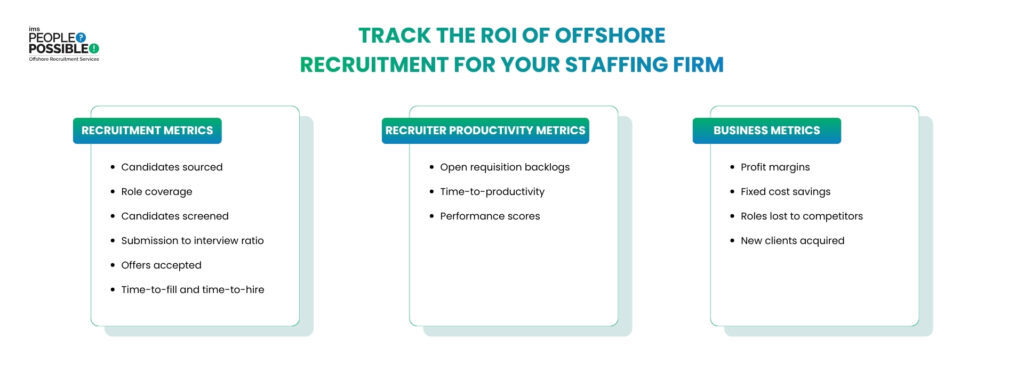
Track three metrics each month or quarter:
- Cost per qualified candidate: This is the total sourcing and screening costs divided by candidates who meet your requirements.
- Cost per interview: This is the total recruitment costs divided by candidates who secure client interviews.
- Cost per placement: This is your recruitment costs divided by completed placements.
If the cost per qualified candidate or placement falls, it signals a positive ROI. However, it’s also important to keep track of the submission-to-interview ratio to ensure candidate quality.
#2 Faster time-to-fill
69% of U.S. organizations find it difficult to hire talent, with technology and AI now the hardest-to-find skills.
A vacancy that stays open for weeks increases your non-billable costs and the chance of losing placements to a competitor. So, when you’re choosing an offshore partner, you must track any improvement in time-to-fill as a critical factor to calculate ROI.
To measure this accurately, record the time between opening a requisition and filling it. It’s also a good idea to timestamp every phase within the funnel:
- Time to the first qualified submission
- First interview
- Accepted offer
Then compare the time-to-fill for similar tech roles before and after offshoring. If it reduces, check which phase is contributing the most, and what still needs improvement.
This one ROI metric not only reflects more placements but also signals better productivity and the opportunity to take on more new requisitions.
#3 Recruiter capacity and productivity gains
Recruiters today manage 56%+ more open requisitions and 2.7x applications vs. three years ago. This puts them at a high risk of burnout, especially with the current growing IT hiring demand.
So, when you choose offshore recruitment process outsourcing services, you must consider the capacity gains of your in-house team.
This is especially important as your recruiters may continue to qualify candidates, advise clients, negotiate offers, work on strategy, and build relationships. So, this helps you track if outsourcing your recruitment process to an offshore team actually helped you gain back recruiter time and productivity.
#4 Scalability without increasing fixed costs
When a client wins a major project or opens several new technology roles, your recruitment team needs enough capacity to respond.
However, time-to-productivity for a new permanent hire can take weeks, which leaves you at the risk of losing the placement. It also increases your fixed overheads before you even share your billing invoice.
An offshore team helps you scale on-demand by providing trained ready-to-work IT recruiters without the cost burden. You usually only pay a flat fee for the recruiter, while everything else is taken care of by the offshore provider.
To see if you’ve a positive scalability ROI, compare the cost and time of meeting peak demand through offshore support with an equivalent in-house figure. Include training and ramp-up time in both calculations.
#5 Better retention rates with sustainable workload
Recruiter turnover can add replacement, training, and productivity costs while you may lose clients to competitors.
To check whether offshore support has genuinely helped reduce this burden, track annualized recruiter turnover, average tenure, overtime hours, administrative workload, and employee engagement scores.
Then, compare results across similar periods and account for changes in compensation, leadership, and hiring demand after bringing in an offshore team.
How to improve the ROI of your offshore IT staffing
While offshoring your IT staffing can help you cut 50-70% of your recruitment costs, it’s only one part of your ROI.
To get the most from your offshore RPO team, focus on how well it supports your recruitment goals.
- Set clear performance targets: Set clear goals at the very start of your offshore engagement and add agreed SLAs which defines the services you need, how they will be measured, and what happens if those targets are missed. So, both teams have clarity about expectations and move ahead accordingly.
- Assign the right tasks: Ask yourself if you want to outsource repetitive, high-volume work such as candidate sourcing, database management, or let the offshore recruiter manage everything end-to-end. This depends on your internal team’s capacity and is crucial to make the most out of offshore recruitment services.
- Leverage timezone for greater coverage: While offshore teams have a timezone difference, the recruiters can work at any time you choose. This is a great way to add more capacity both during your work hours and out-of-hours for 24/7 role coverage.
- Monitor quality alongside cost: Lower operating costs mean little if candidate quality drops or submissions fail to convert. So, it’s important to regularly track submission-to-interview ratios, interview-to-placement conversion, and client feedback to get the maximum ROI.
- Review ROI regularly: Finally, use quarterly reviews to compare your total offshore investment with the cost savings, additional placements, recruiter productivity, and gross profit generated. Then use the data to expand the allotted services or identify what needs to be improved.
Partner with the best offshore IT staffing service provider in USA
The right offshore partner does more than offer cost savings. It gives your staffing firm access to trained recruiters, established workflows, secure infrastructure, and the flexibility to respond to changing hiring demand.
When evaluating offshore IT staffing services, look beyond the quoted fee. Assess the provider’s experience in:
- Supporting similar US staffing firms
- Their understanding of IT roles
- Recruitment technology used
- Data security practices and quality controls
- The opportunity to choose your own resource
Also, clarify what the service fee includes, from recruiter training and management to technology, infrastructure, and replacement support. A transparent cost structure makes it easier to calculate your fully loaded costs and measure the actual return on your investment.
For 20+ years, IMS People Possible has helped IT staffing firms expand recruitment capacity with offshore recruitment services aligned to the USA market and service standards.
Whether you need support with candidate sourcing, screening, or full-cycle recruitment, you can choose your own team member from our ready-to-work recruiter pool while we take care of the rest.
Ready to explore what offshore recruitment can look like for your staffing firm?
FAQs
1.How much can IT staffing firms save with offshore recruitment?
Savings depend on the offshore location, service provider, and services included in the fee. At IMS People Possible, our staffing partners generally see 50-70% savings in their recruitment costs and have seen $1.07M in ROI in just a year.
2. Which recruitment tasks can IT staffing firms outsource offshore?
IT staffing firms can outsource individual hiring tasks like candidate sourcing, resume screening, database management, candidate follow-ups, interview coordination, and recruitment administration. Depending on the provider’s capabilities and your requirements, offshore recruiters can also support full-cycle recruitment.
3. How do you measure the ROI of offshore IT staffing solutions?
Measure ROI by comparing the total cost of offshore recruitment with the financial benefits it generates. You must also track other factors like recruiter productivity, submission quality, scalability ease, and gross profit to understand the true impact on your business.