Summarize and analyze this article with:
Growing a staffing agency sounds straightforward: win more clients, secure more job orders, and make more placements.
But here’s the catch: every new job order adds to your recruitment workload. Your recruiters need to source candidates, screen applications, follow up with prospects, update databases, and keep clients informed.
Before long, your team may get stretched too thin, and slow processes can cost you placements.
Recruitment process outsourcing (RPO) takes some of that workload off your plate, so your in-house team can focus on the strategic work that drives revenue.
This guide explains how RPO works for staffing firms, which model fits your needs, and how to choose and measure the right partner.
What is recruitment process outsourcing for staffing firms?
Recruitment process outsourcing (RPO) is a business arrangement where you transfer some or all your recruitment activities to an external service provider.
For staffing agencies, the arrangement usually means the provider works as an extension of your recruitment team. They follow your existing workflows, systems, quality standards, and hiring requirements to support your clients’ requisitions.
You continue to own your client relationships, job orders, placement decisions, and service standards.
How does the recruitment outsourcing process work?
A typical recruitment process outsourcing engagement follows five steps:
Understand your recruitment needs
Before you bring an external team on board, identify where you need support. Start by reviewing your current recruitment operations.
Are your recruiters struggling with sourcing? Is screening taking too much time? Are database updates and VMS activities pulling them away from candidate engagement? Or, do you need full-cycle support to scale operations?
Then define:
- Which recruitment activities you want to outsource
- Which staffing verticals or job categories need support
- How many resources you need
- Your expected candidate submission volumes and other SLAs
Create a service-level agreement (SLA)
Once you have defined your requirements, document them in an SLA. This must outline:
- The services your provider will deliver
- The number of resources
- Expected turnaround times
- Submission targets
- Candidate quality standards
- Reporting frequency
- Responsibilities on both sides
For example, if you’re outsourcing candidate sourcing to a 2-person offshore team, specify how many qualified profiles you expect per recruiter, how quickly your provider needs to respond to new requisitions, and what qualifies as a submission-ready candidate.
Finalize the engagement and build your team
With your requirements and SLAs in place, shortlist RPO providers and discuss how they can support your operations.
You can also ask them to recommend a suitable engagement model, resource structure, and pricing based on your requirements. Then, compare their experience in your staffing vertical and market before making the final choice.
For instance, if you handle healthcare staffing in the USA, you need resources familiar with clinical roles, healthcare terminology, and compliance within the US market. If you recruit for IT positions, your team needs to understand technical job requirements and relevant sourcing channels.
Align systems, processes, and workflows
Your outsourced team needs to follow the same recruitment processes as your in-house team. Otherwise, you’ll spend more time coordinating work instead of reducing it.
Start by giving the team access to the tools they need, such as your ATS, CRM, VMS, job boards, and communication platforms. Then, walk the team through your recruitment workflows and standard operating procedures (SOPs).
Cover important processes such as:
- How job orders are received, assigned, and prioritized
- Which sourcing channels recruiters can use
- What tools recruiters must use
- How to source and screen candidates
- What information needs to be updated in your ATS or CRM
- How shortlisted resume should be formatted
- How interview co-ordination and follow-ups are handled
- How to report to your account manager
It’s also important to establish confidentiality agreements from the very start, such as data access controls and applicable compliance requirements.
Launch recruitment operations
Once the team is trained and your workflows are aligned, start assigning live recruitment requirements.
You don’t have to hand over every requisition at once. Start with the most urgent job orders or a particular client account. This gives you room to review the initial output and make adjustments before expanding the scope.
For example, if you outsource recruitment for IT roles, compare the number of submissions for the first week against your expectations. Also, review the shortlisted profiles against your client preferences to make sure the recruiters understand the roles.
If the candidates don’t match your requirements, explain what’s missing and refine the search criteria together.
Monitor performance and decide next steps
Once your outsourced team starts working on live requirements, check whether it meets the targets you agreed on in your SLA.
Track metrics such as:
- Candidate submissions: How many qualified profiles does the team submit against assigned requisitions?
- Time-to-submit: How quickly does the team find and submit suitable candidates?
- Submission-to-interview ratio: How many submitted candidates get selected for interviews?
- Candidate quality: How closely do the profiles match your clients’ requirements?
- Recruiter productivity: How efficiently does the team manage its assigned requisitions and sourcing activities?
- Cost per placement: How much do you spend to make a successful placement?
Don’t judge your outsourced team by submission numbers alone. Sending 100 profiles that don’t match your client’s requirements won’t help as much as sending 40 well-qualified candidates.
Then, use your reports to spot problems and work with your provider to fix them.
Looking to partner with a reliable, RPO team who can help you scale?
5 types of RPO models and how they work
Not every staffing agency needs to outsource its entire recruitment operation. Your requirements depend on your hiring volume, available resources, growth plans, and the parts of your recruitment process that need support.
Here are five common RPO models to consider.
1. End-to-end RPO
With this RPO model, your external partner manages the full-cycle recruitment process, from understanding job requirements and sourcing to shortlisting and onboarding.
The provider takes full ownership for the agreed recruitment activities and works closely with your internal team to ensure every stage follows your hiring standards and client requirements.
When should you choose it?
For staffing agencies, you can use this model to manage recruitment delivery for specific clients, business units, or role categories. It works best when you have consistent recruitment volumes and want a dedicated team to manage the process.
2. Project-based RPO
Project-based recruitment outsourcing provides recruitment support for a specific hiring initiative with a defined start and end date.
For example, you need to fill 100 light industrial positions for a new client contract or recruit 15 IT professionals within 3 months. So, you outsource the entire client project to a recruitment partner.
Your provider now builds a team around the project and delivers the project while meeting deadlines.
When should you choose it?
Choose project-based RPO when you have seasonal hiring requirements, large client orders, new contract wins, or short-term recruitment spikes.
This way, you get the additional capacity you need without committing to a permanent increase in your internal headcount.
3. Function-based RPO
Function-based RPO, also called Selective RPO, lets you outsource specific stages of your recruitment process rather than the entire workflow.
For example, your internal recruiters may be good at candidate engagement, interviews, and closing placements, but struggle to find enough qualified candidates fast. You can choose to outsource sourcing and initial screening while keeping the remaining recruitment activities in-house.
When should you choose it?
You can use this model if you have a strong internal recruitment team but need additional support in specific areas. It is also useful if your recruiters spend too much time on repetitive, non-billable admin tasks.
4. On-Demand RPO
As the name suggests, an on-demand RPO gives you access to additional recruitment resources whenever you need them.
You can scale your outsourced team up during busy periods and reduce capacity when recruitment activity slows down.
For example, if your healthcare staffing division receives more requisitions during a particular quarter, you can add sourcing and credentialing resources to manage the increased workload.
When should you choose it?
This model works well when your recruitment volumes fluctuate, and you don’t want to maintain a large in-house team throughout the year. It also gives you flexibility when you are testing a new market or taking on additional clients.
5. Hybrid RPO
The hybrid recruitment process outsourcing model combines internal recruitment resources with an external recruitment team. You decide which activities your in-house team will handle and which ones your outsourcing partner will manage.
For example, your internal recruiters can manage client communication, interviews, and final candidate selection, while your outsourced team handles sourcing, screening, database management, and recruitment administration.
When should you choose it?
Choose hybrid RPO when you want to retain control over important recruitment decisions while expanding your operational capacity.
For many growing staffing agencies, this is a practical starting point because you don’t have to change your entire recruitment structure to benefit from outsourcing.
Should you outsource recruitment locally, nearshore, or offshore teams?
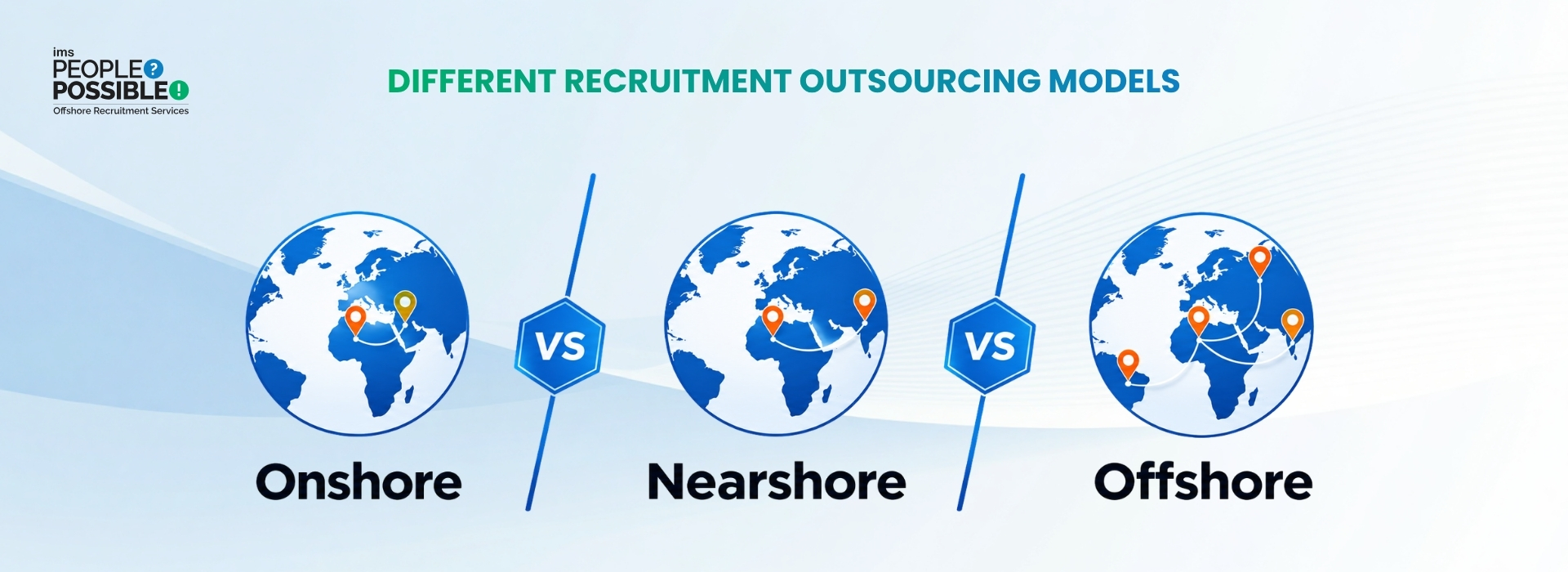
Once you’ve identified which recruitment activities you want to outsource, the next decision is where your outsourced team should be based.
Let’s quickly compare the following RPO teams to help you decide which works best for your staffing agency.
1. Onshore or Local RPO
With onshore RPO, you partner with a recruitment service provider operating within the same country as your business. For a US staffing agency, this means working with an RPO provider based in the United States.
Your outsourced team operates within a familiar business environment, understands local market expectations, and can collaborate with your internal recruiters during regular business hours.
Best suited for: Staffing agencies that prioritize cultural familiarity or in-person collaboration.
2. Nearshore RPO
Nearshore RPO involves outsourcing your recruitment activities to a provider in a nearby country or geographical region.
For US staffing agencies, popular nearshore destinations include Mexico, Colombia, and other Latin American countries. The biggest advantage of nearshore is time-zone alignment while still being more cost-effective than onshore teams.
Best suited for: Staffing agencies that want to reduce operating costs while maintaining significant time-zone overlap and occasional in-person meets.
3. Offshore RPO
Offshore RPO involves partnering with a recruitment service provider in a more distant country, often in a different time zone.
For US staffing agencies, India and the Philippines are typically the most established offshore destinations for recruitment support. You can build dedicated teams to manage full-cycle recruitment or specific activities such as candidate sourcing, screening, database management, VMS management, and recruitment administration.
Partnering with a offshore recruitment team give you access to a broader talent pool and significant operating cost advantages. The time-zone difference also creates opportunities for extended or even 24/7 recruitment coverage. And if you prefer your offshore recruiters to work during your US business hours, most providers can align their shifts with your team’s schedule.
Best suited for: Staffing agencies looking to scale recruitment capacity, improve cost efficiency, and build dedicated teams without increasing their US-based operating expenses.
How a staffing agency achieved 142% more starts across professional staffing in 12 months?
Onshore vs. nearshore vs. offshore recruitment process outsourcing: Comparison table
| Factor | Onshore RPO | Nearshore RPO | Offshore RPO |
| Team location | Within the USA | Nearby countries such as Mexico | Distant countries like India |
| Operating Costs | Follows USA standards and is the highest | May be lower than USA standard | Significantly lower than the other two |
| Time-zone overlap | Full | High | Flexible as per your choice |
| Communication | Smooth collaboration with convenient in-person | Virtual communication with cultural similarities | Virtual, real-time communication with international recruiters |
| Market familiarity | Local familiarity | Depends on the provider’s US market expertise | Depends on the provider’s US market expertise |
| Scalability | Can be expensive as team grows | More cost-efficient than local teams | Strong potential for scaling on demand without spending too much |
| 24/7 coverage | Not possible | Extended work hours possible | 24/7 role coverage possible with out-of-hours work |
| Talent pool | Limited to local pool | Broader pool than onshore teams | Access to international talent pool |
| Quality | Depends on the provider | Depends on the provider | Depends on the provider |
What are the major advantages of outsourcing your recruitment processes?
Recruitment outsourcing does more than add extra resources to your team. Here are five benefits worth considering.
- Scale without increasing fixed costs: When you win a new client or receive a large batch of job orders, you can add recruiters without committing to permanent in-house hires. You pay for the capacity you need and scale your team flexibly as demand changes
- Improve your in-house team’s productivity: Recruiters today manage 56% more active requisitions and receive 2.7x more applications than they did three years ago. This growing workload can stretch your team thin and increase the risk of burnout. Outsourcing repetitive tasks helps reduce that pressure and makes it easier for recruiters to manage their workload consistently.
- Access specialized recruitment expertise: If you recruit across healthcare, IT, and light industrial, you need teams that understand different candidate requirements and workflows. An experienced RPO partner brings trained recruiters who can support these roles without requiring you to build every capability internally.
- Improve time-to-fill: When job orders pile up, sourcing and candidate follow-ups often slow down. A dedicated RPO team can keep the candidate pipeline active, submit qualified profiles faster, and help your recruiters move requisitions forward. Outsourcing to an offshore staffing team can also help you get 24/7 role coverage with after-hours recruitment support.
- Free up recruiters for high-value work: Your in-house recruiters bring the most value through client communication, candidate relationships, interviews, offer negotiations, and placements. Outsourcing sourcing and recruitment administration gives them more time for the work that directly drives revenue.
How to choose the right RPO partner for your staffing agency
If you’re looking to partner with the right RPO team, here are seven things to evaluate before making your decision.
1. Check their staffing industry experience
Corporate recruitment and staffing agency recruitment involve different workflows. Your RPO partner must understand candidate submissions, job orders, client requirements, VMS processes, and the urgency of filling open positions.
Ask potential providers:
- Do you have experience with US staffing agencies?
- Which staffing sectors do you support?
- Can you handle temporary, contract, and permanent recruitment?
- Do your recruiters understand US job requirements and terminology?
Look for experience in your specific vertical, whether healthcare, IT, light industrial, or professional staffing.
2. Evaluate their sourcing and screening capabilities
If you need support with candidate sourcing and screening, look into how the provider builds and qualifies its candidate pipeline.
Ask about:
- Sourcing channels and database access
- Experience with job boards and professional networking platforms
- Resume review and qualification processes
- Candidate outreach and follow-up practices
- Shortlisting and submission standards
Don’t focus only on how many resumes the team can source. Instead, check how many candidates meet your requirements and progress to interviews.
3. Review their technology and data security
To make the most out of your RPO partnership, your outsourced team must work within your recruitment ecosystem. Check whether the provider can use your existing ATS, CRM, VMS, and communication platforms.
Also, ask how they protect candidate and client information.
Look for:
- Role-based access controls
- Secure IT infrastructure
- Documented data security policies
- Employee security training
- Relevant certifications, such as ISO 27001, ISO 9001, or ISO 14001
- HIPAA and GDPR-related controls where applicable
If you serve healthcare clients, assess how the provider supports your HIPAA-related security and compliance requirements.
4. Understand their team structure and training
Find out who will work on your account and how the provider will manage the coordination process.
You must also clarify:
- How does the RPO provider select and train recruiters?
- Can you choose your own recruiters and team lead?
- How quickly can they deploy additional resources?
- What happens when a team member leaves?
- Does it maintain a trained resource bench?
- How does it track recruiter performance?
- What is the reporting structure?
- How do incentives work?
A large employee count alone doesn’t guarantee consistent delivery. Rather, focus on the team’s experience, training, and management structure.
5. Compare pricing and contract terms
RPO providers use different pricing structures. Common options include:
- Monthly retainer: You pay a fixed monthly fee for an agreed scope of recruitment services.
- Per-recruiter pricing: You pay a monthly fee for each dedicated recruitment resource.
- Cost-per-hire: You pay based on the number of successful hires.
- Hybrid pricing: You combine a fixed fee with variable charges based on recruitment activity or results.
So, before you sign, check what’s included in the price. Ask about any additional costs for training, technology, recruitment tools, replacements, overtime, and account management. Also, review the contract duration, notice period, minimum resource commitment, and exit terms to avoid any hidden charges.
6. Ask for relevant case studies and client references
Ask potential RPO providers to share case studies from staffing agencies with similar recruitment volumes and business requirements.
Look for measurable results, such as:
- Higher candidate submission volumes
- Faster sourcing turnaround times
- Better submission-to-interview ratios
- Increased recruiter productivity
- More placements
- Lower recruitment costs
You can also ask them to share real client testimonials or speak with existing clients to confirm the information firsthand.
7. Start with a defined pilot
You don’t have to outsource your entire recruitment operation at once. Instead, start with one client account, role category, or recruitment activity before committing long-term.
For example, you can outsource candidate sourcing and screening to 1-2 recruiters for your light industrial division for 30 days.
During this time, set clear expectations for:
- Number of requisitions handled
- Candidate submission targets
- Candidate quality standards
- Turnaround times
- Communication and reporting
- Resource availability
Once the pilot engagement period is over, review the results before you expand the engagement. This gives you a practical way to assess the provider’s performance before you make a larger commitment.
Also read: How to Choose the Right Offshore Partner for Light Industrial Staffing?
How to measure success for your RPO partnership
Once your outsourced team starts work, you need to know whether the partnership delivers the results you expected.
Set your baseline metrics before the engagement begins. Then agree on the KPIs, targets, and reporting frequency with your provider.
Here are seven metrics you must track.
| KPI | What it measures | What to check |
| Time-to-fill | Total time from job opening to placement | Are you filling roles faster? |
| Time-to-submit | Time from receiving the req to first submission | Is the provider meeting your submission SLAs? |
| Candidates sourced | Number of sourced candidates | Are you creating talent pipelines proactively? |
| Submission-to-interview ratio | Percentage of submitted candidates who get interviews | Do your submissions match client requirements? |
| Interview-to-placement ratio | Percentage of interviewed candidates who get placed | Do candidates progress through the recruitment process? |
| Cost per placement | Total recruitment cost for one placement | Does outsourcing reduce costs or improve your margins? |
| Recruiter productivity | Recruitment output per resource | Has the capacity of your in-house recruiters increased? |
Finally, set up weekly operational reviews and monthly performance reviews to measure all the defined KPIs.
Use weekly meetings to discuss:
- Open requisitions and pipeline gaps
- Submission targets and actual output
- Candidate quality issues
- Delays and workflow bottlenecks
- Any additional trainings required
Use monthly reviews to assess:
- KPI performance against agreed targets
- Cost per placement
- Roles filled vs. unfilled
- Recruiter productivity
- Client feedback
- Resource requirements for the next month
Your RPO partner must deliver on its commitments. But it’s you who’ll provide them with clear job requirements, timely feedback, and the right system access.
Choose the best offshore recruitment process outsourcing services for US staffing agencies
Your staffing agency needs more recruitment capacity to take on additional job orders. Recruitment process outsourcing gives you a way to expand your operations without hiring every resource in-house. But you also need to protect your placement margins as you grow.
At IMS People Possible, we’ve helped US staffing firms scale for 20+ years with our offshore recruitment services.
With 3000+ recruitment professionals across India and Philippines serving 300+ global clients, we support sourcing, screening, database management, VMS management, credentialing, and even full-cycle recruitment.
So, whether you need a few dedicated resources or a larger recruitment team, we’re here to help. To know more about offshore recruitment outsourcing, book a call with our team now.

FAQs for Recruitment Process Outsourcing
1. What is the difference between recruitment process outsourcing vs offshoring
While recruitment process outsourcing or RPO refers to the outsourcing process itself, offshoring refers to where the outsourced work takes place, which in this case is another country like India or Philippines.
For example, you can outsource candidate sourcing and screening to a provider in the United States. That’s RPO without offshoring. But if you outsource the same activities to a recruitment team in India, that’s offshore recruitment outsourcing.
2. When should you consider RPO?
You can consider RPO when:
- Your internal recruiters struggle to manage increasing job orders
- You need more sourcing and screening capacity
- Your recruitment costs put pressure on placement margins
- You have seasonal or fluctuating hiring requirements
- You plan to expand into new staffing sectors or markets
- Your recruiters spend too much time on routine administrative tasks
Start by reviewing your recruitment workload. Identify which activities take up the most time and where your team faces capacity gaps. You can then decide whether to outsource specific functions or the full recruitment process.
3. Which is the best offshore recruitment service provider for US staffing firms?
The best offshore recruitment service provider depends on your staffing sector, recruitment volume, budget, and service requirements.
Before you choose a provider, check whether it offers:
- Experience with US staffing agencies and expertise in your recruitment vertical
- Dedicated recruiters trained in US market requirements
- Flexibility in resource deployment
- Strong data security and compliance practices
- Transparent pricing and measurable performance standards
IMS People Possible is the best offshore RPO option for US staffing firms who want to scale flexibly without increasing fixed overheads. With over 20+ years of staffing industry experience, delivery centers in India and the Philippines, and 300+ client base, the IMS team is a reliable choice for offshoring your recruitment operations.