Summarize and analyze this article with:
It is 5:30 p.m. at an East Coast staffing firm. A client has released new requisitions, several candidate profiles need updating, and a West Coast account still has hours left in its business day.
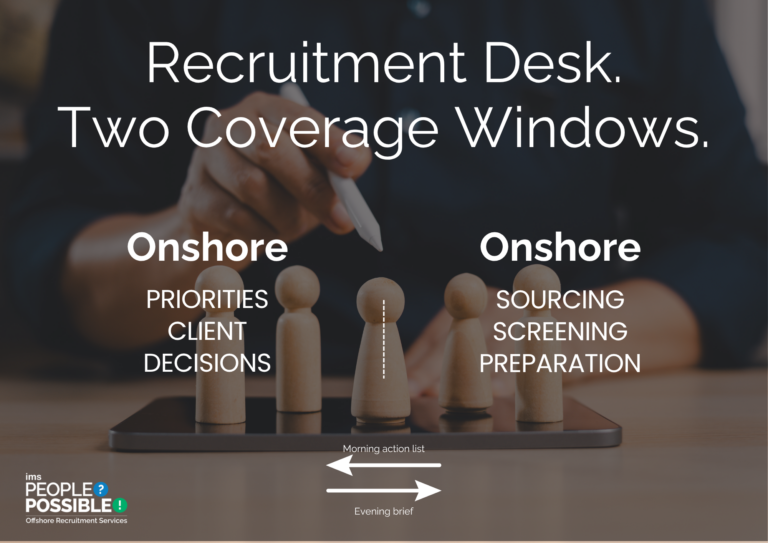
The recruitment team has worked through its priorities. Tomorrow, however, begins with tonight’s unfinished work: reviewing applications, searching the database, formatting resumes, and deciding which orders need attention first.
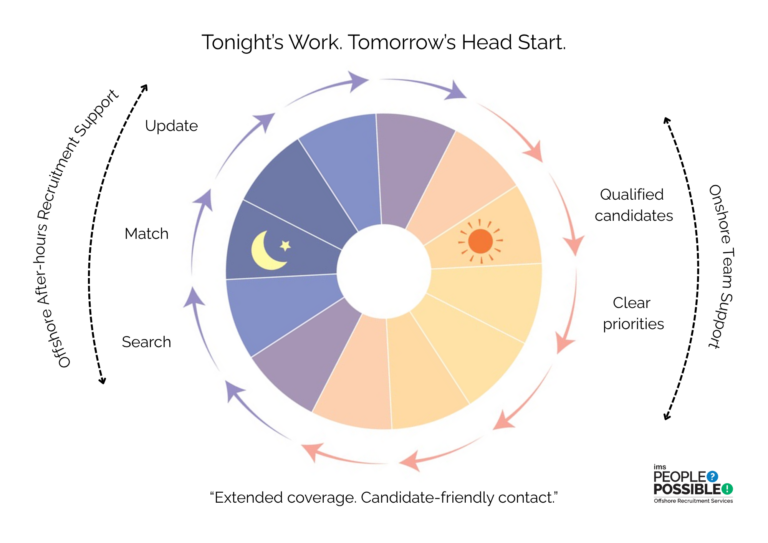
Now imagine a different morning. New requisitions have been reviewed, relevant profiles identified, records updated, and suitable candidates screened during agreed contact windows. Recruiters log in to a prioritized handoff rather than an untouched queue.
That is the purpose of out-of-hours recruitment support: using extended coverage to keep work moving without expecting the onshore team, or candidates, to remain available around the clock.
What Is After-Hours Recruitment Support?
After-hours (or Out-of-hours recruitment support in other geographies) extends selected recruitment activities beyond a staffing firm’s usual operating hours. It can cover evening, early-morning, weekend, or overnight workflows, depending on account requirements.
For US staffing firms, it may involve offshore professionals working an agreed schedule within the agency’s systems and processes.
A follow-the-sun recruitment model passes work between teams across time zones. But not every agency needs full 24/7 recruitment support. A defined coverage window addressing a recurring backlog may be enough.
The distinction is important: round-the-clock recruitment describes operational coverage, not permission to contact candidates at any hour.
Why Extended Coverage Matters?
Recruitment teams are balancing pipeline growth, quality, and speed.
- In Employ Inc’s 2025 Recruiter Nation Report, 52% of respondents prioritized getting more candidates for each role, 47% prioritized candidate quality, and 42% prioritized improving hiring speed. These are broader recruiting findings, not staffing-agency-only benchmarks, but they illustrate the competing demands on delivery teams.
- SHRM’s 2025 State of Recruiting research also found that 56% of recruiting executives identified talent shortages as a challenge. Extended coverage cannot remove a skills shortage, but it can give firms more capacity to research markets, maintain relationships, and prepare relevant candidates.
The opportunity is not simply more activity. It is less avoidable waiting between a requisition arriving and someone progressing it.
Which Recruitment Activities Can Run After Hours?
Just like traditional offshore recruitment services, you can split different recruitment activities and client commitments into three broad categories.
Overnight Preparation
These tasks can progress without contacting candidates:
- Candidate sourcing and recruitment database searches.
- Job matching and preliminary resume review.
- ATS updates, duplicate checks, and pipeline tagging.
- Resume formatting and approved job posting.
- VMS monitoring, requisition prioritization, and reporting.
Treat profiles identified through desk research as potential matches—not fully qualified candidates until the necessary screening and interest checks are complete.
Candidate-Facing Activity
- Outreach, pre-screening, availability checks, interview coordination, and follow-ups should happen during suitable candidate contact windows.
- An evening conversation may suit a candidate who requested it. A late call does not become appropriate simply because a recruiter is working.
- Record time zones, preferred channels, contact preferences, and agreed communication protocols. Schedule messages accordingly, including automated communications.
Morning Handoff
Your onshore team receives an in-depth (and documented) morning handoff of the activities done during the out-of-hours recruitment support. The handoff should distinguish:
- Screened, interested candidates ready for review.
- Potential matches requiring contact.
- Requisitions awaiting clarification.
- Submission deadlines and unresolved exceptions.
This prevents the onshore team from repeating work or mistaking an uncontacted profile for a submission-ready candidate.
When Does a Staffing Firm Need After-Hours Recruiting Support?
Always look for recurring evidence rather than assuming every desk needs another shift.
Extended-hours recruitment coverage may be worth evaluating when:
- Late-arriving requisitions routinely wait until morning.
- Recruiters begin each day clearing administrative backlogs.
- VMS opportunities receive inconsistent attention.
- Branches serve clients across several US time zones.
- New accounts or seasonal peaks exceed current capacity.
- Candidate follow-ups depend on recruiters staying online late.
These issues can arise across healthcare, IT, engineering, light industrial, life sciences, and financial services, although the work and controls differ.
Before adding resources, examine workforce capacity planning: the goal is to identify whether the constraint is available hours, process design, role difficulty, or client decision-making. The linked guide uses light industrial examples to explore recruitment workload and coverage.
Divide Responsibilities Before Extending Hours
Offshore recruiters for US staffing firms should work within defined authority—not operate as a disconnected second recruitment team.
| Workflow | After-hours team | Onshore owner |
| Requisition intake | Monitor, categorize, flag gaps | Clarify requirements and priorities |
| Sourcing and screening | Research, contact within protocols, document fit | Calibrate quality and resolve complex questions |
| ATS and VMS activity | Update records; submit only with authorization | Own client rules and exceptions |
| Compliance and onboarding | Track documents and coordinate follow-ups | Retain designated clearance and approval authority |
| Candidate and client issues | Resolve approved queries or escalate | Handle negotiations and sensitive decisions |
Maintain one system of record, named requisition owners, and an escalation route. Document candidate consent, representation requirements, and approval rules before allowing submissions.
IMS People Possible’s offshore recruitment model positions its professionals as an extension of the staffing firm’s team. That relationship works best when responsibilities, permissions, and handoffs are explicit.
Track Outcomes, Not Just Overnight Activity
An overnight activity report is useful only if it connects to delivery.
Agree on definitions before launch:
| KPI | What to measure |
| Response time | Requisition receipt to human review; inbound candidate query to meaningful response |
| Job coverage | Eligible requisitions receiving defined action within the agreed window |
| Time-to-submit | Requisition receipt to first qualified, authorized submission |
| Submissions | Unique submissions, acceptance, and rejection reasons |
| Interviews | Interviews generated and submission-to-interview conversion |
| Starts and placements | Confirmed outcomes, tracked separately under your definitions |
| SLA compliance | Applicable service commitments met within the reporting period |
| Quality | Screening rework, duplicate submissions, withdrawals, and handoff errors |
Separate automated acknowledgments from substantive responses. Report elapsed time and agreed coverage-hour performance where relevant.
Track downstream interviews and starts by candidate cohort; do not attribute every placement solely to the overnight team. Client feedback, compensation, and onboarding also influence results.
For consistent reporting, distinguish time to fill, time to hire, and time to start rather than treating them as interchangeable measures.
Implement Coverage Without Losing Process Control
Start with one account, requisition category, or workflow.
Establish baseline volumes, response times, job coverage, and quality. Then agree on coverage hours, weekends, holidays, and daylight-saving changes. India–US time-zone overlap changes during the year, so avoid treating offshore daytime as equivalent to every US overnight period.
Train the team on screening standards, candidate communications, system permissions, and escalation rules. Restrict access to necessary information and confirm client authorization for offshore handling.
Use an evening brief containing priorities, deadlines, existing candidate activity, and approval dependencies. Review a sample of morning outputs before expanding scope.
Credentialing and onboarding support should follow the same principle: administrative progress does not replace required verification or final authorization.
An ATS notification is not an emergency by default. Define what requires an on-call decision and what belongs in the morning handoff.
What Does Effective Delivery Look Like?
Effective after-hours recruiting support should produce more than a longer activity report. It should help staffing firms progress requirements, maintain account coverage, and give onshore recruiters actionable candidates and updates.
Two IMS People Possible case studies illustrate these outcomes:
Out-of-Hours Support for US MSP Accounts
A US recruitment agency serving Fortune 500 clients needed to increase placements, improve responsiveness, and support high-volume hiring across MSP programs.
IMS People Possible introduced account-specific workflows, adjusted offshore schedules to overlap with onshore working hours, and included weekend coverage for critical deadlines. The team also managed recruitment activity through to shortlists for onshore review, supported by regular account-manager check-ins and reporting.
Across the 12-month engagement, the case study reports 407 placements and a 54% increase in total placements. The relevant lesson is the combination of coverage, account knowledge, and structured handoffs—not simply additional working hours.
Faster VMS Notification Handling Across US Accounts
For a US staffing organization operating across IT, engineering, and light industry, missed VMS updates and delayed responses were affecting workflow.
IMS People Possible established dedicated notification monitoring, a six-person vendor-neutral team, and a PowerApp-based management process. The case study reports 3,763 notifications managed in one month, with notification response time reduced from two to three hours to approximately 20 minutes. This measures notification handling—not candidate submission or placement speed.
Together, these examples show what to evaluate: whether extended coverage keeps requisitions moving, improves responsiveness, and supports downstream hiring outcomes. The results are provider-reported and engagement-specific; they should not be treated as guaranteed outcomes or attributed to after-hours coverage alone.
Build Your Next Business Day With IMS People Possible
Out-of-hours recruitment support should make the next working day more productive—not create another queue to manage.
IMS People Possible can help staffing firms scope candidate sourcing services, screening, pipeline management, recruitment administration, ATS/VMS support, and agreed compliance coordination. Support can begin with defined workflows or form part of a broader full-cycle recruitment or recruitment process outsourcing arrangement.
Start with the account where work repeatedly stops when your team logs off. Agree on contact windows, decision rights, implementation requirements, and measurable outcomes. Then expand based on quality and delivery evidence.
Connect with IMS People Possible to design after-hours recruiting support around your time-zone gaps, account requirements, and recruiter capacity—so your team starts the morning ready to act.