


Summarize and analyze this article with:
A staffing firm can present candidates quickly and still fail to get associates on-site when the client needs them. That is why light industrial staffing leaders should not choose between time to fill and time to hire as if they measure the same thing. While sounding similar, they need both and, in high-volume warehouse and manufacturing environments, they also need to monitor a third metric – time to start.
For roles such as forklift operators, pickers, packers, material handlers, assemblers, machine operators, and production associates, the commercial outcome is not an accepted offer. It is a candidate who completes the required steps and starts the assignment. The best hiring KPIs expose where speed is being lost without encouraging recruiters to bypass screening, safety, transportation, or availability checks.
Why Speed Matters in Light Industrial Staffing
Industrial staffing operates in a labor market where volume and movement are constant. Transportation and warehousing employed 6.6 million people in the U.S. in August 2026, while manufacturing employed 12.6 million. Both sectors added jobs that month: transportation and warehousing added 5,000 jobs, and manufacturing added 16,000.[The Bureau of Labor Statistics]
The underlying labor supply is also large and dynamic. The The Bureau of Labor Statistics projects an average of 888,600 annual openings for laborers and material movers between 2025 and 2035. Within that group, laborers and freight, stock, and material movers are expected to have an average of 340,500 annual openings, while hand packers and packagers are projected to have 61,800 annual openings.
For staffing firms, these numbers reinforce a practical reality: candidate supply must be maintained continuously, and process speed must be measured at more than one point. A fast submission is helpful. A fast, qualified start is what protects client satisfaction and enables revenue realization.
The American Staffing Association reported a staffing-industry turnover rate of 376% in 2025. While this was lower than the 416% rate in 2024, it still illustrates why high-volume staffing teams need repeatable workflows for sourcing, screening, onboarding, redeployment, and backfill.
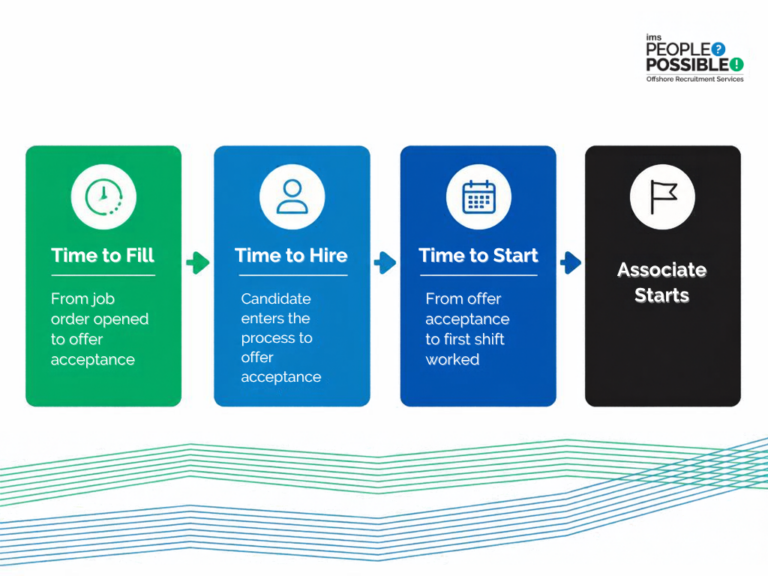
Time to Fill: The Client-Service KPI
Time to fill measures how long it takes to close a requisition. In a staffing context, the clock typically starts when the client opens or releases a job order and ends when the staffing firm confirms the candidate has accepted the assignment. Some firms stop the clock at submission, interview, or start date, which is why the definition must be documented and used consistently across branches and accounts.
A simple formula is:
{Time to Fill} = {Offer Acceptance Date} – {Job Order Open Date}
For an industrial client, time to fill is often the most visible service metric. It answers the question:
“How quickly did our staffing partner respond to the workforce requirement?”
A warehouse client that needs 25 second-shift order selectors cannot wait for a recruiter to begin building supply after the order arrives. Likewise, a manufacturing client opening a new production line may measure a staffing agency by its ability to supply screened, shift-ready associates within a defined service-level agreement.
However, time to fill can be misleading when used alone. A recruiter may close an order quickly with candidates who have not confirmed reliable transportation, production-shift availability, safety requirements, or genuine interest. That can lead to falloffs, no-shows, and further backfill work.
What Time to Fill Reveals
- Whether recruiters can respond quickly to new and urgent job orders
- Whether the agency has an active pipeline for recurring roles and locations
- Whether job-intake requirements are clear enough to begin sourcing immediately
- Whether client approval, interview scheduling, and submission processes create delays
- Whether the team can meet account-specific service-level agreements
For light industrial staffing companies, time to fill should be segmented by role type, shift, location, client, and volume. A three-day fill time for general warehouse associates may not mean the same thing as a three-day fill time for experienced reach-truck operators on a third shift.
Time to Hire: The Recruiter-Process KPI
Time to hire measures the candidate-side journey. It typically starts when a candidate enters the recruitment process—through an application, sourcing response, referral, or database reactivation—and ends when that candidate accepts an offer.
{Time to Hire} = {Offer Acceptance Date} – {Candidate Entry Date}
This KPI focuses on the efficiency of the recruiter workflow rather than the entire job-order lifecycle. It asks:
“Once we identify a relevant candidate, how quickly can we evaluate, engage, and convert them?”
For a light industrial staffing agency, time to hire is often where operational bottlenecks become visible. A candidate may respond to a job alert in minutes but wait days for an initial call, document review, drug-screen scheduling, client interview, or onboarding instruction. During that time, the candidate may accept another opportunity.
Time to hire is therefore closely tied to recruiter capacity. When recruiters are handling sourcing, outreach, screening, candidate follow-up, ATS updates, onboarding coordination, and client communication simultaneously, candidate momentum can be lost.
IMS People Possible can support staffing firms with dedicated offshore recruitment professionals who work as an extension of the onshore team. Services such as candidate sourcing, initial screening, data management, ATS and VMS coordination, candidate follow-up, and onboarding support can help reduce workflow bottlenecks while onshore recruiters retain responsibility for client relationships, final assessments, and account strategy.
| Same Job Order, Two Different KPIs | |
|---|---|
| Time to Fill A warehouse client sends an order on Monday. The agency confirms accepted candidates on Thursday. |
Time to Hire A forklift operator responds on Tuesday, completes screening and compliance steps, and accepts on Thursday. |
| 4 days | 2 days |
| One requisition. Two clocks. Different operational questions. | |
Time to Start: The Revenue-Realization KPI
For industrial staffing, time to start deserves a place alongside time to fill and time to hire. It tracks the period between offer acceptance and the associate’s first worked shift.
{Time to Start} = {First Shift Worked Date} – {Offer Acceptance Date}
This is where many agencies discover that an apparently fast process still has revenue leakage. Candidates can accept but fail to complete paperwork, background checks, drug screens, safety orientation, client onboarding, or transportation planning. A candidate can also simply change their mind before their scheduled shift.
Time to start connects recruiting operations to commercial performance. A placement generally does not generate billable hours until the associate works. If 20 workers accept but only 15 start, the client is still understaffed, and the agency must rework the remaining five openings.
Track time to start alongside:
- Offer-to-start conversion rate
- No-show rate
- Falloff rate
- Compliance-completion time
- Orientation completion rate
- First-week retention
- Redeployment rate
Which KPI Should Leaders Optimize?
The best answer is not “time to fill” or “time to hire.” Industrial staffing leaders should organize KPIs in a hierarchy that reflects client service, recruiter efficiency, and revenue outcomes.
| KPI | Primary audience | What it measures | Why it matters |
| Time to fill | Clients, account leaders | Job order opened to accepted candidate | Shows speed of response to workforce demand |
| Time to hire | Recruiters, operations leaders | Candidate entry to accepted offer | Shows process efficiency and candidate momentum |
| Time to start | Operations, finance, account leaders | Offer acceptance to first shift worked | Shows how quickly accepted candidates become billable starts |
| Offer-to-start rate | Operations and client teams | Accepted offers that convert to starts | Reveals onboarding, compliance, and candidate-commitment gaps |
| First-week retention | Account leaders | New starts who remain through week one | Protects service quality and reduces backfill demand |
For high-volume accounts, optimize time to fill as the external client-service KPI, time to hire as the internal recruiter-efficiency KPI, and time to start as the revenue-realization KPI.
That balance helps avoid a common mistake: rewarding speed to submission or offer acceptance while ignoring whether candidates actually start and remain on assignment.
Shorten the Process Without Lowering Quality
The goal is not to remove important steps. It is to eliminate unnecessary delay between those steps.
1. Clarify job intake before sourcing begins
A recruiter should not have to chase basic information after a requisition is released. Capture pay rate, shift, location, transportation expectations, physical requirements, required experience, safety conditions, screening criteria, start date, and client interview process at intake.
2. Build role-based candidate pipelines
Maintain segmented communities for warehouse associates, forklift operators, assemblers, machine operators, production workers, shipping and receiving staff, and quality personnel. Include location, commute range, shift preference, equipment experience, availability, and previous assignment feedback.
A ready-to-deploy talent pipeline can help reduce time to fill because recruiters begin with known candidates rather than restarting sourcing for every order.
IMS People Possible can help staffing teams maintain this activity through sourcing, candidate re-engagement, availability checks, and ATS hygiene.
3. Separate fast screening from final assessment
Use consistent knockout questions for basic requirements, such as shift availability, commute, work authorization, equipment experience, and required certifications. This speeds up early qualification without replacing human recruiter judgment.
Then reserve recruiter and client time for final fit, safety-sensitive discussions, work-history context, candidate motivation, and account-specific concerns.
4. Remove handoff delays
Map every handoff between sourcing, screening, onboarding, compliance, client approval, and first-day confirmation. Define response-time expectations and an escalation path. Candidate communication should not pause simply because responsibility shifts from one person or team to another.
5. Use automation for reminders, not judgment
Automated text and email workflows can support interview reminders, document requests, orientation instructions, availability confirmation, and first-day check-ins. This helps recruiters protect candidate momentum while still reviewing decisions that require human oversight.
6. Add flexible recruitment capacity before service declines
When job volume rises, the first pressure points are often sourcing, follow-up, screening coordination, and database updates. Rather than immediately adding permanent overhead, staffing firms can use dedicated offshore recruitment capacity to support repeatable workflows.
IMS People Possible works alongside staffing firms as a white-label offshore recruitment partner. Dedicated professionals can help keep sourcing, screening support, candidate engagement, ATS updates, compliance coordination, and reporting moving while internal recruiters focus on client priorities and final hiring decisions.
| Keep: Quality-Control Steps | Remove: Avoidable Delay |
|
|
| Speed to hire improves when workflow friction falls-not when screening standards fall. | |
Measure the Full Journey
A strong recruiting dashboard does not celebrate a short time to fill while candidate falloffs rise. It reviews the complete journey from job order to first shift and then monitors early retention.
Start by setting consistent definitions across the business. Decide precisely when each clock begins and ends. Segment results by client, branch, job family, shift, geography, and recruiter team. Review both averages and medians, since a few exceptionally slow requisitions can distort an average.
Then connect the metrics to action:
- Rising time to fill may point to weak candidate supply, unclear job intake, or client-approval delays.
- Rising time to hire may point to recruiter workload, poor follow-up speed, or excessive process handoffs.
- Rising time to start may point to onboarding, compliance, orientation, transportation, or candidate-engagement issues.
- Falling first-week retention may point to a job-expectation gap, weak screening, pay competitiveness, or worksite experience.
The KPI to optimize is not the shortest possible clock. It is the most reliable path from client requirement to a qualified associate who starts on time.
For light industrial staffing leaders, that means treating time to fill, time to hire, and time to start as connected recruiting metrics—not competing ones. With stronger intake, ready candidate pipelines, disciplined handoffs, appropriate automation, and scalable recruitment support, staffing firms can improve speed to hire while protecting the screening quality their clients depend on.
If it’s about People, we make it Possible.