Summarize and analyze this article with:
The article below is tailored to Australian recruitment businesses, using Australian English, local business context, practical operating advice, and the People + AI + Global Delivery framework. It builds on the earlier capacity-planning content while focusing on how the three elements work together as a modern recruitment operating model.
How can Australian recruitment agencies build a modern recruitment engine?
By combining skilled recruiters, responsible AI and flexible global delivery models to improve productivity, strengthen candidate experiences and scale recruitment operations sustainably.
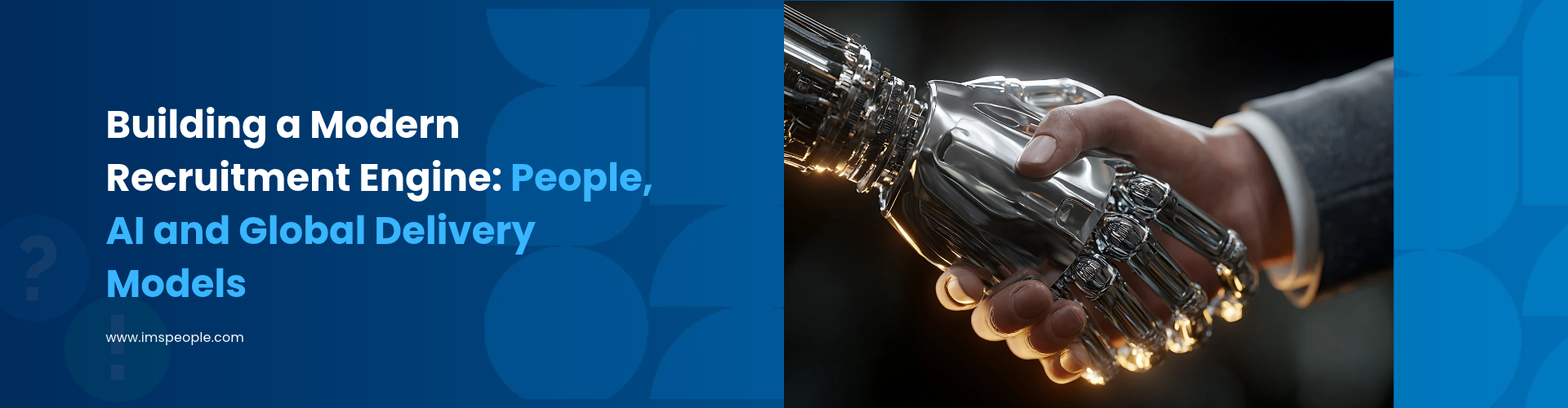
Building a modern recruitment engine: People, AI and Global Delivery Models
Recruitment growth needs more than additional headcount
For an Australian recruitment agency, winning more clients should be a good problem to have. Yet more vacancies, tighter deadlines and increasing candidate expectations can quickly stretch an already busy team.
Consider an agency in Melbourne managing new technology roles while supporting clients across Sydney and Brisbane. Consultants must source candidates, update the applicant tracking system (ATS), coordinate interviews, maintain client relationships and keep placements moving. When administrative work takes over, business development and candidate engagement often suffer.
Hiring another recruiter might help, but it does not automatically resolve inefficient processes or operational bottlenecks.
The real opportunity is to build a recruitment engine that combines people, artificial intelligence (AI) and global delivery capacity. Rather than treating these as separate initiatives, agencies can integrate them into one operating model that supports sustainable growth.
What does a modern recruitment engine look like?
A modern recruitment engine connects skilled people, effective technology, repeatable processes and flexible delivery resources.
Its purpose is straightforward: help recruiters concentrate on valuable client and candidate interactions while ensuring supporting work gets done accurately and consistently.
Three elements make this possible.
People: Keep relationships at the centre
Recruitment remains a relationship-driven business. Understanding a client’s requirements, assessing candidate suitability, negotiating offers and managing sensitive conversations require judgement and trust.
For Australian agencies, these responsibilities should remain central to the local recruitment team’s role.
However, experienced consultants do not need to handle every supporting task themselves. Candidate research, database maintenance, CV formatting, interview coordination and recruitment administration can often be delegated or supported through structured workflows.
The objective is not to remove recruiters from the process. It is to give them more time for work that benefits from their expertise.
AI: Make repetitive work more manageable
AI can help recruitment teams process information, organise candidate profiles, draft communications and identify potentially relevant talent.
For example, a recruiter handling several accounting vacancies in Perth could use AI-assisted tools to organise CV information against defined job requirements. The recruiter can then review relevant experience, verify qualifications and assess suitability before progressing candidates.
This can reduce manual effort without handing recruitment decisions entirely to technology.
Global delivery: Create capacity beyond the local team
Global delivery models allow agencies to allocate suitable recruitment activities to trained teams operating across locations.
An Australian agency might retain client management, interviews and final candidate assessments locally while a dedicated offshore team supports sourcing, database management and recruitment administration.
This model can increase operational flexibility without requiring every additional workload to become another local hire.
Why Australian recruitment agencies need a different operating model
Agencies across Australia operate in different markets, from healthcare and aged care in regional Queensland to construction in Western Australia and technology recruitment in Sydney.
Their recruitment pressures differ, but a common challenge is balancing delivery demands with business development and service quality.
A modern recruitment engine helps agencies address three recurring issues.
| Business challenge | Practical response |
| Recruiters spend too much time on administration | Automate suitable tasks and introduce specialist support |
| Candidate pipelines lack consistency | Improve sourcing processes and database quality |
| Workloads fluctuate across clients and sectors | Use flexible delivery capacity aligned with demand |
The important distinction is that growth requires more than additional resources. It requires the right resources performing the right activities through a consistent process.
Where AI can improve recruitment delivery
AI creates value when it solves a defined operational problem rather than being introduced simply because it is available.
Australian recruitment leaders should begin by identifying repetitive tasks that consume time without requiring substantial human judgement.
Candidate sourcing and matching
AI-assisted search and matching tools can help identify candidates whose skills and experience align with a vacancy.
Recruiters should still validate qualifications, employment history, availability and role-specific suitability. A matching score is a starting point for assessment, not proof that someone is the right candidate.
Screening and recruitment administration
AI can assist with CV parsing, summarising applications, drafting job advertisements and preparing interview questions. Automation can also support scheduling, reminders and routine status updates.
These applications are particularly useful when teams manage high application volumes or multiple concurrent vacancies.
Reporting and decision support
Recruitment leaders can use consolidated data to identify delays, monitor conversion rates and understand where vacancies are getting stuck.
However, the quality of these insights depends on accurate data, appropriate system integration and meaningful performance measures.
Responsible AI requires human oversight, privacy safeguards and regular checks for inaccurate or biased outcomes. Australian Government guidance highlights the importance of fairness, transparency and human accountability in recruitment decisions.
Decide what stays local and what can be supported
| Recruitment activity | Recommended approach |
| Client relationships and negotiations | Local recruiter-led |
| Final candidate assessment | Human-led, with appropriate support |
| Candidate sourcing and market research | Shared or specialist-supported |
| Database cleansing and CV formatting | Specialist delivery support |
| Interview scheduling and routine administration | Process-led, with automation where suitable |
| Compliance documentation and onboarding coordination | Trained support with defined controls |
The right allocation depends on the sector, client requirements and applicable obligations.
Integrate delivery teams into existing workflows
Offshore support works best when teams understand the agency’s recruitment processes, systems, communication standards and performance expectations.
For example, an Adelaide-based healthcare recruitment agency might use offshore specialists to support candidate research and documentation while its local consultants manage client communication and assess candidates against relevant requirements.
Clear task ownership, documented procedures, escalation pathways and regular quality reviews help prevent work from becoming fragmented.
Agencies should also assess data access, confidentiality, security arrangements and contractual responsibilities before sharing candidate information across locations.
Explore recruitment process outsourcing to understand how specialist support can fit into a broader delivery model.
Connect people, AI and global capacity
The greatest opportunity comes from integrating all three elements instead of managing them as separate projects.
Consider an agency in Brisbane experiencing a surge in construction recruitment.
Its local consultants qualify vacancies and maintain client relationships. AI-assisted tools help organise candidate information and support initial searches. A dedicated delivery team researches talent, updates the database and coordinates routine administration.
The recruiter reviews relevant profiles, conducts assessments and manages client submissions.
Each component has a defined purpose, and the workflow connects them.
The agency can then evaluate whether the combined model improves turnaround times, recruiter capacity and service consistency. Results should be measured rather than assumed.
Measure what matters
A modern recruitment engine needs clear performance indicators. Tracking activity alone will not reveal whether the operating model is improving outcomes.
Recruitment leaders should monitor:
- Time to shortlist: How quickly suitable candidates reach the client.
- Submission-to-interview conversion: Whether submitted candidates meet client expectations.
- Roles per recruiter: How workload and delivery capacity change over time.
- Administrative hours: How much time consultants spend on repetitive tasks.
- Placement and revenue per recruiter: Whether additional capacity supports commercial performance.
- Candidate and client satisfaction: Whether faster processes maintain a positive experience.
Compare results against a baseline before introducing major changes. Review quality alongside speed so that faster delivery does not come at the expense of candidate suitability or client trust.
For another useful perspective, Read: Recruiter Productivity: How Staffing Businesses Can Create More Capacity.
A practical roadmap for implementation
Agencies do not need to transform every recruitment process at once. A phased approach makes change easier to manage.
- Step 1: Audit current workflows. Identify where recruiter time is spent and which activities cause delays.
- Step 2: Prioritise one bottleneck. Choose a measurable problem, such as slow sourcing or excessive administration.
- Step 3: Select the right intervention. Determine whether process improvements, AI, specialist support or a combination will address the issue.
- Step 4: Establish controls. Define ownership, data access, quality standards and human review requirements.
- Step 5: Pilot and measure. Compare delivery speed, quality and workload before and after implementation.
- Step 6: Refine and scale. Expand the model when results demonstrate that it meets operational and commercial objectives.
This approach helps agencies make informed decisions without overhauling their entire operating structure unnecessarily.
Frequently asked questions
What is a modern recruitment engine?
A modern recruitment engine combines skilled recruiters, effective processes, AI-enabled tools and flexible delivery resources to improve recruitment productivity, candidate experience and business scalability.
How can Australian recruitment agencies use AI effectively?
Agencies can use AI to support candidate sourcing, CV parsing, workflow automation and reporting. Human oversight, appropriate privacy controls and regular checks for accuracy and bias remain essential.
Can global delivery models support Australian recruitment teams?
Yes. Dedicated global teams can support sourcing, database management, recruitment administration and other suitable activities while Australian consultants retain responsibility for client relationships and critical recruitment decisions.
Key takeaways
- Build recruitment capacity around business outcomes, not simply headcount.
- Use AI to streamline repetitive work while keeping human judgement central.
- Integrate global delivery teams into existing recruitment workflows.
- Protect candidate data and establish clear quality and governance standards.
- Measure productivity, candidate experience and commercial performance together.
Conclusion:
Build capacity around better recruitment
Building a modern recruitment engine is not about choosing between people, AI and global delivery. It is about making the three work together.
Australian recruitment agencies can create a more flexible operating model by protecting relationship-led recruitment, using technology to reduce repetitive work and allocating suitable activities to specialist delivery teams.
The starting point is understanding where capacity is being lost. From there, agencies can improve workflows, introduce appropriate technology and build support around their actual business needs.
The outcome worth pursuing is not simply more activity or faster processing. It is more productive recruiters, stronger candidate experiences and sustainable business growth.
For agencies ready to rethink their delivery model, IMS People Possible’s Australian recruitment solutions offer a starting point for exploring dedicated recruitment support aligned with existing workflows and growth objectives.