
Summarize and analyze this article with:
Your phone rings on Tuesday afternoon. A light industrial client informs they need 100 production line workers and 50 warehouse associates by the end of the month.
Your recruiters are already juggling multiple open requisitions, but you say yes anyway, because you don’t want to lose the client. That “yes” feels good for the first few days, then you see your team is stretched, submissions are delayed, and quality slips.
The good news is this can be fixed by simply planning your workforce capacity in advance, especially for times when hiring volume surges.
This guide breaks down everything you need to audit your existing recruiter capacity and plan it to scale sustainably for high-volume recruiting.
But first…what is your recruiter capacity and why it matters?
Recruitment capacity is the maximum number of requisitions you recruiters can manage at a given time without burning out or letting quality slip. It’s typically measured by calculating open requisitions per recruiter and the difficulty of the roles.
This capacity influences all other metrics in your recruitment funnel as every hiring activity depends on it.
For example, say your team of 4 recruiters can manage up to 100 light industrial roles at once. If a client suddenly pushes you to do 200, the same team now absorbs the extra work until they miss targets, burnout, or both.
You must also ensure that every recruiter has a balanced mix of role difficulties. For instance, take 2 recruiters who are both carrying 10 active requisitions. The first recruiter works on easy to moderate roles while the second recruiter is managing all hard-to-fill roles.
On paper, both carry the same load. But in practice, the second recruiter will hit their capacity much sooner.
This is why simply counting your open requisitions isn’t enough. You must account for role difficulty, recruiter bandwidth, and then plan your overall workforce capacity to scale sustainably.
Need expert support on workforce capacity planning for light industrial recruitment?
How to audit your workforce capacity for high-volume recruiting?
Here are 5 steps to audit your recruitment capacity for high-volume light industrial staffing.
Calculate your actual current recruitment capacity
Your recruiter may work 40 hours a week, but this doesn’t automatically translate to their actual capacity. This is because your team may spend several hours on meetings, admin tasks, and other non-billable activities that consume their time.
To understand your recruiter’s actual capacity, start by calculating the hours they spend on the above hiring tasks.
Now, your recruiter’s actual available capacity is:
Available Capacity = Total Work Hours – (Admin Tasks + Meetings + Non-billable Tasks)
This is the number you must consider before you assign roles to your recruiter.
Map number of open roles and their difficulty per recruiter
Once you’ve a visualization of your workforce capacity, count all open requisitions and categorize them into: easy, moderate, hard-to-fill.
Now, add the total number of roles from each category assigned to a recruiter. You may see a recruiter may have 10 easy roles while the other may have 7 hard-to-fill and only 3 easy roles.
You can use this step to re-assess your recruiter’s actual bandwidth and burnout risk, then switch roles if needed.
Find your recruitment team’s capacity utilization rate
Your utilization rate shows how much of your team’s hours you can actually bill.
Formula:
Capacity Utilization Rate = (Total work ÷ Available capacity) × 100
This metric shows you the actual business output of your recruiter productivity. So, if the utilization rate is lower, it may indicate hidden bottlenecks in your recruitment processes.
See how long new roles remain open before first submission
If the recruiter has 5 active roles they’re already working on, and you assign 5 more to them: check how long it takes before they submit the first candidate for the new roles.
This number works as a smoke alarm — when you’ve more role backlogs without any submission, your team may already be stretched.
It’s a good idea to track and compare this metric week to week, so you’re aware if this turns into a capacity issue causing hiring delays.
Also read: Time to Fill vs. Time to Hire: Which KPI Should Light Industrial Staffing Leaders Optimize?
Check for recruiters working overtime or feeling burnt out
Numbers may tell part of the story, but it’s your people who tell you the rest.
The best way to audit your recruitment capacity is to ask your team members how they feel about the workload. It’s also a good idea to see how often they work after-hours or carry over their pending tasks from previous weeks.
Conduct 1-1 sessions with recruiters every week to understand their current challenges, if they are feeling burnt out, and steps you can take to improve their capacity.
How to efficiently plan your workforce capacity for high-volume recruiting
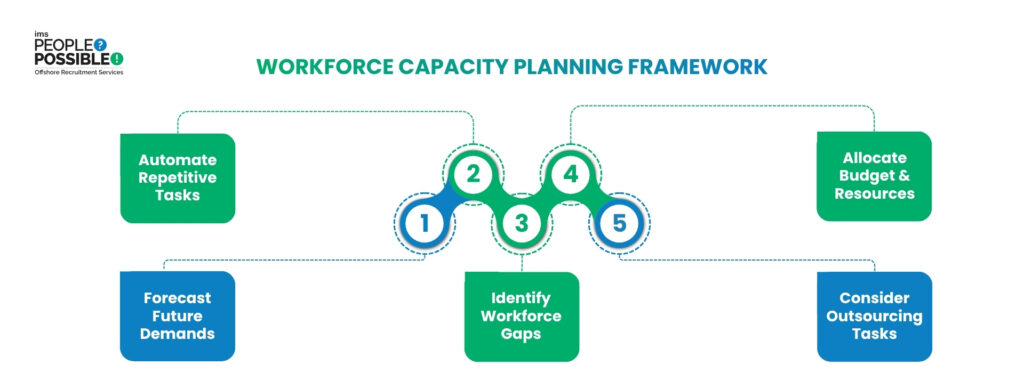
Once you’ve assessed your current recruitment workforce capacity, it’s time to plan for what comes next. The goal here is to match your capacity with client’s hiring demands and prepare for any seasonal staffing surges.
Forecast future hiring demands
Start by pulling 2-3 years of your order data and mark your peaks. Also, check for global news and latest light industrial recruitment reports to understand the overall market sentiment.
Next, talk to your clients regularly about what they think is upcoming, then ask for a rough range and update it every month.
Finally, combine all the data to create a rough future estimate and compare it against your current capacity to find gaps early.
For example, your client may need 150 extra hires next month. And your team of 4 spends an average of 6 hours per hire, which adds up to 900 hours.
So, if your recruiters each have 25 available hours a week, you have 100 hours of capacity a week. So, this order alone may take 9 full weeks.
Automate repetitive recruitment tasks
52% recruiting leaders say scheduling is their most manual or repetitive task. Another 37% feel it’s sourcing while 49% say it’s screening for them.
So, before you add more headcount, focus on removing the extra off your recruiter’s plate. The easiest way to do this is to use automation or AI in recruitment tasks that need less human judgment.
It can include creating job descriptions, resume matching, scheduling interviews, sending follow-up reminders, and more. This way, your recruiters get extra hours which they can then use on more strategic tasks.
Identify your workforce capacity gaps
Check the hiring demand next to your available capacity every week. If the demand surpasses what your team can deliver, it reflects a capacity gap.
It’s a good practice to do this for every hiring phase (e.g., sourcing, scheduling, outreach, interview, etc.). This way, you can identify which exact task is draining your team the most.
Look at the skill gaps, too. To do so, ask yourself:
- Which skills does the client need today or in the near future?
- Are they present in your talent pipeline, or do you need to source from scratch?
- Is the existing candidate pipeline updated?
If you find any missing skills in your light industrial candidate pipeline, start building them now than wait for the actual requirement. And if you already have them present, make sure to update their availability and interest to accurately measure their readiness if a light industrial role opens.
Pro tip: Plan 10% to 20% more candidates than each order requires as no-shows usually rise during a demand surge.
Allocate Budget & Internal Resources
Once you identify your available capacity, any gaps, and hiring demands, start planning your budget and resource allocation.
To optimize your team’s readiness for high-volume recruiting or seasonal surges, you can cross-train your recruiters for different roles, approve temporary overtime, automate, outsource or add more recruiters if necessary.
Each option comes with a cost, so compare them before you commit to one. For example, you may hire an additional recruiter to your team to scale for the peak season staffing. But a new team member also brings in additional infrastructure costs, fixed salaries, and training periods that may delay submissions.
Consider Outsourcing & Offshoring Support
The cost and delays are why many light industrial staffing firms consider outsourcing and offshoring to scale recruiter capacity on demand.
You get the same expertise and greater role coverage without the fixed costs and training time. This becomes especially helpful when there’s a sudden demand spike or the market fluctuating.
At IMS People Possible, we’ve ready-to-deploy light industrial recruiters who work as a natural extension of your team. You choose your own resource, and they integrate into your workflows, following your market standards.
You can also choose to outsource out of your hours, so you get 24/7 role coverage while still having the full control, but without bearing the fixed costs.
Benefits of recruiter capacity planning for light industrial firms
When you plan your recruiter capacity, you stop reacting to hiring surges and start managing them.
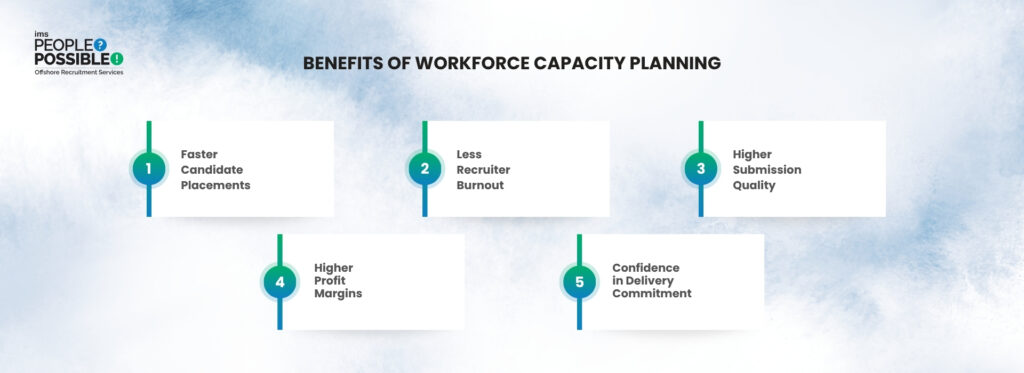
Here are 5 advantages of recruitment workforce capacity planning:
- You fill roles faster: When your recruiters are not drowning in admin or non-billable tasks, they have more time to work on what matters. New requisitions get attention on day one, and delays remain minimal. In turn, you reach candidates before your competitors do and submit quality candidates faster.
- Your recruiters don’t burnout: Balanced workloads cut down overtime and burnout symptoms. As a result, your best employees stay longer, and you avoid the cost of hiring and training new recruiters in the middle of hiring surges.
- Your submission quality is high: When your recruiters have manageable reqs, they screen candidates more carefully. Pre-vetted candidate pipelines also reduce no-shows and early drop-offs, protecting your client relationships.
- Your profit margins improve: When you plan your workforce capacity in advance and have a forecast of future demand, you can allocate your resources and budget more efficiently. You also have a better idea when to outsource or offshore to scale flexibly, and when to bring in permanent headcounts to improve margins.
- You say “yes” with confidence: If a client calls with a big order, you know whether your team can deliver or you need extra support. This lets you distribute your open reqs as per your capacity, give honest timelines, and ultimately gain client trust.
Wrapping Up
Light industrial clients keep hiring in waves, and your next big order can land on any Tuesday afternoon.
To make sure you’re ready to meet the demand spikes, start auditing your real recruiter’s capacity using the above steps. Then, forecast hiring trends and plan your workforce capacity to stay ahead of demand.
The goal isn’t to do it all in one day. Start small, then run weekly checks and compare the results to keep optimizing any gaps.
If your team is already near its limit, or a surge is on the horizon, you don’t have to face it all alone. Get in touch with us to see how we can help you plan your workforce capacity and scale on demand.
Workforce & recruitment capacity planning FAQs
1. What is a good utilization rate for recruiters?
A 70-80% utilization rate for staffing firms shows your recruiters have a healthy workload where they are spending their time on strategic tasks. A utilization rate above 90% signals hidden recruiter burnout, while anything lower than 60% suggests your recruiters may be under-utilized.
2. How far should you forecast your hiring demand and workforce capacity?
Ideally, you must use a dual-horizon forecast approach that combines a short-term operational window (0-6months) and a long-term strategic window (6months+). For the short term, aim to look at least 90 days out for your internal forecast and start talking to clients directly during this period. Once a surge begins, review the data every week and optimize any gaps as you go. The long-term window must include tasks that you can’t fix in a few weeks and need more strategic capacity solutions.
3. When should you consider offshoring for light industrial recruitment?
You can consider offshore recruitment support for your light industrial hiring when you have a seasonal surge coming but limited capacity. This way, you can scale on-demand without increasing your overheads. You can also integrate offshoring as a long-term recruiting strategy when you need higher role coverage, 24/7 pre-vetted candidate pipelines, higher profit margins, and place candidates faster.