

Summarize and analyze this article with:
In an ideal world, winning a large warehouse, distribution, or manufacturing account should create profitable growth for a light industrial staffing business. Instead, it raises an immediate need to add permanent recruiters, coordinators, and administrators to handle the additional work.
Most businesses wish to expand delivery capacity while keeping their fixed cost base controlled.
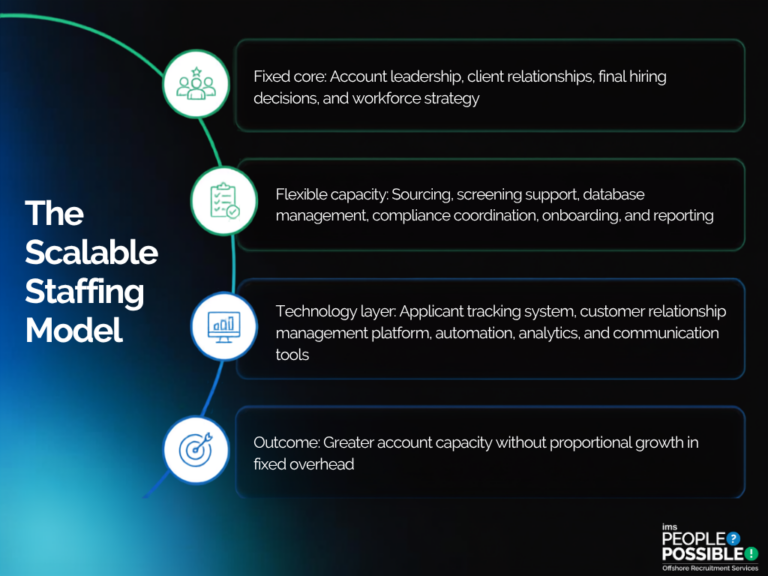
It means separating the work that requires local relationships and judgment from the repeatable recruitment activity that can be standardized, automated, or supported externally. For a light industrial staffing agency, the result is a more flexible operation that can respond to volume without increasing permanent headcount at the same rate.
Why Scalability Matters Now?
Demand across U.S. manufacturing and logistics remains significant. In July 2026, manufacturing had 580,000 seasonally adjusted job openings, including 429,000 in durable goods manufacturing. Transportation, warehousing, and utilities recorded another 316,000 openings (U.S. Bureau of Labor Statistics)
The warehouse labor market is substantial on its own. U.S. warehousing and storage businesses employed approximately 1.84 million people in August 2026. In 2025, the sector included 457,740 stockers and order fillers, 433,060 hand laborers and material movers, and 286,750 industrial truck and tractor operators.(Warehousing and Storage: NAICS 493, Bureau of Labor Statistics)
Volume is only part of the light industrial staffing challenges. The American Staffing Association reported that staffing employee turnover was 376% in 2025, despite falling from 416% in 2024. For agencies providing warehouse staffing and manufacturing recruitment, that level of movement creates constant sourcing, screening, onboarding, replacement, and redeployment work. (American Staffing Association)
Growth therefore depends on more than hiring additional recruiters whenever demand rises. It requires a delivery system that can expand and contract with client activity.
Steps to Scaling Your Light Industrial Staffing Business Intelligently
Build Forecast Capacity by Account
Before accepting a larger account, translate its projected demand into recruitment workload. A request for 150 associates is not one number. It may include pickers, forklift operators, machine operators, assemblers, and quality inspectors across different locations and shifts.
Build a capacity forecast around:
- Expected requisitions and starts by week
- Roles, shifts, locations, and pay rates
- Historical application-to-screen, screen-to-submit, and offer-to-start ratios
- Recruiter hours needed for sourcing, follow-up, coordination, and administration
- Seasonal peaks, call-offs, attrition, and replacement demand
- Service-level agreement and vendor management system requirements
This exercise shows where the current team has room and where activity will create bottlenecks. It also prevents a light industrial staffing company from adding full-time positions based on a short demand surge that may later decline.
Standardize the Delivery Engine
Larger accounts magnify inconsistent processes. If each recruiter searches differently, records different information, or follows a separate onboarding sequence, adding volume usually adds confusion.
Create a repeatable account-launch playbook with candidate sourcing strategies covering job intake, sourcing channels, screening questions, submission standards, compliance steps, escalation paths, and reporting. Develop role-specific scorecards for recurring positions such as material handlers, reach-truck operators, production associates, machine operators, and packers.
Candidate records should capture the factors that determine real-world deployability: commute radius, transportation reliability, shift preference, overtime availability, equipment experience, production environment, safety training, work authorization, and rehire eligibility. Standardization makes it easier to distribute work across recruiters, branches, automation, and external support without lowering visibility.
A pod structure can strengthen accountability. Instead of assigning an entire large account to one overstretched recruiter, create a delivery pod with clear ownership for sourcing, screening, onboarding, candidate care, and reporting. The pod can expand or contract while the account leader remains the consistent client contact.
Use Technology Selectively
Technology should remove repetitive work, not add another disconnected platform. An applicant tracking system (ATS) can provide the operational foundation by centralizing applications, candidate stages, communications, and recruiter activity.
Prioritize workflows that directly improve throughput:
- Automate job distribution across suitable boards and local channels
- Use templates for shift-specific SMS and email communication
- Create knockout questions for location, schedule, and minimum requirements
- Trigger availability checks and document reminders
- Tag workers by role, shift, geography, equipment, and redeployment status
- Connect ATS and vendor management system updates where practical
- Build dashboards for requisitions, submissions, starts, falloffs, and recruiter capacity
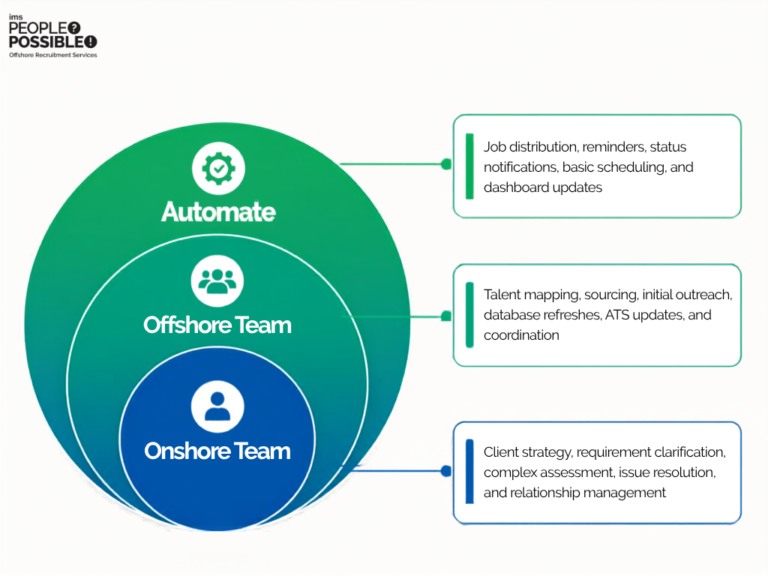
Recruitment automation is particularly useful for confirmations, reminders, and status updates. Recruiters should still handle nuanced screening, candidate concerns, client communication, and final fit decisions. This division protects the human side of industrial staffing services while reducing administrative drag.
Build Talent Pipeline Before Demand
A scalable delivery model needs candidates before the order arrives. The U.S. Bureau of Labor Statistics projects an average of 904,200 openings for hand laborers and material movers each year from 2025 to 2035, largely because workers will transfer occupations or leave the labor force. Waiting for every requisition to open before sourcing makes speed and recruiter capacity harder to protect. (Hand Laborers and Material Movers : Occupational Outlook Handbook)
Build talent pipelines around recurring account demand rather than one generic database. Separate candidates by warehouse, equipment-operation, production, assembly, packaging, and quality roles. Then layer shift, ZIP code, transportation, pay expectations, availability, and previous assignment outcomes.
Keep those communities active through scheduled availability checks, relevant job alerts, database rediscovery, and redeployment outreach. A clean candidate pipeline reduces the amount of net-new sourcing required during every surge and helps recruiters start from a qualified segment rather than a blank search.
Add Flexible Recruiting Capacity
Even a strong internal system has limits. When sourcing, screening, database maintenance, and coordination consume local recruiter time, flexible external capacity can help the business accept more work without immediately creating permanent positions.
Options include contract recruiters for temporary peaks, recruitment process outsourcing for defined workflows, and offshore recruitment teams for repeatable, ongoing delivery. The right model depends on demand duration, process maturity, role complexity, required coverage hours, and the degree of operational control the agency wants to retain.
IMS People Possible provides white-label offshore recruitment support that works as an extension of staffing firms’ existing teams. Depending on the operating model, dedicated professionals can support market mapping, candidate sourcing, pre-screening, database management, ATS and VMS coordination, compliance activity, onboarding, consultant care, and full-cycle recruitment.
The objective is not to disconnect recruitment from the agency. The offshore team works within the staffing firm’s systems, brand standards, workflows, and performance measures. This can help onshore recruiters spend more time on client relationships, candidate decisions, offer conversations, and account growth while repeatable delivery work continues consistently.
IMS People Possible has also supported a U.S. light industrial engagement in which a 25-person sourcing and VMS team helped manage 39% more job volume than the prior year, while submissions increased 25%, interviews increased 45%, and placements increased 19%. Results vary by account, but the example shows how process design and dedicated capacity can support higher throughput without relying only on local headcount growth. (IMS People Possible Case Studies)
Protect Margin With Metrics
Scaling is not simply filling more orders. A larger account can grow revenue while weakening margin if overtime, recruiter workload, falloffs, and rework rise faster.
Track a balanced operating scorecard:
- Job coverage and time to first submission
- Starts and starts per recruiter
- Submission-to-interview and interview-to-start ratios
- Offer acceptance, falloff, and no-show rates
- Redeployment and retention rates
- Cost per submission and cost per start
- Gross margin by account
- Recruiter workload and capacity utilization
- SLA compliance and aging requisitions
Set trigger points before the account launches. For example, a sourcing backlog, declining contact rate, missed submission window, or rise in recruiter overtime should activate additional capacity. This makes scaling deliberate rather than reactive.
Scale the System First
The most sustainable light industrial staffing companies do not treat every new account as a reason to recreate their organization. They forecast workload, standardize delivery, automate repeatable steps, maintain role-based talent communities, and activate flexible recruitment capacity when demand requires it.
Start with one high-volume account. Map every activity from job intake to associate care, identify where recruiter time is being absorbed, and decide which tasks should remain with the core team, move into automation, or receive external support. Then connect every decision to speed, quality, capacity, and gross margin.
How Can IMS People Possible Support Light Industrial Staffing Business Scale?
With the right mix of operational discipline, technology, and scalable light industrial staffing services, larger accounts can become a controlled growth opportunity rather than a fixed-cost commitment. IMS People Possible can help staffing firms build dedicated offshore recruitment capacity around their existing delivery model—so the operation can scale while the onshore team stays focused on relationships, decisions, and growth.
If it’s about People, we make it Possible.