

Summarize and analyze this article with:
A light industrial client approaches two different staffing firms on Wednesday for 30 second-shift associates by Monday.
Staffing firm A begins sourcing after the requisition arrives.
Staffing firm B taps into their talent pipeline.
Guess who got the deal?
A talent pipeline gives recruiters a practical advantage: a living, segmented community of candidates who are known, engaged, qualified, and closer to being assignment-ready.
What is a ready-to-deploy talent pipeline for staffing firms?
For light industrial staffing firms serving warehouses, distribution centers, manufacturing facilities, and production operations, that readiness has a direct connection to two commercial priorities: speed to fill and recruiter capacity. The issue is not simply generating a larger candidate database.
It is being able to identify, contact, qualify, and submit the right mix of forklift operators, pickers, packers, assemblers, machine operators, production associates, and material handlers before client demand turns urgent.
The U.S. Bureau of Labor Statistics reported 608,000 manufacturing job openings in July 2026, a 4.6% job-opening rate. Transportation, warehousing, and utilities recorded 316,000 openings and a 4.1% opening rate during the same month. For staffing firms, those figures reinforce a familiar reality: demand can shift quickly across the combined warehouse, distribution, and production ecosystem.
A proactive recruitment pipeline helps teams prepare for that reality. Here is how to build one that supports high-volume light industrial accounts without adding unsustainable pressure to recruiters.
Why High-Volume Recruiting Depends on a Light Industrial Talent Pipeline
High-volume recruiting becomes difficult when every new order starts at zero. A client may require 50 pickers for peak fulfillment, 15 forklift operators for an additional shift, or a production crew for a manufacturing ramp-up. The roles may be different, but the operational requirement is the same: the staffing firm needs a reliable supply of people who can start soon and meet the worksite’s conditions.
This is especially important in light industrial staffing because job-fit depends on more than a job title. A candidate may have warehouse experience but be unable to work an overnight shift. A qualified forklift operator may live outside a practical commute radius. An experienced assembler may be available only after a current assignment ends. When these details are unknown or stale, recruiters spend critical hours rechecking basics rather than progressing qualified people toward a start date.
The scale of recurring replacement need is substantial. As per U.S. Bureau of Labor Statistics, Occupational Outlook Handbook, Hand Laborers and Material Movers, approximately 904,200 openings per year for hand laborers and material movers from 2025 to 2035. This broad occupational group includes many roles that underpin warehouse, fulfillment, distribution, and production operations.
A ready-to-deploy talent pipeline changes the starting point. Instead of treating an urgent order as a fresh search, recruiters can work from role-specific lists of candidates whose availability, work preferences, and relevant experience have already been assessed.
Talent Pool vs. Talent Pipeline in Light Industrial Staffing
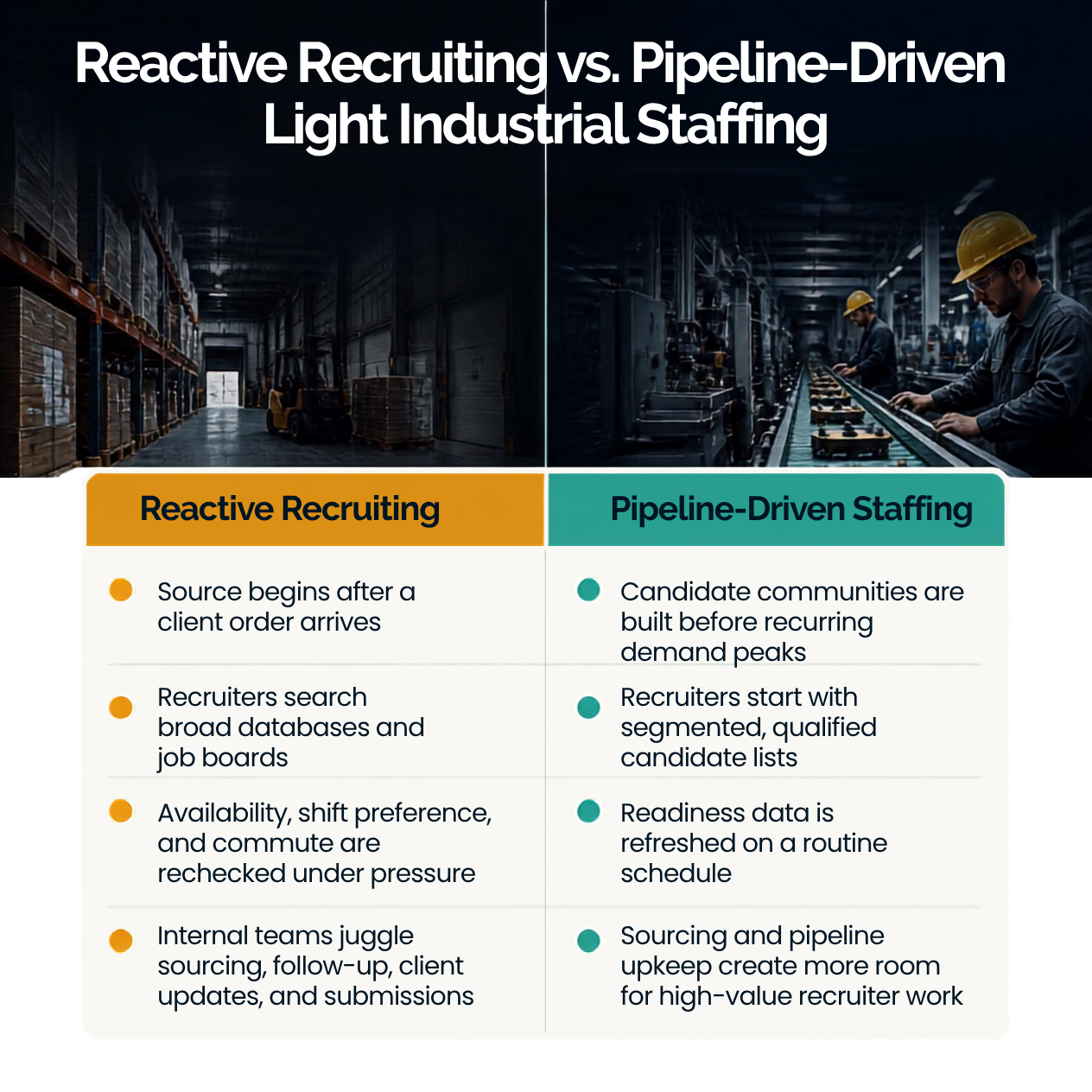
A candidate talent pool is valuable, but it is not automatically a recruitment pipeline. A talent pool can contain applicants, former associates, referrals, passive candidates, and old resumes. A pipeline becomes more useful when people are organized around future deployment needs and regularly engaged.
For high-volume light industrial staffing, the distinction is practical:
- A candidate talent pool may include every person who has ever applied for a warehouse, production, or general labor role.
- A talent pipeline identifies which candidates are suitable for a defined group of recurring requirements, such as second-shift production, weekend distribution, or certified material handling.
- Talent pipeline management keeps that information current through segmentation, outreach, status updates, and performance feedback.
Consider a staffing firm supporting a client with both a distribution center and a production floor. One combined database might have 5,000 records. But a deployable pipeline might reveal that only 110 candidates are within the client’s commute radius, open to the required shifts, responsive, eligible, and suited to the relevant role family. That smaller, verified group is far more useful when the account needs immediate coverage.
The objective is not to exclude candidates unnecessarily. It is to give recruiters a faster route to the people most likely to move forward for a particular assignment.
Segment Candidates for High-Volume Warehouse and Production Roles
Effective talent pipeline management begins with segmentation. In light industrial staffing, the best categories are the ones that help a recruiter answer a deployment question quickly: Can this person realistically start this role, at this site, on this shift?
Start with role families that reflect your recurring client demand:
- Warehouse and distribution: Pickers, packers, order selectors, shipping and receiving associates, inventory associates, loaders, and material handlers.
- Equipment operation: Forklift operators, reach-truck operators, clamp-truck operators, and pallet-jack operators, where relevant to the account.
- Manufacturing and production: Assemblers, production associates, machine operators, line workers, machine feeders, and packaging associates.
- Quality and support: Quality inspectors, sorters, sanitation associates, maintenance support, and general labor.
Then layer the information that determines genuine readiness:
- Location, commute radius, transportation reliability, and willingness to travel.
- First-, second-, third-shift, weekend, overtime, and start-date availability.
- Relevant warehouse, production-line, machine-operation, or equipment experience.
- Certifications, safety orientation, work authorization, background-check stage, and client-specific requirements.
- Previous assignment outcomes, attendance feedback, rehire eligibility, and redeployment status.
- Preferred communication channel, pay expectations, and job-environment preferences.
This approach also protects recruiter capacity. A recruiter should not need to open dozens of profiles and make repeated calls to determine who can work an evening production shift 12 miles from the site. Good pipeline data makes the first shortlist more targeted, helping teams move from requisition to candidate conversation more quickly.
Use Proactive Recruiting Before High-Volume Job Orders Arrive
Proactive recruiting means building candidate supply before there is an urgent vacancy. It does not mean guessing what clients might need. It means using account history, seasonal patterns, planned ramp-ups, prior shifts, turnover trends, and conversations with account teams to identify recurring role demand.
For example, a firm may know that a distribution client increases weekend picker and packer requirements before a seasonal peak, while a manufacturing client frequently needs additional assemblers and material handlers when production volumes rise. These patterns provide a basis for focused sourcing and candidate engagement well before the order is released.
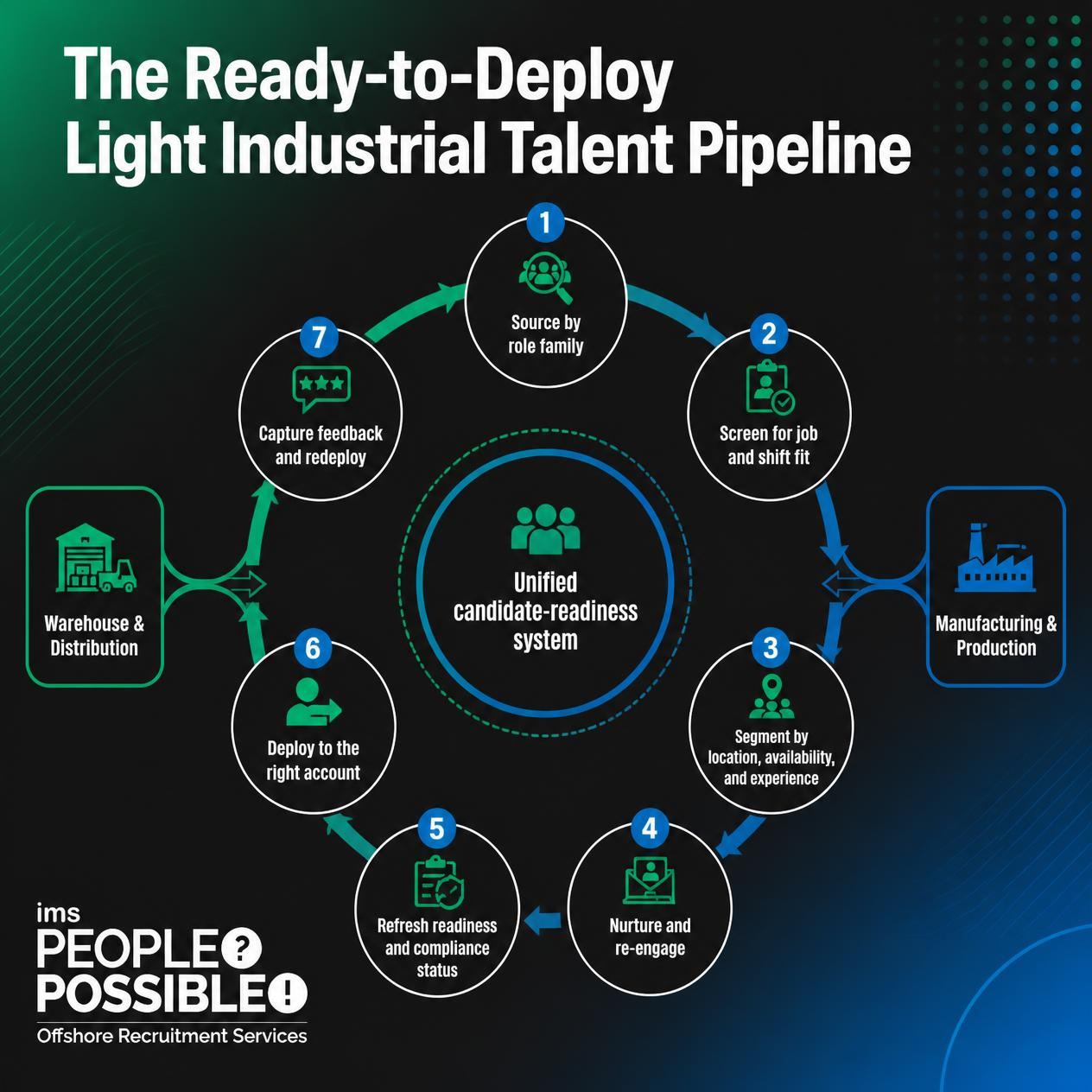
A practical proactive recruiting workflow looks like this:
- Map recurring demand by account, job family, location, shift, and likely volume.
- Build sourcing campaigns around those specific segments rather than generic “warehouse jobs” messaging.
- Screen for the role and readiness details that matter most to each account.
- Maintain a nurture cadence through SMS, email, calls, and relevant job updates.
- Reconfirm availability before a projected hiring period and again before submission.
- Capture deployment outcomes and route successful associates into redeployment segments.
Candidate messaging should be specific and helpful. A general “jobs available” message is easy to ignore. A message such as, “We are updating our list of experienced second-shift forklift operators within 15 miles of [location]. Reply with your current availability if you would like to hear about upcoming opportunities,” gives the candidate a clear reason to respond.
IMS People Possible can support this always-on activity with dedicated offshore recruitment professionals who work as an extension of a staffing firm’s team. Depending on the operating model, they can help source role-specific candidates, update applicant tracking system records, run reactivation campaigns, conduct initial outreach, and coordinate screening steps. That sustained capacity can help onshore recruiters devote more time to client communication, final qualification, submissions, and start management.
Refresh Your Recruitment Pipeline to Improve Speed to Fill
Candidate data loses value quickly if it is not refreshed. Someone marked “available” two months ago may have accepted another position, changed shifts, moved, lost transportation access, or simply stopped responding. In high-volume recruiting, outdated data turns into wasted recruiter time.
A simple refresh cadence makes the pipeline more dependable:
- Reconfirm “available now” status every 7 to 14 days during active hiring periods.
- Revalidate shift preference, commute feasibility, and contact details monthly.
- Check time-sensitive documents, certifications, and client-specific screening requirements before a candidate becomes deployable.
- Move unreachable or uninterested candidates into a reactivation track rather than treating them as immediately available.
- Record attendance, performance, completion, and rehire feedback when an assignment ends.
This is not administrative busywork. It is a speed-to-fill discipline. The more reliable the data, the less time recruiters spend chasing candidates who are no longer a fit.
The American Staffing Association reported a 416% turnover rate for temporary and contract employees in 2024. That metric reflects the short-term and assignment-based nature of contingent work, but it also highlights why staffing firms need a consistent way to engage, redeploy, and replace talent.
For a high-volume light industrial account, every completed assignment should create new information for the pipeline. Which associates were reliable? Who is eligible and interested in redeployment? Which job conditions attracted strong response? Which shift groups need more proactive sourcing? This feedback is what turns a candidate list into an improving operational asset.
Measure Talent Pipeline Management for High-Volume Recruiting
Pipeline size alone is not a useful measure of readiness. A database with 10,000 candidates may still be unable to supply 25 available, qualified, and responsive associates for a next-day shift.
Track measures that connect the recruitment pipeline to speed to fill and recruiter capacity:
| Metric | Why it matters for light industrial staffing |
|---|---|
| Active, contactable candidates | Shows how much of the candidate base can realistically be reached |
| Qualified candidates by role, shift, and location | Indicates supply for specific warehouse and production needs |
| Availability-confirmation rate | Reveals whether candidate records are current enough for rapid deployment |
| Response rate by channel | Helps optimize SMS, email, calling, and reactivation efforts |
| Time to first qualified shortlist | Connects pipeline readiness directly to speed to fill |
| Submit-to-start rate | Shows whether screening and job matching are strong enough to support starts |
| Redeployment rate | Measures how well known associates are retained in the candidate community |
| Recruiter hours spent on sourcing and data upkeep | Makes the capacity case for workflow support and dedicated sourcing resources |
Review these measures by account, role family, branch, and shift—not only at an overall company level. A firm may have adequate total supply but a shortage of third-shift production associates or experienced reach-truck operators near a particular distribution facility.
Increase Recruiter Capacity With Dedicated Light Industrial Sourcing Support
Building a proactive talent pipeline requires discipline, and it requires capacity. Sourcing, rediscovering past applicants, confirming availability, updating records, following up, and running candidate nurture campaigns all take time. When volume rises, these activities often compete with the same recruiters who must manage client updates, conduct final conversations, make submissions, coordinate starts, and solve exceptions.
That is why pipeline work should not depend entirely on a recruiter finding spare time between urgent requisitions. It needs a repeatable operating model and clear ownership.
IMS People Possible provides white-label offshore recruitment services designed to work alongside staffing firms as an extension of their recruitment teams. Dedicated recruitment professionals can support the recurring work that keeps a light industrial talent pipeline active: candidate sourcing, resume review, database management, outreach, screening coordination, and reporting. This can help staffing firms create more consistent pipeline coverage while keeping onshore recruiters focused on client relationships, candidate decisions, and account delivery.
The right model is collaborative. Account managers contribute demand intelligence. Internal recruiters define quality standards and lead high-touch decisions. Dedicated sourcing support helps maintain the candidate flow and data quality between peaks. Together, the team can create a recruitment pipeline that is more responsive when high-volume orders arrive.
Build Supply Before the Next Hiring Spike
The fastest response to a high-volume light industrial order starts before the order is issued. Staffing firms that segment candidates by role and readiness, nurture communities consistently, refresh data, and measure deployment capacity are better positioned to respond when warehouses ramp up and production demand changes.
Start with one priority account. Map its most common warehouse, distribution, manufacturing, and production roles. Identify the shifts and locations that create the greatest pressure. Then build a candidate talent pool into an active talent pipeline with a clear refresh cadence and readiness scorecard.
When proactive recruiting becomes part of daily delivery—not an emergency project—staffing firms can improve speed to fill and make better use of recruiter capacity. With dedicated sourcing support from IMS People Possible, it becomes easier to keep those candidate communities active, organized, and ready for what comes next.
Need more capacity to keep your light industrial talent pipeline active?
Talk to IMS People Possible about dedicated recruitment support that can help your team source, engage, refresh, and organize candidate communities for high-volume warehouse, distribution, manufacturing, and production requirements.