

Summarize and analyze this article with:
As of 2026, 69% of U.S. employers find it difficult to hire qualified professionals, with AI and technology skills now the hardest-to-find capabilities.
And as organizations continue investing in AI, cloud infrastructure, cybersecurity, and digital transformation, the pressure on tech recruiters and IT staffing firms is only increasing.
From talent shortages and niche skill gaps to rising cost per hire – you must navigate multiple challenges to find and place the right talent. But before you can solve them, it’s important to identify what’s creating hiring bottlenecks in the first place.
Let’s look into some of the biggest tech recruitment challenges that most IT recruiters face today, along with some practical solutions.
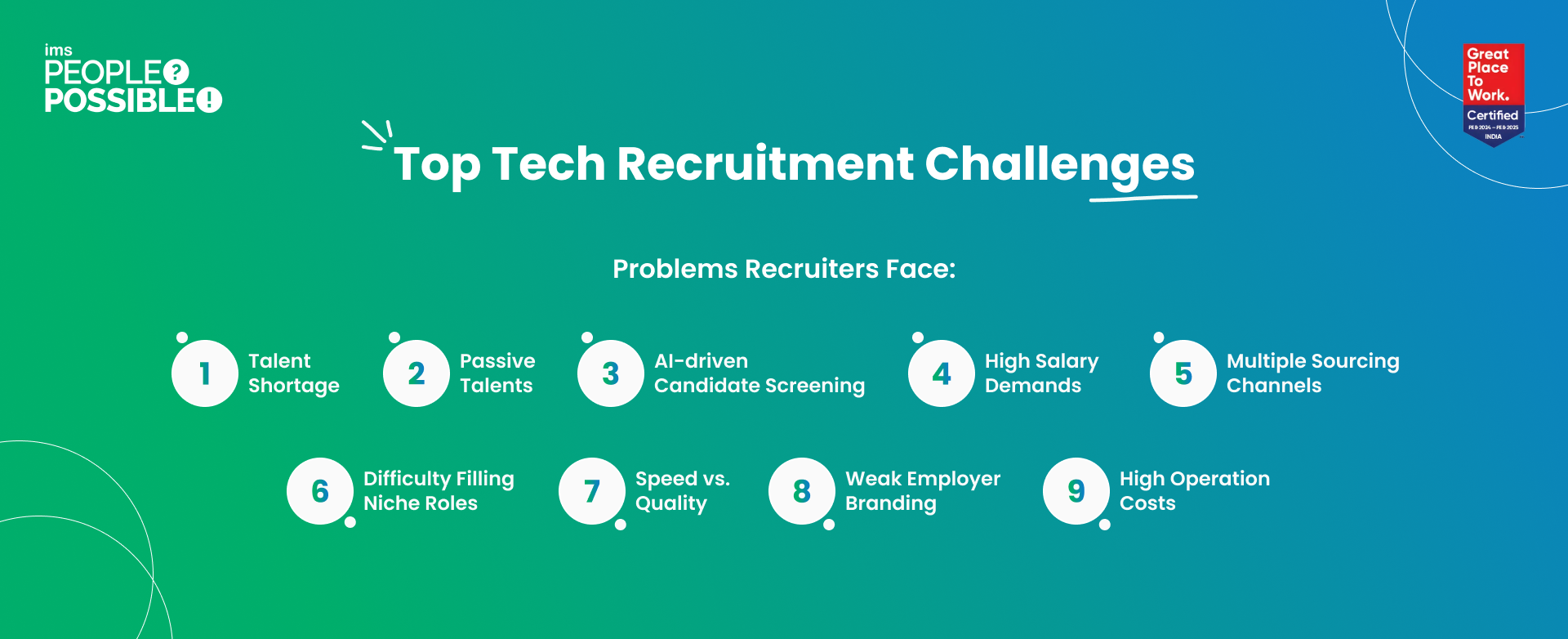
Top 9 IT Recruitment Challenges in 2026
IT recruitment in 2026 is defined by speed, scarcity, and shifting priorities. Understanding these challenges is the first step to building a smarter, more resilient hiring strategy.
Challenge #1: Increasing Client Vacancies, but Local Talent Shortage
U.S. employers posted nearly 1.1 million technology job openings last year, with demand for AI-related skills growing the fastest. Even highly specialized fields such as cybersecurity recorded more than 20,000 job postings, highlighting the ongoing need for skilled tech professionals.
However, many local talent markets simply cannot supply enough qualified candidates. As a result, IT staffing firms are often competing for the same limited pool of talent.
How to Solve It?
Instead of limiting your search to a single region, consider expanding sourcing efforts nationally or even globally. If the job is on-site, find candidates who’re genuinely willing to relocate and present those opportunities early in the hiring process.
It’s also important to maintain open communication with clients about current market realities. Helping them understand talent shortages can encourage:
- greater flexibility around location
- experience requirements or budgets
- remote or hybrid work options
- relocation support
Facing Talent Shortage Challenge in Your IT Staffing Agency?
Challenge #2: Passive Top Talents Making Sourcing Harder
The best technology professionals are rarely actively job hunting. So, traditional job boards alone are no longer enough.
Even if you successfully find these passive candidates, sourcing them is only the first step. Your hiring success also depends on building relationships and keeping the candidates warm for months before you finally place them.
How to Solve It?
Modern tech recruiters must focus on proactive talent engagement and on maintaining warm pipelines rather than reacting to sudden job openings.
Here are some best practices for passive tech recruitment to follow:
| Don’t | Do |
| ✗ Source reactively only once a role opens | ✓ Treat passive sourcing as an always-on function |
| ✗ Generic InMail blasts for all candidates | ✓ Personalized, value-led outreach |
| ✗ Using only traditional job boards | ✓ Build presence in tech communities |
| ✗Source and forget | ✓ Re-engagement of past candidates |
| ✗ Focus on volume-based KPIs (e.g., profiles sourced, responses booked) | ✓ Focus on outcome-first KPIs (e.g., candidate conversions, time-to-hire) |
However, keeping passive candidates engaged for months isn’t easy when you’re also filling open reqs. This is why the passive candidate strategy almost always gets sidelined.
Solution? Assign a few dedicated recruiters to do the proactive work for you, so you’re ready when the role opens.
Also Read: How this IT staffing firm achieved 142% more starts in 12 months..
Challenge #3: AI-Driven Candidate Screening Inaccuracy
AI screening tools promise speed at scale, screening thousands of resumes in the time it takes a recruiter to review ten. But the accuracy isn’t always where vendors imply it is.
You can also no longer rely on resumes and cover letters as strong indicators of candidate quality because AI tools make it easy for candidates to tailor and optimize them. Even when the candidate reaches the interview, it’s easy to manipulate the process with real-time assistance tools.
As a result, you face a growing challenge: how do you identify genuine talent when AI influences almost every stage of the candidate journey?
How to Solve It?
Don’t rely on a single screening method. Instead, combine AI tools with active recruiter judgment and skills-based assignments.
You can:
- use practical assessments that mirror real job requirements
- include technical exercises or live problem-solving sessions
- ask follow-up questions that test real project knowledge
- use AI as a supporting tool and not a decision-maker
The goal isn’t to eliminate AI from your hiring process. It’s to create enough verification points that help you confidently identify candidates.
Challenge #4 Top Talents’ High Salary Demands
In-demand positions like LLM developers have reached an average base compensation of $209,000 in the USA, while the average U.S.-based salary for a senior data professional is $178,000.
This often creates challenges for clients operating under fixed hiring budgets, which in turn forces IT and tech recruitment agencies to squeeze their margins.
How to Solve It?
Get creative with the full offer and emphasize:
- ownership of work
- work flexibility
- learning budgets
- remote or hybrid options
While salary remains important, many candidates evaluate the total value proposition of a role when making their choice.
Challenge #5: Unsure Where to Look for Tech Talents
Popular job boards and LinkedIn are the default starting point for most IT role searches, but they’re an incomplete map of where tech talent actually is.
In fact, industry benchmarks show job boards and social sites make up roughly half of total application volume, yet account for less than a quarter of actual hires.
How to Solve It?
A meaningful share of strong engineers and niche tech talent are active on developer communities like GitHub or Stack Overflow, and through referral networks that never touch a public job board at all.
So, it’s a good idea to diversify your sourcing channels and strengthen your referral game. As a best practice, mine your existing ATS or CRM database to re-engage with previous candidates before starting new sourcing efforts.
Challenge #6: Difficulty in Filling Niche IT Roles
Not all open roles take the same time to fill. While the average time-to-hire for traditional tech roles is around 42-44 days, AI/ML specialist roles average at 89 days, and senior site reliability engineer roles around 75 days.
And here’s the deeper challenge for tech recruitment agencies: your cost-per-hire increases with each passing day as your recruiter bandwidth is consumed for the same position.
How to Solve It?
We’ve said it before, and we’ll say it again: don’t wait for a requisition to open before you start sourcing.
Build specialist talent pools ahead of need rather than starting from zero once a requisition opens. Also, consider investing in recruiters trained for specialized domains or outsourcing part of the reqs.
Challenge #7: Maintaining Speed vs. Quality
Tech unemployment sits at just 2.8%, well below the national average of 4%. But surprisingly, as we speak, the U.S. alone has over 1.2M unfulfilled engineering roles.
That’s a demand and supply mismatch!
Clients want candidates quickly. Other vendors are competing for the same IT roles as you are. But on the candidate side, you know that rushing staffing processes can lead to poor placements and a higher candidate’s attrition rate.
How to Solve It?
Build candidate sourcing strategies that includes multiple touchpoints and uses automation for repetitive tasks.
You can also create a near 24/7 staffing model by extending your sourcing capacity beyond your local working hours. That way, by the time your team is ready to work, the offshore recruiters have already sourced candidates for you (or even completed the full hiring cycle if you prefer).
Many of our partners at IMS People Possible have successfully used dedicated offshore recruitment teams to accelerate candidate delivery without sacrificing quality, while their onshore recruiters focus on client management. If you are looking for a similar solution, talk to our IT recruitment experts now.
Challenge #8: Employer Branding to Attract Talent
Candidates evaluate employers just as carefully as employers evaluate candidates. A weak employer brand can dramatically reduce application and acceptance rates.
How to Solve It?
If you’re an employer, invest in a strong Employer Value Proposition (EVP) and communicate it consistently across your website, social media channels, and candidate touchpoints. Showcase your culture, growth opportunities, employee success stories, and workplace flexibility.
If you’re a tech recruitment agency, don’t treat employer branding as your client’s responsibility alone. Work closely with clients to understand what makes them an attractive workplace and help them communicate those strengths effectively.
Your recruiters must also know the client’s value proposition inside out. The better they can articulate it, the more effectively they can engage candidates and address concerns throughout the hiring process.
Also Read: How the IMS Philippines team achieved 25 veterinarian starts and 113 re-engagements despite a negative client reputation.
Challenge #9: High Operation Costs
If you place a software engineer earning $120,000 annually, your placement fee may range from 15–30% of the salary. On paper, that looks like a healthy margin.
But if you go deeper, an unfilled technical role costs roughly $500 a day; at the average 42–44-day time-to-fill, that adds up to more than $22,000 before a recruiting invoice even arrives. The challenge becomes even bigger when niche roles stay open for months.
Moreover, whether you fill the position or not, your in-house recruiter’s spend remains constant, going up to 1.2X to 1.4X of their base salary (including equipment, paid leaves, payroll taxes, etc.)
How to Solve It?
The first step is to improve your recruiter efficiency. Automate repetitive tasks, build reusable talent pipelines, and reduce the manual effort required for every search.
It’s also important to rethink how you scale your staffing and recruitment operations while optimizing for costs. For instance, you can provide a hiring subscription model with a flat monthly fee instead of the per-hire fee. You can also opt for contract recruiters or offshore IT recruitment teams to scale on demand beyond local hours at a fraction of the cost.
Future-Proof Your IT Staffing Firm With Offshore Recruitment Solutions
If you look at it together, the above nine challenges share a common thread: capacity. Your onshore IT recruiters don’t have enough hours or niche expertise to run full-cycle, multi-channel IT recruitment well, all at once, every day.
That’s a large part of why a growing number of US IT staffing agencies and recruitment firms have turned to outsourced and offshore recruitment partners like IMS People Possible to extend their sourcing, screening, market mapping, and compliance capacity without the overhead of growing in-house headcount.
With delivery centers in India and the Philippines, our IT recruiters go beyond your local hours to create 24/7 talent pipelines (or conduct 360 hiring if you prefer) while still engaging with your onshore teams in real-time, so there’s no delay in your hiring process — all at 70-80% lower costs.
To know more about how we operate or learn how we can help you recruit IT and tech talent in the USA, get in touch with us now.