
Summarize and analyze this article with:
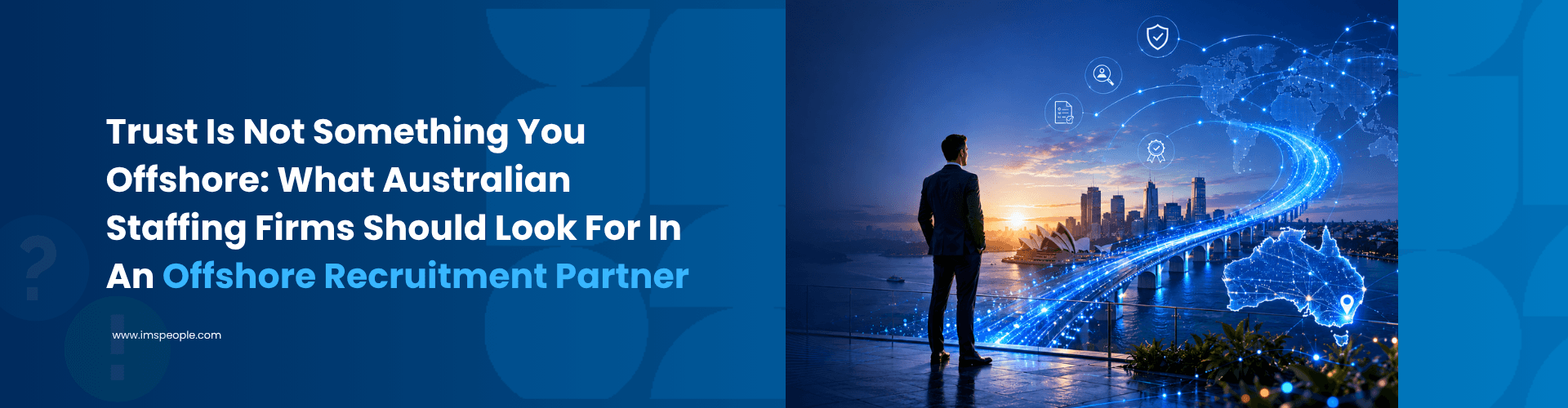
The offshore recruitment model has become a strategic advantage for many Australian staffing firms.
What has changed, however, is not the model itself — but the level of responsibility that comes with it.
As agencies extend access to offshore teams, they are not just scaling delivery. They are extending access to their systems, candidate data, and client relationships.
Whether supporting candidate sourcing, talent pooling, compliance administration, contractor care or back-office operations, offshore teams help agencies increase capacity and improve delivery outcomes.
The benefits are clear.
What is often overlooked is the responsibility that comes with giving another organisation access to your systems, candidate records, and client information.
When staffing firms evaluate offshore partners, conversations typically focus on capability, cost, and turnaround times.
The more important question is often:
Can we trust this organisation with our data, our clients, and our reputation?
As privacy expectations rise and regulatory scrutiny continues to evolve, choosing an offshore partner is no longer simply an operational decision.
It is a business risk decision.
Why Data Security Matters More Than Ever
Recruitment agencies handle some of the most sensitive information in the workforce ecosystem.
Every day, recruiters process:
- Candidate personal information
- Employment histories and references
- Right-to-work documentation
- Salary and remuneration data
- Client organisational structures
- Commercial agreements
- Contractor records
- Compliance and onboarding documentation
When information is shared with an offshore provider, accountability does not disappear.
Your clients still trust your business to protect their information.
Your candidates still associate that responsibility with your brand.
Your reputation remains on the line.
This is why data security should never be treated as a procurement checkbox.
It should be a core part of evaluating any offshore recruitment partnership.
The Real Risk Is Not Technology
The real risk in offshore recruitment models is rarely the technology itself.
It is how access to information is managed, governed, and controlled day to day.
While cyber threats are real, many of the biggest risks come from weak processes, unclear accountability, and inconsistent operating discipline.
Questions every staffing firm should consider include:
- Who has access to our information?
- How is access controlled and monitored?
- What happens when employees leave?
- Can information be downloaded or transferred?
- What controls exist around remote work?
- How are incidents managed if something goes wrong?
These questions don’t just reduce risk — they reveal how mature and accountable a provider’s operating model really is.
Strong security is rarely the result of a single tool or system. It is created through a combination of people, processes, and technology working together consistently.
Questions Every Staffing Firm Should Ask An Offshore Partner
1. How Is Candidate And Client Information Accessed?
Leading offshore providers should clearly explain how information is accessed, managed, and protected.
The safest environments minimise unnecessary data movement and ensure access is restricted to authorised individuals.
2. What Controls Exist Around Access Management?
Access should never be granted on a blanket basis.
Staffing firms should understand:
- How access permissions are assigned
- How permissions are reviewed
- How activity is monitored
- How access is removed when no longer required
Strong access management improves both security and accountability.
3. What Does The Working Environment Look Like?
Many firms focus heavily on recruiter capability but overlook the environment in which those recruiters operate.
Important considerations include:
- Is work performed from a controlled office environment?
- What physical security measures exist?
- How are devices managed?
- What controls exist around remote work?
The answers often indicate the maturity of the provider’s overall operating model.
4. How Is Security Governed Across The Business?
Technology is only one part of the equation.
Effective security frameworks also include:
- Documented policies and procedures
- Employee training and awareness
- Incident response processes
- Business continuity planning
- Vendor management controls
The strongest offshore partners embed security into daily operations rather than treating it as a standalone function.
5. Can Security Claims Be Independently Verified?
Any organisation can claim to take security seriously.
Independent certifications, audits, and recognised frameworks provide an additional level of confidence that security practices have been assessed externally.
When evaluating a provider, it is worth understanding what standards support their claims.
Security Is Ultimately About Trust
While certifications and systems play an important role, trust is built through consistency.
A strong offshore partner understands they are not simply supporting recruitment activity. They are becoming an extension of your business.
That responsibility requires governance, accountability, and a culture that prioritises the protection of client and candidate information.
The right offshore partner should not just support delivery — they should strengthen how securely and confidently your business operates.
What We Believe At IMS People Possible
At IMS People Possible, security is not treated as a standalone function or a compliance exercise.
It is built into the way our delivery model operates — across people, processes, and technology.
Our approach focuses on controlled delivery environments, structured governance, secure access frameworks, and continuous employee awareness.
Our goal is not just to protect data, but to ensure our clients can scale offshore delivery without introducing unnecessary risk into their business.
Our framework is supported by internationally recognised standards including:
- ISO 27001 Information Security Management
- ISO 27701 Privacy Information Management
- SOC 2 Type II
- Cyber Essentials
- ISO 9001 Quality Management
These are not just certifications — they represent independently validated standards across security, privacy, and operational governance.
More importantly, trust is built through consistent execution, transparency, and accountability.
For nearly two decades, staffing firms across Australia and globally have trusted IMS People Possible to support critical recruitment operations while maintaining the standards their clients and candidates expect.
The Bottom Line
Offshoring can be an effective way for recruitment businesses to scale, improve delivery, and strengthen performance.
The right partner can become a genuine extension of your team.
However, before evaluating turnaround times, recruiter experience, or cost models, ask a simpler question:
Would we trust this organisation with our most important client and candidate information?
Because when it comes to offshore recruitment partnerships, trust is not something you outsource.
It is something you build.
Considering Offshore Recruitment Support?
Before choosing a partner, take the time to understand their approach to security, governance, and data protection.
The right questions today can help avoid significant risks tomorrow.