
Summarize and analyze this article with:
According to the Mental Health UK Burnout Report 2026, one in five UK workers took time off work due to poor mental health caused by stress, while 42% identified high or increasing workloads as a source of stress.
Although these findings are not specific to the recruitment industry, they raise an important concern for employers across the UK, including recruitment agency owners.
After all, when your recruiters are already managing demanding workloads, additional operational pressure can make their jobs even harder.
And recruiter burnout can have several contributing factors, including:
- Recruitment technology gaps
- Repetitive recruitment administration
- Uneven workloads
Together, these issues can add unnecessary pressure to your recruiters, leaving them with less time to focus on candidates, clients and placements.
But what if the problem is not simply how hard your recruiters are working, but how their work is organised?
In this article, you’ll discover three operational gaps that could be affecting your recruitment delivery performance, how to identify them in one week and what you can do to improve your team’s capacity.
Is Recruiter Burnout Really a People Problem, or a Delivery Model Problem?
Recruiter burnout could be both a people problem and a delivery model problem because recruitment is a target-driven job, and that won’t change.
However, constant pressure shouldn’t automatically become part of your recruiters’ job.
As per the recent survey done by the Health and Safety Executive, 964,000 workers in Great Britain alone experienced work-related stress, depression or anxiety.
Below are the tasks and exercises that turn normal work into pressure and then friction.
| Billing targets and deadlines | Your recruiters type the same candidate data into several systems. |
| Demanding clients and candidates | Your best billers chase compliance documents and VMS updates by hand. |
| Competitive markets | Covering colleagues’ desks with no plan |
When these tasks become friction for your recruiters, they become an expense for you. Totaljobs research found that UK recruiters spend 17.7 hours on manual admin for every vacancy.
These hours cost them about £17,000 a year in lost productivity per recruiter.
As a result, responses slow down, good candidates drop out and clients notice.
Unlike many wider recruitment challenges facing UK agencies, you can control friction.
But to control friction, you first need to know where it comes from.
And this is what we will be talking about in the next section.
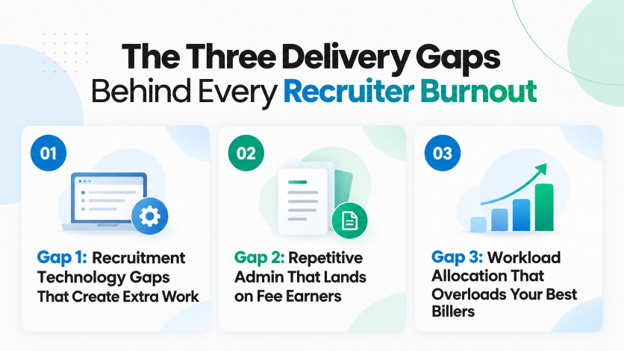
The Three Delivery Gaps Behind Every Recruiter Burnout
Recruiter burnout can happen for several reasons. But out of many, there are three delivery gaps that cause major recruiter burnout and they are:
- The systems you use (Recruitment Technology Gaps That Create Extra Work)
- The admin nobody owns (Repetitive Admin That Lands on Fee Earners)
- How work is shared (Workload Allocation That Overloads Your Best Billers)
Let us explore each gap one by one.
Gap 1: Recruitment Technology Gaps That Create Extra Work
Most agencies have plenty of technology, but it just doesn’t connect, so people fill the gaps by hand.
For example, your recruiter has a task to place a nurse; he logs the nurse details in the ATS, enters them again in the client’s VMS portal (its system for managing agency staff), then updates a compliance spreadsheet. That’s the same data type entered three times.
That is why buying more talent acquisition software rarely fixes the problem.
According to Bullhorn’s 2026 GRID report, only one in ten recruitment agencies use AI that can work autonomously across the entire hiring process.
Most are held back because their data is not ready and their plans are unclear. Simply put, buying another recruitment tool will not help if your existing systems don’t connect.
The fix is to tidy up your recruitment database software first, so your recruiters can trust it again.
For one engineering recruiter, IMS updated more than 24,500 candidate profiles in a year by cleaning up the recruitment database.
Once you close these recruitment technology gaps, you free up your recruiters’ valuable hours, so they can do what they should: place candidates and close deals.
However, someone still must handle the admin’s work, and you can get help from an offshore delivery partner. (also known as a recruitment outsourcing partner).
Let us now explore the second delivery gap.
Gap 2: Repetitive Admin That Lands on Fee Earners
Every admin task needs an owner. If your admin doesn’t have the owner it deserves, it lands straight on your fee earners, your most expensive staff.
Research from Totaljobs data shows how much time it takes per vacancy:
- Reviewing CVs: 3.6 hours
- Writing post-interview notes: 3 hours
- Scheduling interviews: 2.5 hours
On top of the above tasks, your recruiters also format CVs, post jobs, and chase compliance documents.
For example, if your recruiter fills four roles each month, they’re probably spending over 36 hours on those three tasks alone. That is nearly a full working week lost to paperwork.
An easy fix to this second delivery gap is to standardise what you can, then decide what to automate, outsource and keep in-house.
In addition, dedicated administrative support for recruiters can handle candidate sourcing and the rest, so your consultants can focus on clients and candidates.
Even after sorting out your administrative burden, a third gap quietly burns out your top performers.
Gap 3: Workload Allocation That Overloads Your Best Billers
In many recruitment agencies, leaders share work out by counting heads rather than looking at the actual roles. That might sound fair on paper, but it rarely works well in reality.
Let us understand this with a simple example of workload allocation that overloads your best billers.
Imagine you have a team of five recruiters who are managing 20 open vacancies. Your top biller usually ends up with eight of the hardest roles plus all his own admin, while two junior recruiters sit around waiting for work.
Then, when your top recruiters take two weeks off for the Christmas holidays, nobody else knows their clients or how to manage the roles.
As a result, your best biller ends up sourcing candidates in the evenings and on weekends just to keep up.
So instead of letting that happen, you should track your team’s workload before people burn out, organise holiday cover early and bring in flexible support during busy periods.
Learn about the “8 Recruitment Metrics That Reveal Capacity Issues” →
Now that you know what causes these problems, how do you spot them (delivery gaps) inside your own agency? We will discuss the same thing below.
A One-Week Check to Find Your Agency’s Delivery Gaps
The good news is that you do not need outside consultants to spot recruitment technology gaps or workload problems. In simple terms, a straightforward one-week check will show you exactly where the friction is.
Here is how you can do it:
- Ask your few consultants to log their time for one week in 30-minute blocks, noting whether each block went towards revenue work or routine admin.
- Map every system a placement touches from start to finish and count how many times people type in the exact same data.
- Compare live roles, candidate submissions, and actual hours worked across each consultant on your team.
- List out who is covering each desk during the December holidays, so you know who holds the relationships.
Once you have that information, you can match what you find to the right fix:
- If data is typed into several systems, you need to connect your tools properly or retire from the ones you do not use.
- If you see repetitive manual tasks, you should standardise them first and then automate where possible.
- If there is too much admin sitting on fee earners, you ought to move that routine burden to delivery support.
- If there is no clear process of owner or holiday cover, you must agree who owns what, and plan December cover early.
Notice that only one of those issues actually requires new technology. Therefore, you should always check the other operational areas before you spend more money on software.
If you would like a second pair of eyes on your process, you can book a 20-minute call with our UK team.
Once you know where your gaps are, the next logical question is who should actually fix them.
Where Offshore Delivery Support Helps (and Where It Doesn’t)
An offshore delivery partner can be a brilliant solution, but only if you use them for the right tasks.
Delivery support works best when:
- The work is repeatable and documented, such as sourcing candidates, formatting CVs, cleaning up your recruitment database, and running compliance checks.
- The tasks can be completed directly inside your own ATS and CRM, fully under your brand.
- You need extra capacity for seasonal peaks, out-of-hours coverage, or holiday absences in December.
However, offshore support will not fix messy, undocumented processes, a broken tech stack, or unrealistic revenue targets on its own.
But when you get it right, this is how offshore teams improve recruiter productivity without forcing you to add expensive UK headcount.
And this results in a way that “your consultants continue to own client relationships, lead commercial negotiations and make final candidate choices, while the offshore support team handles the agreed tasks in the background.”
Successful staffing leaders who have this shift are experiencing the real difference:
Check it out what he experienced with IMS offshore dedicated support:
Alternatively, you can watch the testimonial:
Similaly, other staffing company owners who took benefit from the dedicated offshore recruitment support have shared their experience.
Hear them all and see how you can leverage the same support for your business.
Now that you have seen and heard what people like you are growing up in their business, you know what to do next.
Conclusion: Fix the Friction Before Year-End
There is an old saying: “A stitch in time saves nine”. It means that if you take the time to fix this operational friction now, you will not have to rebuild a burnt-out team in future.
Moreover, recruitment technology gaps, admin with owner and uneven workloads are the real culprit behind recruiter burnout today.
The good news is that you can fix all three by designing the right setup and doing so will naturally boost your team’s delivery performance.
For over 20 years, IMS has helped staffing businesses across the globe do exactly that. You can see proven results from agencies just like yours or explore our dedicated offshore recruitment support designed specifically for UK staffing firms.
Frequently Asked Questions
What causes recruiter burnout in recruitment agencies?
Recruiter burnout in recruitment agencies comes from heavy administrative work, high-performance pressure (unrealistic targets and metrics), candidate and client friction, candidate scarcity, lack of autonomy and a lack of control over unpredictable hiring markets.
What are recruitment technology gaps?
Recruitment technology gaps are the disconnects, limitations and blind spots within a company’s hiring software that forces recruiters to rely on manual workarounds. These gaps usually happen when ystems do not talk to each
Will buying more talent acquisition software reduce recruiter burnout?
No. Buying another talent acquisition software will not automatically reduce recruiter burnout. In fact, it may add extra logins, manual data entry and a chaotic environment known as “tool fatigue” or “tech bloat” if you add more tools without clear strategy. To reduce the recruiter burnout, another software if added to the company should simplify the recruiter’s day and not complicate it.
How can recruitment agencies reduce consultant workload before year end?
Recruitment agencies can reduce their consultant workload before year end by automating routine tasks, running a one-week time audit, shifting routing CV formatting and sourcing to dedicated delivery support, streamlining client and candidate communication, tightly managing active requisitions.
What is recruitment delivery performance?
Recruitment delivery performance refers to how consistently, quickly and accurately an organisation or talent partner executes its hiring process to fill open positions.
How does delivery support improve recruitment delivery performance?
The dedicated delivery support improves recruitment delivery performance by standardising the hiring process, removing administrative friction and using data-driven sourcing to fill open faster with better talent.