
Summarize and analyze this article with:
If you run an education recruitment agency in the UK, you know how busy January is. But have you ever worked out what that January rush really costs you?
You may know, or you may never have figured it out. But asking these three simple questions can help you find the real cost:
- How many candidates will you need to clear for the first week of term?
- How many hours will your recruitment team lose to chasing paperwork?
- How much does each booking really earn you now that fees are capped?
This guide is written with these questions in mind and will help you find answers, plus more insights to help you make better decisions for your recruitment agency. You’ll also get solutions you can choose from to implement the right fix.
Let’s start with the date that sets everything off. Under the Burgundy Book, a teacher who wants to leave on 31st December must give notice to resign no later than 31st October. (NASUWT).
Those notices become your January vacancies. So planning for education hiring surges must start in October and not in December. A saying that fits well: fix the roof while the sun is shining. It means prepare your agency and the recruiters in October (in the sun) without waiting for the rain (January).
What Is an Education Hiring Surge?
An education hiring surge is a short burst when schools suddenly need far more staff than usual. The biggest surge comes in January every year, right after teachers give notice by 31st October. It happens because the dates are fixed, so you can plan ahead.
Think of it like a restaurant on Christmas Eve. The restaurant owner can not hire chefs at the last moment when the queue is already at the door. The owner already knows the festive rush, especially on Christmas Eve, so he prepares weeks in advance to meet demand without losing customers.
Here’s how your hiring surge usually builds:
- By 31st October: Teachers give notice to schools to leave on 31st December.
- By November: Schools reach out to education recruitment agencies with their new term requirements.
- By December: Your recruiters race to clear candidate compliance before schools break up.
- And by the first week of January: The new term begins and supply placements start.
Remember, 31st October is the last date, not the first, and academies can set their own dates as well.
The pressure is growing, too. Schools reported 20,500 supply teachers on census day in November 2025, up from 17,700 a year before (DfE). That means more schools calling you for cover.
Now that you know when the surge comes, let us look at why this January will cost you more.
Why Will This January Cost You More?
This January will cost you more because agency fees now have a fixed ceiling.
The government launched the STeER framework in May 2026. This framework limits how much margin you can add on top of a supply worker’s daily pay. Your workload stays exactly the same, but every booking earns you less profit.
Let us look at the new maximum daily fees set by the DfE:
| Non-STEM teacher | £40 |
| STEM teacher | £45 |
| Support staff (SEND) | £38 |
For example, DfE shared a real invoice where an agency charged a daily fee of £71. But under the new fee cap, that margin drops straight down to £40 or less. And if you supply academy trusts, they must use the framework from September 2026.
Trusts are also cutting down the number of agencies on their preferred supplier lists. For example, Shaw Education Trust runs 31 schools and spends over £5 million a year on supply staff before reducing their agency partners.
These school trusts are also cutting down their supplier lists. For example, Shaw Education Trust runs 31 schools. They spent over £5 million a year on supply staff before trimming their agency partners down to just a few. When trusts use fewer agencies, only the fastest teams get the bookings.
Think of your agency like a bucket. Your fees pour in at the top, and your admin hours leak out from the bottom. When fees were high, small leaks did not hurt your profits as much. Now that fees are capped, every single leak shows.
So where are those leaks coming from? We will explore that below.
What Are the Hidden Costs of a Hiring Surge?
The hidden costs of a hiring surge are the billable hours and school bookings you lose without noticing.
The hidden costs include manual document chasing, repeated screening, admin overload, and missed submissions. These costs never show up directly on an invoice, so they’re easy to overlook.
Here are a few common places where your profits slip away:
- Job adverts that bring in unvetted leads
- Chasing references instead of calling headteachers for new briefs
- Expensive team overtime during peak weeks
- Re-registering candidates you already cleared last year
- Hiring temporary admin staff to clear the backlog
- Burned-out consultants who quit right after the January rush
Let us break down the four main areas where your agency loses time and money.
1. How Does Document Chasing Slow You Down?
Document chasing slows you down because one missing check can block a whole booking.
Every candidate must pass strict supply of teacher compliance checks before stepping into a classroom. That means an enhanced DBS with a barred list of check, verified right to work, and confirmed qualifications.
Official figures show that DBS missed its target of issuing 80% of enhanced checks within 14 days in 2025/26. Delays happen quickly, so starting references and paperwork in November protects your January pipeline.
2. Why Is Repeated Screening a Hidden Cost?
Repeated screening is a hidden cost because your team ends up redoing work they have already completed.
For example, say a teaching assistant worked with you last spring and gets in touch again in November. If her file has sat untouched, your recruiters often start the entire registration and compliance process from scratch.
That is valuable consultant time spent re-entering details instead of placing candidates.
3. How Much Time Do Administrative Tasks Take?
Administrative tasks can take your recruiters up to 17.7 hours of time for every single placement. (Totaljobs)
That works out to more than two full working days spent on routine paperwork per vacancy instead of fee-earning activity.
Also Read: How Offshore Recruitment Teams Improve Recruiter Productivity
4. What Is a Missed Submission?
A missed submission is a booking you lose simply because another agency cleared their candidate faster.
Imagine you and a competitor both have the exact same math teacher registered on your databases. Your competitor finishes her compliance file by Friday, while you are still chasing one reference on Monday. The schoolbooks with the competitor.
Now that you can see where these leaks happen, let us put a clear number on them.
Also Read: How UK Education Recruitment Agencies Can Improve Sourcing, Screening and Compliance
How Much Does a Hiring Surge Really Cost You?
A hiring surge can easily cost a mid-sized agency around £38,000 in hidden costs in a single January.
Most agency owners assume their biggest expense during peak times is payroll. But in reality, the bulk of this loss comes from missed school bookings, not wages.
Let us look at a simple example to see how the numbers add up.
Say your education recruitment agency needs to clear 120 candidates for the January term, with 50 of them returning to work with you again. An experienced recruitment consultant costs you around £20 an hour.
During the rush, one in ten candidates does not get cleared in time. Each missed placement represents a 60-day term booking at the new £40 daily fee cap.
Here is how those hidden compliance costs break down:
| Document chasing | 120 × 3 hours × £20 | £7,200 |
| Repeated screening | 50 × 2 hours × £20 | £2,000 |
| Missed submissions | 12 × 60 days × £40 | £28,800 |
| Total | £38,000 |
To make up for that £38,000 loss, your team will need to bill 950 supply days just to break even and stand still.
When your recruitment team spends peak hours buried in supply of teacher compliance checks instead of building school relationships, you leave revenue on the table.
So, what’s the good news? You don’t have to absorb these costs every year. You have clear, practical options to protect your margins.
How Do You Choose the Right Way to Add Capacity?
The right way to add seasonal recruitment capacity depends on how long your hiring surge lasts, what work needs support and how much you can spend.
Let us explore the four right ways below that you can use to add capacity based on your requirements:
- Temporary staff: Choose temporary staffing during recruitment peaks when you need extra hands for a short period. However, consider the time and cost of training new people.
- Overtime: Choose overtime when your existing team needs a few extra hours to clear urgent work. However, it is less suitable for longer peaks as fatigue and costs increase.
- Technology: Choose automation when repetitive tasks are slowing your team down. But consider technology costs in high-volume recruitment, including setup, licences and training.
- Offshore support: Choose offshore recruitment support when you face recurring hiring peaks and need ongoing help with sourcing, administration and compliance coordination. A dedicated offshore team can give you extra capacity without adding permanent local headcounts.
Before deciding, ask yourself: Is this a one-off rush or a problem your agency faces every term? The answer will help you choose the right approach.
But if offshore support is an option, how do you keep education compliance safe? Let us check that below.
Also Read: Offshore Recruitment Services for UK Staffing Firms: A Complete 2026 Guide
Is Offshore Support Safe for Education Compliance?
Yes, offshore support is completely safe for education compliance when you set it up properly.
Recruitment compliance outsourcing works safely and smoothly when you have four key guardrails in place:
- The candidate data stays in your own ATS
- Your offshore team has limited access to the data, and they see only the necessary records that you want
- You sign a UK GDPR data processing agreement with the offshore recruitment support partner
- Your UK team signs off on every check
Under KCSIE 2026, you still confirm to the school and education institutions that all checks (verification and validation) are done.
Also Read: Recruitment Outsourcing: When to Go Beyond the Local Team
How Do You Start Planning for Education Hiring Surges?
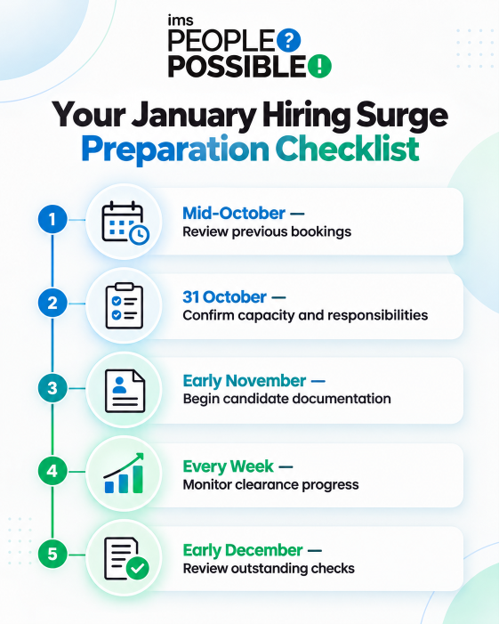
You can start planning for education hiring surges in mid-October with this simple workforce planning checklist:
- Mid-October: Look back at the bookings you missed last January and start reaching out to candidates who worked with you last year.
- By 31 October: Decide how you will handle the extra workload, and name one person to lead your compliance checks.
- Early November: Send out document requests and ask for candidate references early before the rush starts.
- Every week: Keep an eye on your numbers, and track how many days it takes for a candidate to go from registration to fully cleared.
- Early December: Chase down any missing papers or checks before schools close for the Christmas break.
How Can IMS People Possible Help You as Your Offshore Support Partner?
Now that you know where the hidden costs come from, the next step for you is to add offshore capacity without burning out your local recruiters.
This is where IMS People Possible UK can help you. With over 20 years of experience supporting UK staffing firms (especially education recruitment agencies), we provide a dedicated offshore team that works inside your ATS, on UK hours, and under your brand.
Our experts take on the time-consuming and repetitive work such as:
- Compliance management: chasing references, documents, and DBS checks
- Administration support: formatting CVs, updating records, and clearing backlogs
- Talent sourcing and database management: keeping candidate pipelines ready for term starts
Your consultants stay focused on schools, while we handle the paperwork.
Frequently Asked Questions
When do UK teachers give notice for January?
UK teachers give notice to resign in January no later than 31st October, as per the Burgundy Book rules to leave on 31st December. Academies can set separate dates, but January supply demand starts building in late October.
Does offshore compliance support GDPR compliance?
Yes, offshore compliance support is fully GDPR-compliant. But only when they work within a UK education recruitment agency’s ATS under a signed UK data processing agreement. They only view assigned files, and your UK team keeps the final compliance sign-off.
When should agencies start planning for education hiring surges?
Agencies should start planning for education hiring surges in mid-October. This window lets UK education recruitment agencies re-engage past candidates, chase references, and submit DBS checks before schools break up for the Christmas break.