Summarize and analyze this article with:
This blog was initially posted on February 26, 2024 and has been updated to be relevant to current market landscape.
Nobody can foresee the future, but a business can only withstand it when it is able to predict any shifts. A sudden surge in vacancies may lead to rushed permanent hiring; a slowdown may then leave teams with more fixed capacity than the business can sustain.
The answer: Strategic workforce planning
It involves forecasting workforce needs, mapping required skills, modelling capacity, and selecting the right mix of internal, flexible, and specialist support.
For staffing firms, recruitment leaders, HR teams, and operations functions, offshore recruitment support can form one part of that model. It can provide adjustable delivery capacity for selected recruitment activities, but it is not a guarantee against layoffs, nor a replacement for a strong core workforce.
Why reactive hiring and layoffs are costly
Reactive hiring-and-layoff cycles create disruption on both sides of the demand curve.
When recruitment volumes rise, internal teams may become stretched across job requisitions, sourcing, candidate engagement, compliance, administration, and client updates. This can affect time to submit, candidate response times, service-level performance, and overall client experience.
When demand falls, businesses often review fixed costs. If permanent capacity was expanded as a workaround for short-term or unpredictable workloads, leadership may face difficult restructuring decisions.
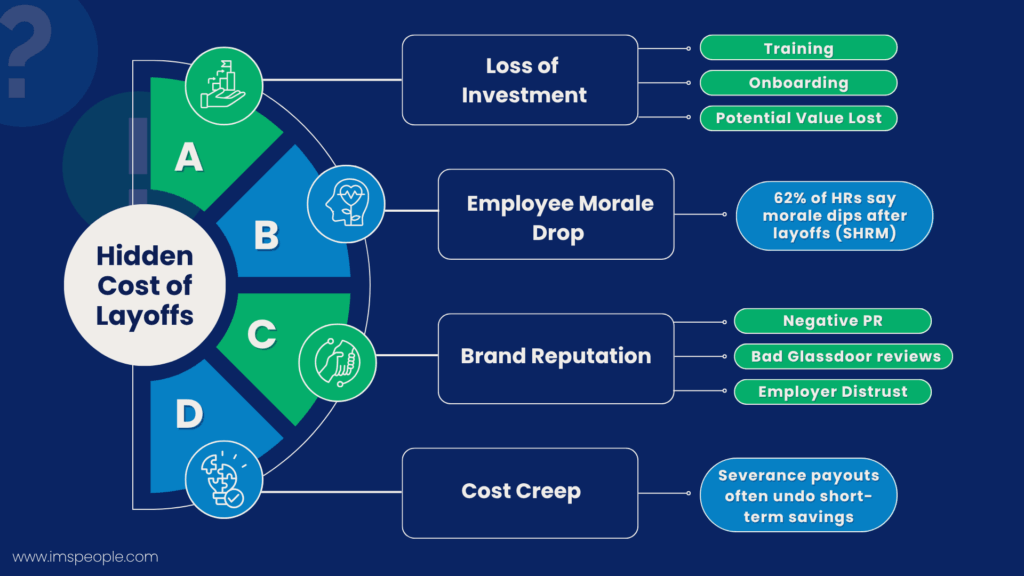
Although it may appear like a simple way to save money, layoffs can have hidden costs that a company bears in the long term. The consequences of this have more profound impacts on your company than are initially visible.
Some of the immediate affects you can observe are the impact on your brand image as disgruntled employees would spread negative information about your business. This can tarnish your reputation as an employer and affect future hiring.
Additionally, the cost saved from laying off an employee is quickly undone from the costs incurred as severance packages.
The interpretation is not that businesses should never hire internally. A stable Core team remains essential for leadership, client relationships, workforce strategy, hiring decisions, culture, and specialist knowledge.
But what determines which activities need permanent internal ownership and which can be supported through a more flexible delivery model?
That is where strategic workforce planning becomes valuable.
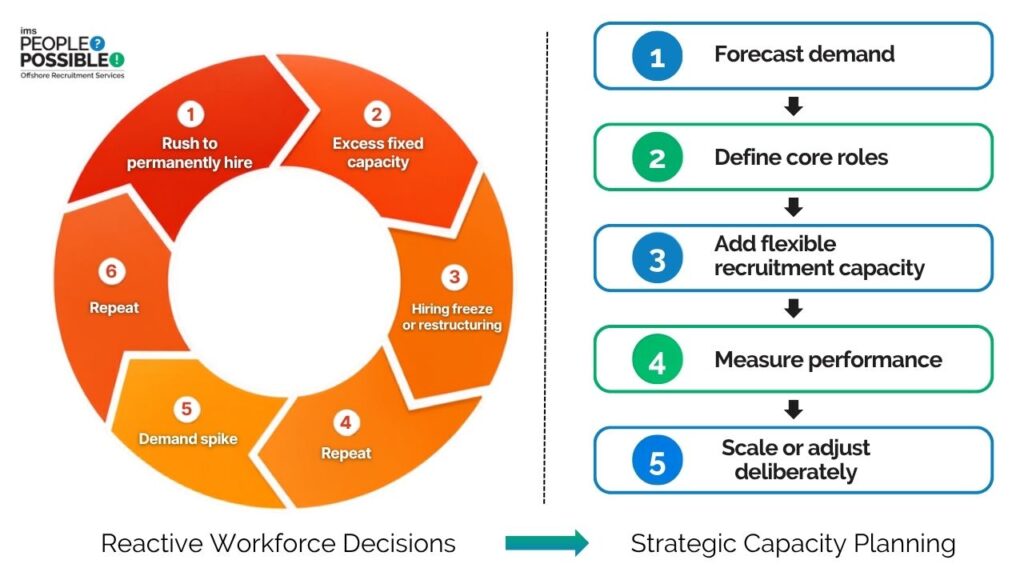
Strategic workforce planning helps recruitment leaders match capacity to demand before temporary peaks or slower periods force reactive decisions.
Can offshore recruitment reduce the need for reactive layoffs?
Offshore recruitment can provide adjustable recruitment-delivery capacity, but it cannot remove financial, operational, or restructuring-related layoff risk.
No workforce model can guarantee that an organization will never need to make difficult employment decisions. Demand may decline sharply, clients may change direction, budgets may be reduced, or business strategy may shift.
Why today’s workforce pressures require flexibility
Recruitment and staffing operations are managing several pressures at once:
AI investment and role redesign
AI is changing how many organizations approach work allocation. Some activities are easily automated, while other areas, such as talent advisory, candidate relationship management, stakeholder engagement, compliance oversight, and complex hiring decisions, continue to require skilled human involvement.
This creates a workforce-planning challenge. Leaders must decide which roles need to be retained, developed, or redesigned internally, and which repeatable activities can be supported through specialist capacity.
Cost pressure and organizational restructuring
Cost control is not limited to payroll. Recruitment teams also carry costs associated with technology, sourcing tools, advertising, onboarding, compliance, training, management, and replacement hiring.
When cost pressure increases, organizations need to protect service quality without automatically adding or removing permanent roles. A flexible workforce strategy helps leaders assess capacity more deliberately rather than relying only on broad hiring freezes or headcount reductions.
Hiring freezes alongside skills shortages
A hiring freeze does not always mean recruitment work disappears. Existing requisitions may still need coverage. Candidate pipelines must be maintained. Compliance, VMS activity, onboarding, and client communication may continue at the same pace.
At the same time, many businesses still struggle to access specialist talent. This creates a gap between what internal teams need to deliver and the permanent capacity they are able or willing to build.
A move toward flexible workforce models
Flexible workforce models help organizations align resources with demand. For recruitment functions, this may include a combination of in-house recruiters, recruitment process outsourcing, offshore recruitment support, technology, contingent labor, and specialist partners.
The aim is not to outsource every activity. It is to create an operating model that can maintain quality, job requisition coverage, and SLAs when hiring demand changes.
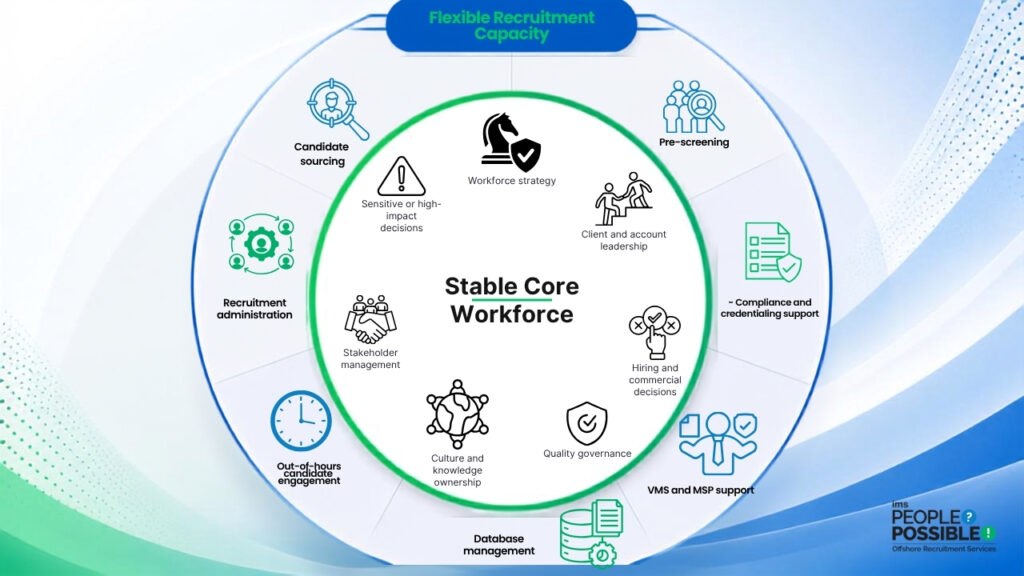
Offshore recruitment support works best as an adjustable delivery layer for defined, measurable work – not as a substitute for leadership, client ownership, or core workforce capability.
However, offshore recruitment support can reduce overreliance on permanent internal expansion for fluctuating work. This gives leaders more options when volumes change.
A practical model is to retain a stable internal core team while using offshore support for selected recruitment processes. The core team can continue to own strategy, client relationships, commercial decisions, quality governance, sensitive work, and account leadership. The offshore team can support defined activities that require capacity, specialist recruitment skills, or extended delivery hours.
This approach can help recruitment teams:
- Maintain job requisition coverage during high-volume periods
- Support agreed service levels without overloading internal recruiters
- Add sourcing, screening, administration, compliance, or VMS capability
- Create capacity for multiple desks, clients, or geographies
- Reduce pressure to hire permanent support staff for temporary workload increases
- Allow in-house teams to focus more time on client engagement, business development, and strategic hiring work
The key is governance. Offshore recruitment works best when responsibilities, handovers, systems access, quality standards, escalation routes, reporting, and SLAs are clearly defined.
How recruitment process outsourcing creates flexible capacity
Recruitment process outsourcing, or RPO, enables organizations to use an external recruitment partner to deliver part or all of their recruitment process. An offshore recruitment model can be structured as a dedicated team, a function-specific support unit, or a wider managed recruitment service.
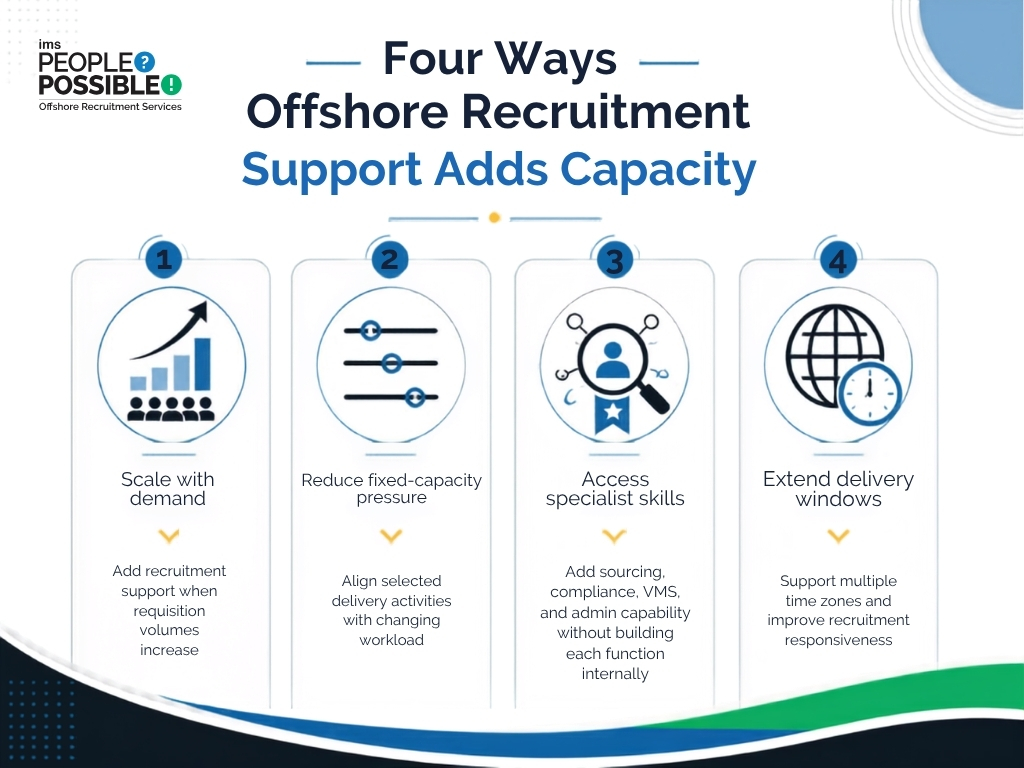
A recruitment process outsourcing model can help teams maintain delivery during changing workloads by providing scalable sourcing, administration, compliance, and extended-hours support.
Scale recruitment support as demand rises
When requisition volumes increase, internal recruitment teams can quickly become overloaded. Job coverage may slip, candidate follow-ups can slow down, and recruiters may have less time for client communication and quality engagement.
An offshore recruitment support team can add capacity across defined workflows, such as sourcing, pre-screening, job posting, database management, interview coordination, and compliance administration.
The purpose is not indiscriminate expansion. It is to create controlled capacity that aligns with active demand, account requirements, and documented service levels.
Reduce excess fixed recruitment capacity
When hiring volumes decrease, businesses may not require the same level of support across every recruitment activity. A flexible offshore model can help organisations review and adjust support capacity without assuming that each process requires permanent internal headcount.
This does not mean internal teams become less important. It means leaders can design a workforce model where fixed capacity is reserved for work that requires long-term ownership, while variable-volume work is supported through a flexible layer.
Access specialist recruitment skills
Recruitment support often involves more than sourcing candidates. Staffing firms may need dedicated support for VMS management, credentialing, compliance, market mapping, CRM management, consultant care, candidate engagement, data cleansing, or out-of-hours delivery.
Building every one of these skills internally may be costly and time-consuming. A recruitment outsourcing partner can provide specialist support where it is needed, provided the model includes appropriate training, process documentation, quality assurance, and client-specific knowledge transfer.
Support multiple time zones and delivery hours
For recruitment firms serving the US, UK, Europe, or APAC, candidate and client expectations do not always fit standard office hours. Delayed response times can affect candidate experience, interview scheduling, submission speed, and client confidence.
An offshore recruitment team can support extended delivery hours when workflows are clearly structured. This may include candidate response, sourcing, database work, VMS updates, compliance administration, and interview coordination outside the core team’s working day.
Recruitment Activities Suitable For Offshore Support
Suitability depends on process maturity, data-security requirements, systems access, client expectations, and the ability to define measurable outcomes.
The following activities are commonly suitable for an offshore recruitment delivery model:
- Candidate sourcing and talent mapping
- Candidate pre-screening and interview coordination
- Job posting, advert response, and CV formatting
- CRM or database cleansing, enrichment, and reactivation
- VMS and MSP notification management
- Recruitment administration and onboarding support
- Credentialing and compliance support
- Consultant care and out-of-hours support
- Lead generation and market mapping
- Full-cycle recruitment support for defined roles, desks, or accounts
Not every function should be offshored. Client leadership, complex stakeholder management, high-sensitivity decisions, and strategically important account ownership may require a stronger in-house presence.
The right approach is to separate core, high-value work from repeatable, capacity-intensive work and then determine the most appropriate delivery model for each.
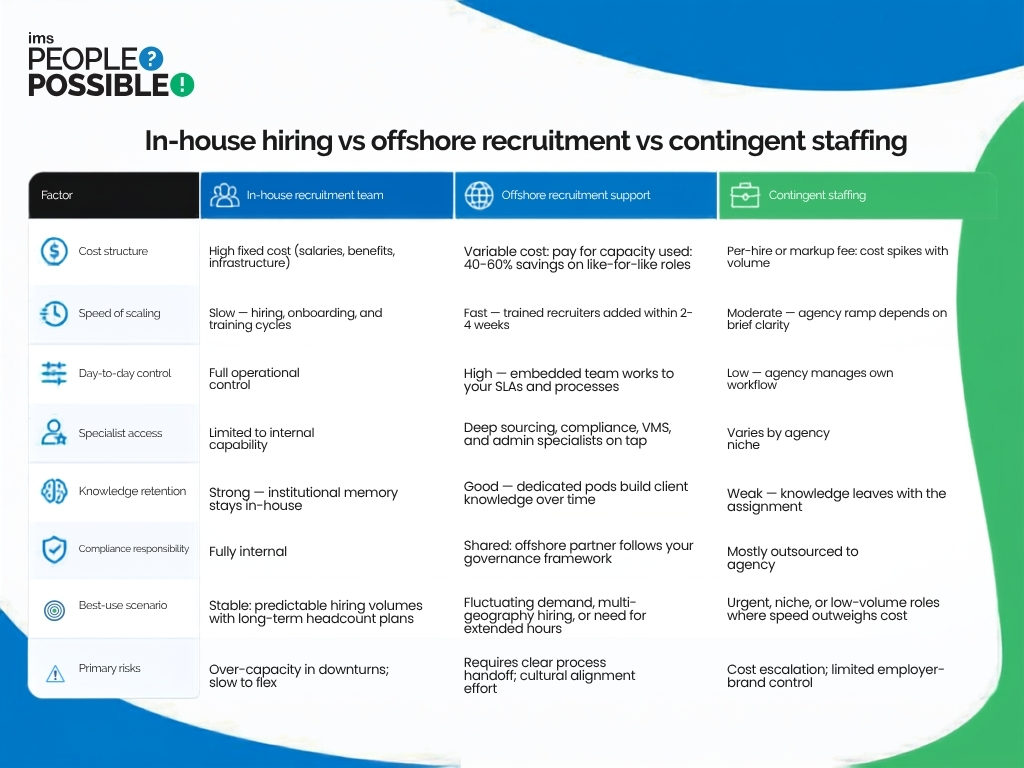
How to measure whether the model is working
A recruitment outsourcing model should be assessed through operational and quality measures, not cost alone.
Track metrics such as:
- Job requisition coverage rate
- SLA attainment
- Time to submit
- Time to fill
- Candidate response time
- Recruiter capacity and requisitions per recruiter
- Submission-to-interview ratio
- Interview-to-offer ratio
- Offer-to-start ratio
- Starts and placements
- Compliance completion rate
- Rework rate and quality errors
- Candidate and client feedback
- Internal recruiter time released for client strategy and revenue-generating work
The most useful metrics are the ones tied directly to the business problem the model was designed to solve. If the issue is unfilled requisitions, focus on coverage and submission speed. If the issue is client-service performance, prioritize SLA attainment, response times, and account outcomes.
IMS example: Requisition Coverage and SLA Performance
A well-governed offshore recruitment model can be especially valuable when staffing firms need to recover stalled accounts, manage complex VMS processes, and restore client confidence.
For one of the clients, IMS deployed specialized recruiter teams across multiple accounts and delivered 92 starts within 12 months, including 35 starts for a premium manufacturing account and 57 starts for a large-scale BPO hiring project, while maintaining 100% SLA compliance.
In another engagement, IMS supported a client with 44 dedicated recruitment professionals, helping generate 3,000+ starts, improve service performance from Tier 3 to Tier 1 status, and achieve a 1:1 offer-to-start ratio across key accounts.
These outcomes demonstrate how a structured offshore recruitment model can enhance delivery capacity, strengthen client service levels, and support long-term workforce planning objectives.
How IMS People Possible Assists You in Strategic Workforce Planning
Flexible Capacity for Demand Fluctuations
Scale recruitment support in line with changing hiring volumes.
Access to Specialized Recruitment Expertise
Gain access to recruiters, sourcers, VMS specialists, and compliance professionals.
Improved Requisition Coverage and SLA Performance
Maintain hiring momentum while consistently meeting client expectations.
Enhanced Recruiter Productivity
Enable internal teams to focus on strategic and revenue-generating activities.
Multi-Time Zone Recruitment Support
Extend recruitment coverage across global markets and business hours.
Scalable and Cost-Conscious Workforce Models
Build a more agile workforce strategy without overcommitting fixed headcount.
Conclusion
When implemented with clear workflows, accountable SLAs, quality controls, and measurable outcomes, offshore recruitment can help teams maintain requisition coverage, extend delivery capacity, and respond more confidently to changing hiring demand.
Need more recruitment capacity without expanding fixed internal headcount too quickly? Request an offshore recruitment capacity assessment from IMS People Possible.