Summarize and analyze this article with:
If you run a UK engineering recruitment agency, you know the feeling when your consultant walks over to you and says, “we have mapped and searched the whole market, and the candidates our client wants just do not exist.”
Well, sometimes they may be right. But an engineering role can be difficult to fill for several reasons like:
- There may genuinely be too few qualified people in the market.
- The brief may be too narrow.
- Your team may be searching for the right skills on the wrong platform.
- Or your recruiters may simply not have enough time to search the market at the depth of the roles needed.
But there is another side to the coin as well. As per the Engineering UK report, there are 6.3 million people who work in engineering and technology roles.
So, if the engineers’ number is in millions, then why is my team unable to fill the roles? Is there a problem with my team capability, capacity or time? (you may have this question)
And the answer lies in using AI technology in engineering recruitment with expert level offshore recruitment delivery support services, so your team faces no talent shortages in future.
This blog will walk you through:
- Is it really an engineering talent shortage?
- Four types of scarcity that can slow your engineering desk
- How is AI changing UK engineering recruitment agencies?
- Where does human judgement still matter?
- What is AI’s impact on entry-level engineering recruitment?
- Where should your engineering recruiters spend their time?
- What should UK engineering recruitment agencies take from this?
Let’s start with an engineering talent shortage.
Is It Really an Engineering Talent Shortage?
Not really, but the answer is both: Yes and No.
When around 6.3 million people (as mentioned above) work across engineering and technology domains in the UK, then saying there are simply “not enough engineers” does not tell the full story.
The real challenge is usually more specific.
For example, imagine your client needs an engineer with skills like:
- Siemens TIA Portal and PLC programming experience
- Recent pharmaceutical or life sciences exposure
- GMP or highly regulated manufacturing experience
- Commissioning experience
- Availability to work onsite within a specific location
Engineers may exist in the market, but candidates who meet all the above requirements at the same time could be much harder for your recruitment team to find.
So, that distinction does matter to most of the engineering recruitment agencies and engineering staffing firms like yours. The issue is not always about engineering talent shortages but a shortage of very specific combinations of skills.
And before you ask your recruiters to search harder for engineers, check every part of the candidate brief is really essential or whether some requirements are making candidate pool too small for your team.
You may also like to read: Engineering Recruitment in the UK: Challenges, Trends and Opportunities
Four Types of Challenges That Can Slow Your Engineering Desk
Now that you know the reality of engineering talent shortage, let us look at the four types of scarcity that may be slowing down your recruiter’s desk.
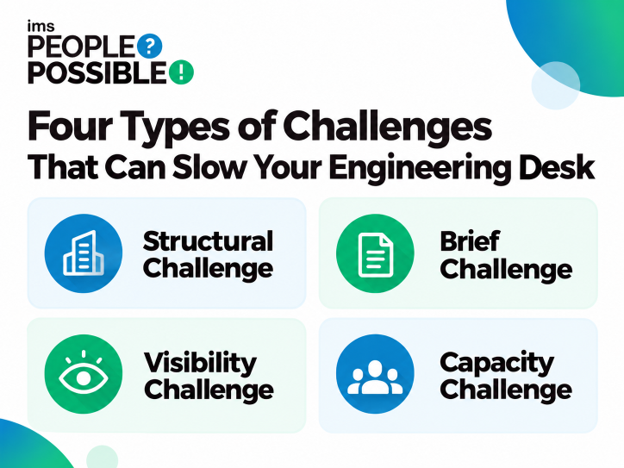
Challenge 1: Structural Challenge
Sometimes, your recruiters are right as there are really too few suitable candidates in the open market.
This usually happens when your client needs a combination of technical skills, sector experience, location or certification.
What should you check?
You should look closely at local market demand, salary levels, commuting limits and competition from other sectors.
Challenge 2: Brief Challenge
More often than not, the talent does exist but your client specification makes the market look artificially empty.
This happens when a hiring manager hands over a ten-point wish list and treats every single preference as a non-negotiable requirement. This makes your team end up turning away perfectly capable candidates who could easily hit the ground running.
What should you check?
You should sit down with your client and separate true operational must-have from nice to have preferences. Ask him if adjacent industry experience or transferable design tools could work just as well.
Challenge 3: Visibility Challenge
Your team may be searching hard for the engineering candidates, but they are only seeing a small slice of the active market.
This often happens when your recruiters rely only on LinkedIn recruiters, standard job board alerts or older search methods.
What should you check?
Review your search strings, look at adjacent job titles, clean up dormant records in your CRM and map out where your competitor engineering teams are currently deployed.
Challenge 4: Capacity Challenge
Here the problem is not about candidate availability at all. It’s about the time that your fee earners may simply not have to search deeply as they might be spending 15 hours a week reformatting CVs, updating CRM fields and chasing move on to put the next fire.
What should you check?
Audit how and where your fee earners spend their week. Know how much uninterrupted time your recruiters actually have to pick up the phone and source.
Once you know which challenge is slowing down your desk, it becomes much easier to see where using AI technology in engineering recruitment can help.
Once you know which challenge is slowing down your fee earners desk down, it becomes much easier to see where using AI technology in engineering recruitment can help you and where you simply need a better operational process.
How AI Is Changing UK Engineering Recruitment Agencies
Once you know what is slowing down your engineering desk, the next question is to know where AI can help your recruiters in recruiting engineers in the UK.
AI is not here to replace your recruiters. But AI alone too is not capable enough to recruit engineers for you. It’s a combination of AI + People (mostly offshore recruitment support providers) that helps you work with more information without letting your recruiters spend every hour gathering it manually.
And this is how AI is changing UK engineering recruitment agencies in the real world.
For engineering staffing agencies and engineering staffing firms, AI can support the below mentioned three areas especially well:
- Search expansion: Find related job titles, skills and experience that a standard search may miss.
- CRM rediscovery: Revisit candidates already known to your agency but missed in earlier searches.
- Market mapping: Build a clearer picture of where relevant engineering talent sits.
For example, if your recruiter keeps seeing the same candidates for a specialist engineering role, AI-assisted search can help your team uncover related job titles, transferable skills or people already in your CRM.
AI + offshore recruitment support can also support your routine tasks such as database management, scheduling and information processing, giving your recruiters more time for candidate qualification and client conversations.
And this is how AI is changing UK engineering recruitment agencies but not alone. It is changing with the combination of AI + People = makes the change possible.
Which further kills the generic question of: “Are you using AI?” And raises another question: “Are we using it with the human brain to understand the market better and help our recruiters make better decisions?”
Can the Client Brief Create an Artificial Shortage?
To be honest, yes, it can.
Because if your client gives you a very specific brief, the candidate pool can become too small before your recruiters even start searching.
And once that happens, even your best candidate’s sourcing strategy may not work to fix it.
This is where the old saying “Measure twice, cut once” fits well.
Before your recruiters spend hours searching hard, make them ask your client whether every requirement he mentioned in the brief is really essential.
For example, if your client asks you for:
- 10 years of engineering experience
- Knowledge of one specific software platform
- Previous aerospace exposure
- Full-time onsite availability
On the other hand, you recruiters find candidates with 8 years of experience with strong CAD and quality knowledge which makes the candidate capable of doing the job. But if every point on the brief is treated non–negotiable, your recruiters may never reach the shortlist.
This is where skill-based hiring becomes more useful. Guide your clients to focus on core capabilities, problem-solving, and practical project delivery rather than exact job titles or software badges.
The same approach can help your team get far more from using AI technology in engineering recruitment.
When you challenge the brief early, you widen your talent pool, save your recruiters hours of wasted effort, and keep your placements moving.
Where Does Human Judgement Still Matter?
Human judgement still matters when you need to understand what a candidate has actually done and not just what is written on the CV.
AI can help you find profiles, but your recruiters still need to judge experience, responsibility and suitability for the role.
For example, there are two engineers who list PLC programming as their expertise. But one may have only supported small changes, while the other has designed and commissioned complete systems. That difference needs human judgement.
What Is AI’s Impact on Entry-Level Engineering Recruitment?
AI’s impact on entry-level engineering recruitment needs careful thought because graduate junior candidates naturally have less work in particular care because junior candidates naturally have less professional evidence on their CVs.
The impact of AI on entry-level engineering recruitment is that it can help your recruitment team screen applications faster, but it may also overlook good candidates who have less work experience.
For example, a graduate engineer may not have five years of project history, but they could still show strong potential through placements, university projects and technical coursework. And that is why human reviews still matter.
More Applications Do Not Mean More Engineering Talent
It is true because AI now helps candidates write and tailor CVs much faster. That can increase application volumes, but it does not automatically increase the number of suitable engineers in your pipeline.
For example, your recruiters may receive 120 applications for a specialist role instead of 40. While searching them online, many candidates with CV may look stronger on paper because candidates possibly may have used AI to improve their CVs.
Hence, it is said that more applications do not mean more qualified engineers.
And this is where using AI technology in engineering recruitment should help you prioritise and organise applications, while your recruiters focus on the decisions that need experience and context.
Where Should Your Engineering Recruiters Spend Their Time?
Your engineering recruiters should spend their time on work that matters most, that needs judgement, building relationships and commercial experience.
That means your engineering recruiters should focus on client conversations, candidate qualification, technical screening, offers and relationship building rather than routine admin.
For example, if your engineering recruiter (fee earners) spends hours updating the CRM, doing admin work or arranging the interviews then they will not have enough time left to speak to clients and move strong candidates through the process.
This is why you should protect your engineering recruiters from time to unlock their productivity and help them do what matter most.
Is Talent Scarcity Really the Constraint on Your Desk?
If your recruitment team spends too much time on sourcing, mapping or handling routing admin tasks, then that problem may not be a lack of recruiter capability but a delivery capacity.
This is where additional recruitment delivery support can give your local recruitment team more time for candidate qualification, client conversations and placements.
Is Your Delivery Capacity Holding Back Your Desk?
Give your billers more room to speak with qualified engineers and close high-margin assignments.
Where Can IMS Help Your Engineering Recruitment Team?
IMS can help your engineering recruitment team from managing one admin task to 180-degree recruitment support to 360-degree recruitment support.
But this is feasible and helpful when your recruiters understand their market but lack enough time to map, source, screen and maintain pipelines consistently.
IMS people possible can provide engineering recruitment support around your existing team through:
- Candidate sourcing: Structured searches and market mapping.
- Screening support: Initial qualification and pipeline management.
- CRM management: Database cleansing and candidate rediscovery.
- Recruitment administration: Scheduling and operational tasks.
- Compliance support: Candidate checks and process administration where required.
With this model that IMS supports, your agency keeps full control of the client and candidate relationship while the additional capacity supports the work behind it.
Give Your Engineering Recruiters More Room to Recruit
What Engineering Recruitment Agencies Should Take from This?
Engineering recruitment agencies should take one important lesson from this: “not every hard to fill role cause by a lack of talent”.
Sometimes the real problem for your billers is they get a narrow brief, limited market visibility or not enough recruiter time.
That is where “using AI technology in engineering recruitment” can help you search more widely, organise information faster and make better use of your existing candidate data. But the best results still come when AI supports experienced recruiters rather than replace them.
The real key is to identify the real challenge first, then use the right mix of AI, recruiter judgement and delivery support to solve it.
The agencies that benefit most will not necessarily be those using the most AI. They will be the ones that understand exactly where technology helps and where people still need to lead.
Frequently Asked Questions
How is AI changing UK engineering recruitment agencies?
AI is changing UK engineering recruitment agencies by helping recruiters search wider, finding candidates already in their CRM, map skills and reducing repetitive work. This gives your team better market visibility and more time for qualification, candidate conversations and client relationships.
Can AI solve an engineering talent shortage?
No, AI alone cannot solve an engineering talent shortage. It cannot create skills that are genuinely missing from the market, but it can help you find related skills, search a wider talent pool and use your existing candidate’s data more effectively. AI + People formula can definitely help you solve an engineering talent shortage.
How can engineering staffing agencies use AI effectively?
Engineering staffing agencies can use AI effectively for market mapping, CRM searches, search expansion and routine data work. The best approach is to use AI for repeatable tasks while your recruiters focus on client briefs, technical qualification and candidate relationships.
What should UK recruitment agencies consider when recruiting AI and machine learning engineers?
UK recruitment agencies should consider what candidates have actually built, deployed or maintained, not just the keywords on their CVs. When recruiting AI and machine learning engineers, you should also look at project scale, technical depth and how independently the candidate worked.
What are the risks of AI candidate screening?
The risks of AI candidate screening include missing good candidates because of exact keyword matching or unusual career paths. Human review is still important when you need to assess transferable skills, technical experience, motivation and entry-level potential.