Summarize and analyze this article with:
The AI demonstration you just undertook looks convincing. A recruiter enters a job requirement, and a ranked shortlist appears within seconds.
The real test begins when your firm connects its own database.
One candidate appears three times. Another is recommended for an on-site role despite having moved. A strong match is missing because their skills sit in an old resume attachment rather than a searchable field. Someone marked “available immediately” started an assignment months ago.
The tool is faster. The recruiter still has to untangle the information.
As agencies plan their 2027 technology investments, AI readiness for staffing agencies should begin with a less glamorous question:
Can the business trust its candidate records?
Buying software is one decision. Making the underlying information current, consistent, and usable is an operating discipline.
Why Recruitment Data Quality Shapes AI Results
AI-powered sourcing, matching, screening, and engagement use different techniques, but their usefulness depends partly on the information they can access and interpret.
IMS People Possible’s guide to AI in recruitment describes applications ranging from resume parsing and candidate search to screening and workflow support.
Poor candidate data can undermine those workflows in different ways:
- Duplicate records can produce repeated recommendations and conflicting outreach.
- Missing skills or experience fields can hide relevant candidates.
- Outdated availability can make a shortlist look more actionable than it is.
- Inconsistent titles can separate candidates with comparable experience.
- Disconnected communication records can trigger inappropriate follow-ups.
Some tools can interpret synonyms or identify possible duplicates. That does not make uncertain information verified.
Nor does clean data guarantee fair or accurate AI. Model design, selection criteria, integration, and human oversight still matter.
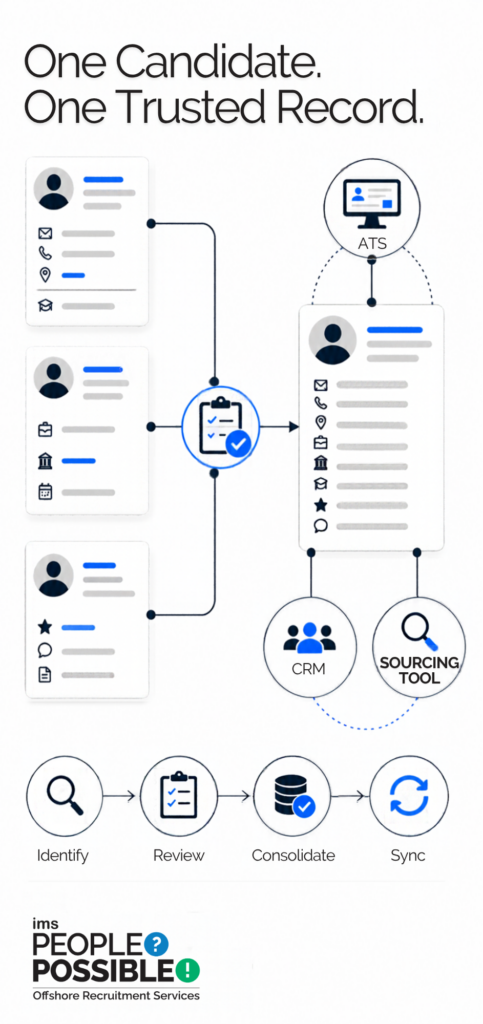
1. Establish One Authoritative Candidate Record
Before candidate database cleanup begins, decide which system owns the record.
A single source of truth does not require every activity to happen inside one platform. It requires clear authority across the applicant tracking system (ATS), customer relationship management system (CRM), sourcing tools, and engagement platforms.
Document:
- The master candidate ID and authoritative system.
- Which system owns each shared field.
- Where recruiters enter updates.
- How integrations handle conflicting changes.
- How corrections, opt-outs, and deletion requests propagate.
Otherwise, a corrected location in the ATS may be overwritten by an older CRM value.
Need database management
guidance?
Assign an operations owner for standards and a technical owner for integrations. Recruiters also need to know where and how to record changes.
2. Deduplicate Without Losing Candidate History
ATS deduplication should use multiple identifiers, not exact names alone.
Compare normalized email addresses, phone numbers, LinkedIn URLs, and name variants. We recommend choosing a primary record based on recent activity and completeness, while routing uncertain matches to an exception queue.
Treat those signals as evidence and not as automatic proof. Shared names, changed contact details, and recycled phone numbers can create false matches.
Before merging, reconcile assignment history, submissions, communication preferences, notes, and opt-outs. Preserve an audit trail and a recovery route where the platform supports one.
Then address the cause. Review import rules, integrations, and recruiter record-creation habits so duplicates do not immediately return.
3. Define a Minimum Viable Candidate Record
“Complete” should mean sufficient for a defined recruitment workflow and not collecting everything possible.
Use a practical minimum dataset:
| Field group | Useful information |
| Identity and contact | Candidate ID, name, validated contact details, permitted contact channels |
| Location | City/state, time zone, commute or relocation preferences |
| Professional profile | Original title, standardized role family, seniority, core skills |
| Work preferences | Contract/permanent, remote/hybrid/on-site, shift preferences where relevant |
| Availability | Status, expected availability date, last confirmation date |
| Evidence and governance | Resume source/date, last meaningful contact, field provenance, owner |
Capture work-authorization or credential information only where appropriate to the role, stage, and policy, with suitable access controls.
Distinguish “unknown,” “not applicable,” and “not yet verified.” A populated field is not necessarily accurate. Do not convert an AI inference about a skill, location, or availability into a confirmed fact without validation.
4. Standardize Meaning Without Flattening Differences
A skills taxonomy for recruitment provides controlled terms and relationships that make records more consistent.
Map genuine synonyms such as “JS” and “JavaScript” to a canonical skill. Preserve original job titles while adding standardized role families. Keep related, but distinct skills separate: Java is not JavaScript.
Standardize locations, time zones, seniority, work arrangements, and availability using controlled fields rather than unrestricted notes.
Retain nuance. “Remote preferred” differs from “remote only.” A candidate willing to relocate should not be treated as permanently restricted to their current city.
Review skills families and synonym mappings against live demand, rather than allowing uncontrolled tags to accumulate.
For candidate data enrichment, record where information came from and when it was checked. Resume formatting should improve structure without rewriting experience or manufacturing missing qualifications.
5. Measure Readiness Before Expanding Automation
Database size is not an AI-readiness KPI.
Create a dashboard for the candidate segment entering the pilot, with explicit denominators:
| KPI | Suggested definition |
| Required-field completeness | Eligible records meeting the agreed minimum dataset ÷ records assessed |
| Confirmed duplicate incidence | Confirmed duplicate records ÷ records audited |
| Freshness | Records revalidated within the field-specific window ÷ relevant records |
| Contact validity | Records with a recently validated usable channel ÷ records checked |
| Taxonomy conformity | Applicable values mapped to approved terms ÷ values assessed |
| Synchronization exceptions | Conflicting or failed updates awaiting resolution, including age |
| Match quality | Recruiter-accepted recommendations plus review of missed suitable candidates |
There is no universal percentage that makes an agency AI-ready. Establish a baseline, set use-case-specific acceptance criteria, and sample underlying accuracy—not just field completion.
Test whether known suitable candidates are retrieved, not merely whether top-ranked recommendations look plausible.
Start with one desk or redeployment community. Broader rollout should follow evidence of useful results and manageable exceptions.
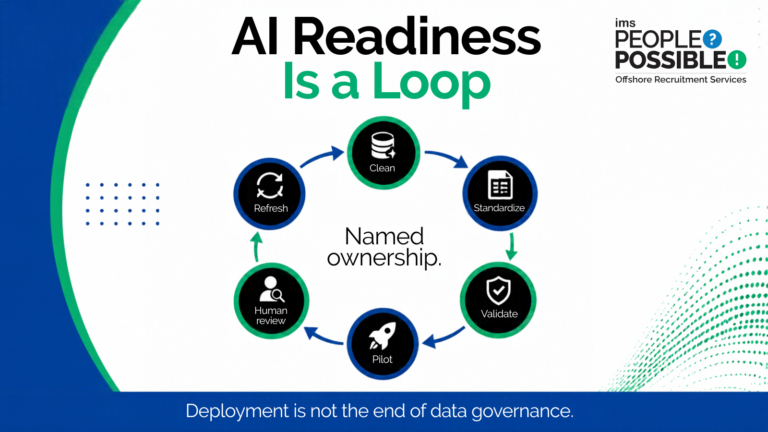
6. Keep Human Review and Governance After Launch
Data cleanup is not a substitute for responsible AI controls.
The UK Information Commissioner’s Office issued 296 recommendations and 42 advisory notes following consensual audits of recruitment AI providers. Its findings addressed accuracy, fairness, transparency, and excessive personal-data collection. While this is UK regulatory evidence and not a US legal standard, it provides useful vendor-evaluation questions
Ask vendors what data their tools access, whether it trains models, how corrections propagate, and how recommendations can be challenged.
For US agencies, the EEOC states that federal employment-discrimination protections apply when AI is used. Its guidance also warns that tools can screen out qualified people with disabilities and highlights accommodation processes.
Recruiters should review uncertain matches, unsupported inferences, and consequential recommendations. Reviewers need authority to disagree, correct records, and escalate issues—not simply approve an output.
Make Database Quality Part of Everyday Recruitment
A cleanup project will not last if updates remain in inboxes.
Build availability confirmation, preference changes, and structured screening notes into normal recruiter workflows. Use reminders for stale records and exception queues for uncertain changes. Avoid mandatory fields that encourage placeholder answers simply to save a profile.
For the 2027 planning cycle, select one use case, audit its data, assign owners, and pilot before scaling. This follows IMS People Possible’s AI Execution Roadmap: choose a defined workflow, establish governance and measures, then expand through operational adoption.[
Build Your AI Foundation With IMS People Possible
IMS People Possible can help staffing firms address the operational work behind AI readiness: reviewing and maintaining candidate databases, resolving duplicates, enriching approved fields, and standardizing searchable records within agreed workflows. Its database-management guidance emphasizes ongoing governance, recruiter adoption, and practical maintenance—not a one-time cleanup.
Start with the candidate segment your next AI workflow will use. Agree on the master record, minimum fields, review rules, and quality measures. Dedicated offshore recruitment professionals can support maintenance while your internal leaders retain data-policy and decision ownership.
Connect with IMS People Possible to scope recruitment database support around your 2027 priorities, so AI works with information your recruiters can understand, verify, and trust.