


Summarize and analyze this article with:
Candidate sourcing in 2026 looks very different from a couple of years ago. Recruiters are dealing with talent shortages and increasing pressure to fill roles faster without compromising on quality.
In fact, 69% of U.S. employers are struggling to find qualified talent, with larger companies facing the biggest hit. And now, with AI in the picture, candidate fraud has become a key concern among staffing and recruiting professionals when sourcing candidates.
The good news? The right sourcing strategies can still help you stay ahead and build high-quality candidate pipelines even in a changing market.
Let’s dive in.
Top 11 Candidate Sourcing Strategies in Recruitment
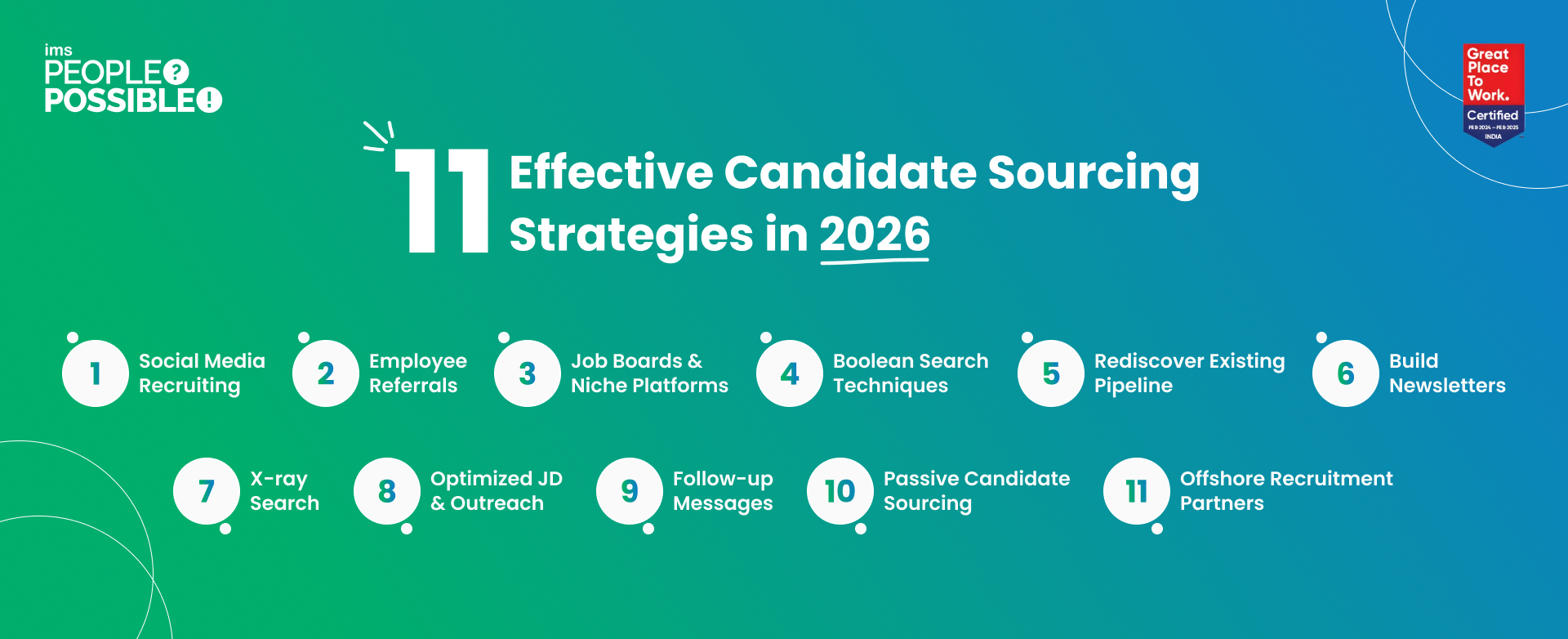
Here are 11 candidate sourcing strategies that work in 2026 and will help you source the best talent even during slow-moving markets or sudden demand surges:
1. Use Social Media Recruiting
With over 4.7 billion active users on LinkedIn, Meta, and X (formerly Twitter), social media can be a gamechanger for identifying talent beyond job boards.
Social media recruiting offers multiple methods to source candidates, including:
- Job Posts: You can post job openings across multiple social platforms for free, or promote them to reach more candidates.
- Employer branding: Use your company page to highlight your employer brand, build thought leadership through your leaders’ profiles, and share updates that give candidates a real feel of your company culture. When done right, this in turn helps you attract stronger talent organically.
- Active engagement: Posting consistently keeps your brand visible and your audience engaged, so when candidates are ready to make a move, you’re already on their mind.
- Networking: Leverage direct messages on Meta or LinkedIn features like InMail and connection requests to go beyond job posts and build genuine relationships with candidates directly.
For instance, LinkedIn alone has over 1.3 billion users, giving you access to both active job seekers and passive candidates through in-built outreach tools, job postings, and direct connection requests.
You can also filter the candidates by skills, experience, location, and industry to find the best fit. In fact, 72% of recruiters regularly use LinkedIn to source candidates, and 67% say LinkedIn hires are of higher quality.
2. Use Employee Referrals as a Recruitment Sourcing Strategy
This candidate sourcing method taps into your current employees’ networks to surface candidates who may not be actively job hunting but are already a strong fit. What makes referrals so effective is the in-built pre-vetting by a member of your organization.
The numbers back this up — around 71% of U.S. employers have established a referral program, with 4 out of 14 referred candidates getting hired. They also stay 70% longer and are more likely to be high performers.
3. Post on Job Boards and Niche Platforms
If you’re looking to reach targeted job seekers, job boards and niche platforms can be a powerful sourcing channel. While general job boards like Indeed, Monster, and Google for Jobs give you a broader reach, niche platforms let you dive deeper.
For example, you can use sites like Dice for tech talent, Behance for creatives, or Wellfound for startup professionals to attract highly specialized candidates. This makes niche platforms especially valuable when you’re hiring for hard-to-fill or highly technical roles.
4. Try Different Boolean Search Techniques
With talent shortages a major pain point for staffing companies in 2026, creative Boolean searches can give recruiters a precision edge in massive candidate pools.
Here are some unique Boolean search techniques to try:
| Boolean Search Type | Example |
|---|---|
| AND & OR Combination | String like("data engineer" OR "data architect") AND ("Snowflake" OR "BigQuery") AND "pipeline" targets candidates across two valid titles with experience in either modern data warehouse, without pulling in everyone who simply listed “data” on their profile. |
| Stacked Exclusions | String like("product manager") AND (SaaS OR B2B) NOT ("junior" OR "associate" OR "intern" OR "contract") filters out every seniority mismatch at once. |
| Wildcard Searches | String likedevelop* returns “developer,” “development,” and “developing” in a single query. It’s especially useful when titles aren’t standardized. |
5. Rediscover Your Existing Candidate Database
Recent studies show 46% of sourced hires now come from rediscovered candidates already present in a company’s CRM or ATS. That means your best next hire might already be in your database, waiting to be re-engaged.
As a best practice, tag candidates directly in your ATS using labels like “future consideration,” or organize them by job title, location, skill set, or any other criteria relevant to roles you anticipate hiring in the future.
6. Build Newsletters to Keep Candidates “Warm”
Most recruiters go silent between the moment a candidate doesn’t get an offer and the next time a relevant role opens.
Newsletters and nurture campaigns fix that gap by keeping your brand and your opportunities top of the candidate’s mind. So, when they are ready to make a move, they already know where to apply.
7. Use X-ray Search as a Sourcing Technique
This sourcing method uses advanced search techniques to source hidden documents within specific websites on search engines like Google and Bing.
For instance, a search string like site:linkedin.com/in/ “software engineer” Python runs directly through Google and scans only LinkedIn profiles mentioning Python. You can use the same site: command at GitHub, university pages, or personal portfolio sites. You can also use filetype:pdf resume “job title” term to pull uploaded PDFs that mention those terms.
8. Optimize Job Descriptions & Outreach Messages
Vague job descriptions loaded with buzzwords and a laundry list of requirements repel strong candidates, particularly passive ones. Lead with what the role does, include salary range (As of 2026, pay transparency is now required in several U.S. states, including California, New York, and Colorado), and trim requirements to what’s genuinely necessary.
For outreach messages, it’s important to create relevance for the candidate to improve the open and response rate. Here are four outreach tactics to improve the response rate:
- Write short InMail (ideally 50-70 words)
- Highlight the job skills that match the candidate’s expertise or interest in the very subject line
- Sell the problem they’d be solving and not the company at the very beginning
- Add a CTA that lets them take the next steps with minimal friction
9. Send Follow-Up Emails & Messages
Whether it’s re-engaging a candidate who went quiet, checking back in after an interview, or circling back with someone who said “not right now” three months ago — a well-timed follow-up is what separates full talent pipelines from empty ones.
Consider sending a 3-4 step outreach sequence, spread over two to three weeks across different outreach channels (e.g., email, LinkedIn, and SMS) to get a higher response rate.
10. Don’t Miss the Passive Candidate Sourcing Method
As per a LinkedIn study, about 70% of the global workforce is passive talent and not actively applying for jobs. That means if your entire sourcing strategy is built around inbound applicants, you’re only tapping into 30% of the potential.
Use the above methods, like employer branding, newsletters, and sending outreach messages, to connect and engage with passive candidates.
11. Partner with Offshore Recruitment Service Providers
If you’re scaling your services or hiring demand is high, offshore recruitment agencies can give you a flexible way to keep pipelines moving without burning out your onshore teams or investing in infrastructure.
While cost factor is a major benefit of outsourcing candidate sourcing to offshore recruitment partners, other major advantages include:
- Flexible way to scale up during sudden demand spikes and seasonal hiring trends
- Instant access to dedicated recruiters without the infrastructure setup
- 24/7 pipeline building by leveraging employees from different time zones
To know what kinds of results you can achieve with offshore recruitment services, check out our case studies.
Candidate Sourcing: Here’s How IMS People Possible Can Help
Candidate sourcing in 2026 is no longer about simply posting jobs and waiting for applications to come in. Use the above strategies to optimize your current recruitment sourcing strategy and fill roles faster.
However, building and running that system at scale takes capacity — and that’s where most recruiting teams hit a wall. That’s where offshore recruitment partners like IMS People Possible can come in as an extension of your team, handling the sourcing heavy lifting 24/7 while your onshore recruiters focus on moving those placements forward.
Whether you’re navigating a hiring surge, trying to maintain a pipeline during a slow market, or simply looking to scale, contact our team of experts to learn how offshoring can help you drive growth.
FAQs:
1. What is candidate sourcing?
Candidate sourcing is the process of identifying and engaging with talent to build a talent pool for a current or future job opening. This includes posting job posts to receive qualified candidates as well as proactively reaching out to passive candidates during the early phase of the talent acquisition process.
2. How is sourcing strategy different from recruitment strategy?
Candidate sourcing strategy focuses on how you build the qualified candidate pipeline as part of the hiring strategy. Recruitment strategies, on the other hand, involve how the entire talent acquisition funnel works till a hire is made.
3. How do you source passive candidates effectively?
Since passive candidates aren’t active on job boards and may not apply directly, you need to reach them through employer branding, social media recruiting, and personalized outreach.
4. How can you improve your candidate response rate?
LinkedIn’s data shows that 50 to 70-word InMail get the highest response rates, and personalization is the single biggest driver of replies. Beyond message length, timing, follow-ups, and channel mix affect response rates for recruiters.
5. How do offshore recruitment partners help with candidate sourcing?
Offshore recruitment partners give U.S. staffing firms a scalable way to expand recruitment sourcing capacity without adding full-time headcount. In addition to cost savings, coverage is another significant benefit: offshore teams operating in different time zones keep pipelines moving around the clock, which is especially valuable during high-volume hiring seasons.