Summarize and analyze this article with:
The client calls about a new data center project. At first, it sounds like an IT staffing opportunity: servers, networking, infrastructure support.
Then the requirements arrive.
Electrical supervisors. Mechanical technicians. Commissioning engineers. Controls specialists. Construction managers. Later, the client will need facilities operators and hardware technicians to keep the site running.
Your agency recognizes several job titles. But recruiting for this account means understanding how those roles fit together—and when each becomes critical.
For US staffing firms, the data center boom creates opportunities across engineering, skilled trades, construction, and IT. Capturing that demand requires more than adding “data center experience” to a search string. It requires a recruiting strategy built around project phases, transferable skills, geographic realities, and deployment readiness.
Understand the Opportunity Without Confusing Capacity With Jobs
The expansion is substantial. CBRE reports that supply across its eight primary North American data center markets reached 10,903 megawatts in the first half of 2026, up 33.7% year over year. Capacity under construction reached 7,481.1 megawatts. The markets tracked are US hubs, including Northern Virginia, Atlanta, Dallas–Fort Worth, and Phoenix.
These figures measure data center capacity—not employment or staffing requisitions. They indicate development activity, but they cannot be converted into a universal number of jobs.
The workforce challenge is clearer in operator research. Uptime Institute’s 2025 global survey found that 46% of operators had difficulty finding qualified candidates, while 37% struggled to retain staff. These are global findings, not US-only statistics.
For staffing firms, the opportunity is not simply “more hiring.” It is helping clients secure the right capabilities at the right stage of development and operation.
- Recruit Around the Project Lifecycle
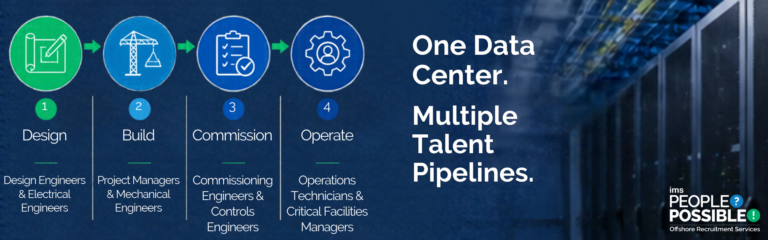
A data center is not one staffing market. Separate construction, commissioning, facilities operations, and IT infrastructure before building candidate pipelines.
Use the following as an intake framework, then validate responsibilities with each client:
| Project stage | Illustrative role families | What recruiters should clarify |
| Design and planning | Electrical, mechanical, and controls engineers; project managers | Design scope, systems experience, licensing requirements |
| Construction and installation | Electricians, HVAC technicians, supervisors, structured-cabling teams | Site requirements, trade qualifications, schedule, travel |
| Commissioning and handover | Commissioning engineers, test technicians, controls specialists | Testing responsibilities, documentation, client acceptance criteria |
| Ongoing operations | Critical facilities technicians, shift leads, maintenance personnel | Power and cooling systems, shift patterns, incident response |
| IT deployment and support | Hardware technicians, network technicians, infrastructure support | Installation, troubleshooting, platform and connectivity requirements |
Do not assume every client hires directly. Establish whether your customer is the owner/operator, general contractor, specialist subcontractor, equipment provider, or facilities-management organization. That determines purchasing authority and submission routes.
-
Turn Job Titles Into Technical Screening Criteria
“Data center technician” is too broad to guide a reliable search.
One requisition may require server installation and hardware troubleshooting. Another may focus on electrical distribution, backup power, cooling, or building controls.
Before sourcing, clarify:
- Which systems the person will work on.
- Whether the role involves installation, maintenance, testing, or operations.
- Required hands-on experience versus preferred exposure.
- Site-specific qualifications, training, and authorization.
- Shift, travel, overtime, and on-call expectations.
- Who conducts the final technical assessment.
Build a screening scorecard around evidence. Ask candidates to describe responsibilities, systems used, and problems resolved without sharing confidential material.
A recruiter can establish relevant experience and flag gaps. The client’s qualified technical team should validate suitability for safety-critical work.
This distinction is particularly important when staffing firms expand from familiar engineering searches into unfamiliar facility environments.
-
Search Adjacent Talent Markets—With a Validation Plan
Restricting every search to candidates already employed in data centers can narrow supply unnecessarily.
Uptime’s research identifies continuing shortfalls in electrical and mechanical trades and notes that competitor hiring contributes to retention pressure. It recommends sustained recruitment from broader candidate sources.
Consider adjacent experience in industrial maintenance, utilities, hospitals, telecommunications, manufacturing, and military technical occupations.
Treat these as talent-mapping hypotheses, not automatic qualification:
- Industrial electrical experience may warrant assessment for power-related roles.
- Commercial or industrial HVAC experience may provide a foundation for cooling work.
- Automation and controls experience may be relevant to monitoring systems.
- Network and field-service backgrounds may support infrastructure searches.
Ask the client which experience transfers, what training is available, and which requirements are nonnegotiable.
IMS People Possible’s guidance on hard-to-fill engineering roles similarly emphasizes looking beyond titles to specialization, skills, and candidate availability.
-
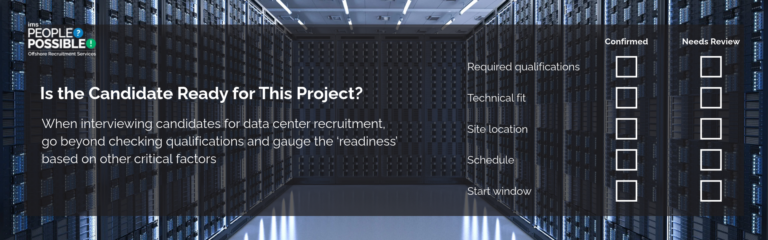
Map Geography and Project Readiness Before Promising Starts
A development announcement is not a confirmed hiring schedule.
CBRE identifies power availability and infrastructure delivery as decisive constraints. Its 2026 outlook notes that large AI campuses can involve multiyear construction schedules.
Ask clients which milestones trigger recruitment, what is funded, and what could move. Record whether a requisition is forecast, approved, or actively recruiting.
Then map candidate deployment constraints:
- Commute distance and realistic site access.
- Travel frequency and rotation arrangements.
- Relocation interest and support.
- Assignment duration and expected start flexibility.
- Overtime expectations, benefits, and expense arrangements.
These details matter when candidates compare opportunities across projects.
Avoid repeatedly asking candidates to remain available for uncertain dates. Maintain contact, explain what is confirmed, and refresh availability when milestones change.
For agencies expanding engineering desks, IMS People Possible’s engineering recruitment guidance offers a transferable skills-mapping approach, although its market context is UK-focused.
-
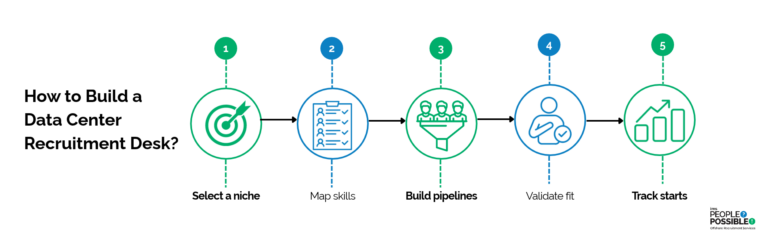
Build Searchable Pipelines Before Requisitions Peak
Create separate talent communities for electrical, mechanical, controls, commissioning, facilities operations, and IT infrastructure.
Within each, capture systems experience, seniority, geography, shift preferences, travel willingness, availability, and the date information was confirmed. Distinguish candidate-reported qualifications from verified evidence.
Keep original job titles alongside standardized classifications. A controls technician may be discoverable through relevant systems experience even when “data center” never appears in the resume.
IMS People Possible’s recruiter database management guide recommends standardized records, deduplication, clear ownership, and ongoing maintenance. Those practices make existing candidates easier to rediscover.
Nurture communities with relevant opportunities rather than generic messages. A traveling commissioning specialist and a locally based shift technician need different conversations.
-
Add Recruitment Capacity Without Diluting Accountability
As accounts expand, sourcing and coordination can consume the time recruiters need for client consultation and candidate assessment.
Offshore recruitment support can help with defined activities: market mapping, candidate research, initial outreach, approved pre-screening, database updates, scheduling, and resume formatting.
IMS People Possible provides recruitment support that can be structured around engineering sourcing and pipeline management. The scope should reflect your team’s technical knowledge, account requirements, and access restrictions.
Offshore professionals support recruitment delivery; they do not replace licensed on-site personnel or the client’s technical, safety, or security authorities.
Document what information can be shared. Data center work should not automatically be treated as requiring a security clearance, but particular clients or projects may impose security and confidentiality restrictions. Confirm these before granting access.
-
Measure Qualified Progress, Not Resume Volume
Start with one role family and market. Track:
- Time to first qualified submission.
- Submission-to-interview conversion.
- Technical rejection reasons.
- Offer acceptance and offer-to-start conversion.
- Start-date changes and their causes.
- Early retention and assignment completion.
- Pipeline freshness by specialization and location.
Separate recruiter delays from project postponements. Otherwise, hiring data may suggest a sourcing problem when the client’s delivery schedule has changed.
Use rejection feedback to refine screening, compensation conversations, and transferable-skills criteria.
Build Your Data Center Recruitment Capability With IMS People Possible
The data center opportunity rewards staffing firms that understand what clients are building, which skills transfer, and what makes a candidate genuinely deployable.
Start with one segment: commissioning, critical facilities, electrical and mechanical engineering, or IT infrastructure. Establish the screening standard and pipeline before expanding.
IMS People Possible can support that work through engineering talent sourcing, market research, candidate engagement, database management, and coordinated recruitment delivery within an agreed scope. Your internal team retains client relationships, technical calibration, and final decisions.
Connect with IMS People Possible to identify where dedicated offshore recruitment capacity can support your data center strategy—so growth begins with an informed talent pipeline, not a last-minute search.