Summarize and analyze this article with:
AI can search your CRM, read CVs and book interviews in minutes. But it can’t tell you whether an engineer can actually do the job.
That’s why AI and offshore STEM recruitment work best together. For most UK STEM recruitment agencies that are under capacity pressure, the split looks like this:
- AI handles rule-based and repeatable tasks.
- Your offshore recruitment team adds sourcing capacity and validation.
- Your UK consultants looks after client advice, technical judgement and final decisions.
This guide shows what STEM recruitment agencies like yours can automate, where you need offshore recruitment support, what needs human expertise and how to combine all.
Quick Question : What should STEM recruitment agencies automate?
STEM recruitment agencies should automate the rule-based work like CRM searches, CV parsing, interview scheduling and routine candidate updates.
Keep your local recruitment team for technical validation, client briefs, candidate motivation and every hiring decision. If a task requires judgment about a person, it should stay with a person (your local team).
You don’t need to automate everything. You need to automate the right things.
AI can read every CV in minutes, but it can’t tell you who can actually do the job. Let’s build a team that can.
AI and Offshore STEM Recruitment: What Actually Changes
In offshore STEM recruitment, a dedicated team supports your UK desks with sourcing, screening and admin support. Whereas, AI recruitment automation changes where that team spends its time, but not what good recruitment looks like.
Think of AI as a very fast researcher. It can read every CV in your database, but it has never set foot on a factory floor.
So, when a CV says “commissioned Siemens S7 PLCs”, AI-powered candidate sourcing tools simply flag a “keyword match”. Your experienced consultant immediately asks deeper questions: which site, which system, and what happened when things went wrong?
The benefits are clear. According to Bullhorn’s GRID 2026 report, recruitment agencies in the UK and Ireland using AI were 4 to 8 times more likely to report revenue growth in 2025.
However, using AI alone does not guarantee growth. What matters is how effectively you use it in your recruitment process.
Is AI Replacing Offshore Recruitment Teams?
No. AI is not replacing offshore recruitment teams. Instead, AI is changing how offshore recruitment teams spend their time: less data entry and more validation.
The best offshore recruitment partners for engineering and STEM do not only supply admin hands. They also provide trained specialists who understand the UK market standards, know the technical roles and spot what software misses.
ENGINEERING RECRUITMENT IN THE UK: CHALLENGES, TRENDS & OPPORTUNITIES
What UK-based STEM Recruitment Agencies Should Automate?
Earlier, after the intro, we gave the short answer to this question that UK-based STEM recruitment agencies should automate anything that is rule-based and does not require human judgement.
However, in practice, a busy UK STEM desk breaks down into three distinct operational areas such as:
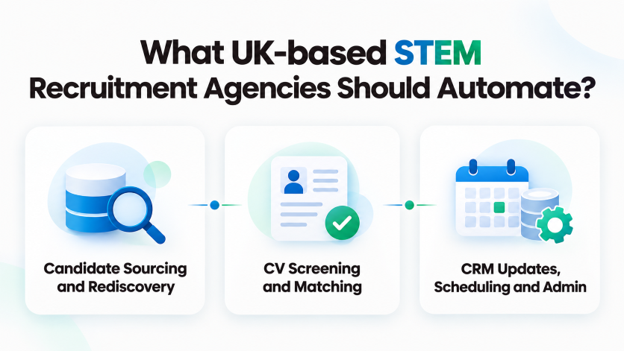
Candidate Sourcing and Rediscovery
This should be the first task you automate because it’s repetitive, manual, and time-consuming, and it keeps your billers off the real tasks.
Automate this activity with smart AI candidate sourcing that helps your recruiters scan the CRM for genuine skills and project experience, not rigid wording.
That makes AI-powered candidate sourcing ideal for candidate rediscovery, such as finding the automation engineer you placed in 2021.
CV Screening and Matching
The next job you should automate is CV screening and matching, as it’s a repetitive task that consumes most of your billers’ time.
Using automated CV screening and matching pulls skills, qualifications and work history stratight out of CVs for you.
Your consultants do not have to waste time reading every line which means they can focus on speaking with engineers and placing candidates.
The numbers back this claim too. According to Bullhorn’s report, 37% of recruiters said AI sped up their candidate screening by 26% to 50%, giving your team more time each week to bill.
CRM Updates, Scheduling and Admin
Finally, this is the third and last operational area that you should automate.
Interview scheduling, candidate updates and duplicate or outdated CRM records need no human judgement. Yet they eat into every consultant’s day, pulling them away from billing.
In simple words, use technology for the search and admin, and let your people focus on the shortlist.
What Requires Human Expertise in STEM Recruitment?
There could be several areas where you may require human expertise in STEM recruitment. However, there are four key areas where automated tools fall short and experienced recruiters must take the lead.
Let us explore each of the four in detail below.
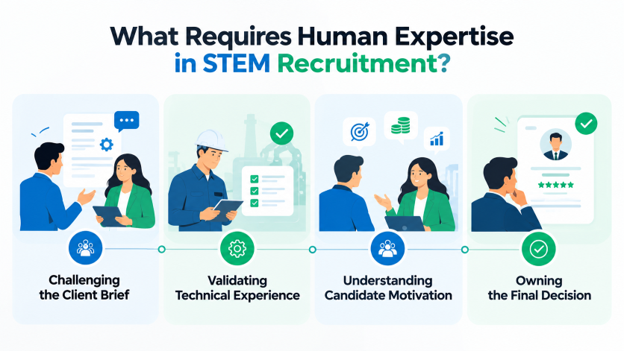
Challenging the Client Brief
Job descriptions rarely reflect what your hiring manager genuinely needs on site. Automated tools take requirements literally, but your consultants know how to look beneath the surface.
For example, your client might insist that they need ten years of experience, but then your recruiter discovers they simply need an engineer who has commissioned a production line like theirs without panicking. Challenging the brief early on stops your team from filtering out capable talent over arbitrary wish lists.
Validating Technical Experience
Just because a candidate’s CV lists the right skills does not mean they have used them in real projects. That is why you need experienced recruiters or offshore recruitment partners to check their practical experience, especially when hiring for hard-to-fill technical roles.
If you want to see how top UK recruitment agencies manage this balance, take a look at our guide: AI recruitment in the UK.
Understanding Candidate Motivation
Having the right technical skills does not always mean a candidate is ready to accept a job. You also need to understand why they want to move, what they expect from their next role and what might influence their decision.
AI can help you find suitable candidates, but your recruiters need to understand what they want from their next job. This includes their career goals, salary expectations and any concerns they may have.
By speaking with candidates directly, you can find out whether they have the right skills and are genuinely interested in the role.
Owning the Final Decision
AI can suggest suitable candidates, but you still need to decide who should be put forward to your clients. Before submitting a candidate, you need to review their technical experience, assess their suitability and make sure they meet the role’s requirements.
For example, AI might match an engineer based on their PLC, SCADA and Siemens experience. But how do you know whether they have actually commissioned similar systems? That is where your recruiters need to ask the right questions and verify their experience.
This final review helps you maintain shortlist quality and gives your clients confidence in the candidates you recommend.
Unconscious Bias in Recruitment: The Risk of Automating It
The risk of automating recruitment is definitely unconscious biased output. AI can help you screen candidates faster, but the real question is: does it always make recruitment fairer?
You may answer it: Not necessarily. But if your AI tools use baised data or screening criteria, they could overlook qualified candidates without you even realising it.
So, before you automate more of your recruitment process, you need to understand how unconscious bias in recruitment differs from AI bias and what you can do to reduce these risks.
Let’s understand both in more detail.
Unconscious Bias vs AI Bias
Both can affect your recruitment decisions, but they work differently. The table below gives the clear picture for both.
| Type of bias | What it means | Example in STEM recruitment |
| Unconscious bias | Making assumptions about candidates without realising it. | Favouring engineers from well-known companies over equally skilled candidates. |
| AI bias in recruitment | AI producing unfair results because of its data, design or screening criteria. | Ranking qualified candidates lower because they have changed careers or followed a different career path. |
Neil Carberry OBE, Chief Executive of the Recruitment & Employment Confederation (REC), warned that AI could accelerate existing recruitment biases rather than improve hiring decisions.
This concern is also reflected in regulatory findings. When the Information Commissioner’s Office (ICO) audited AI recruitment tools in 2024, it made almost 300 recommendations to improve data protection practices that includes fairness and transparency.
Three Safeguards Every Agency Needs
So, how can you reduce the risk of bias while using AI in recruitment?
You can start with three practical steps mentioned below:
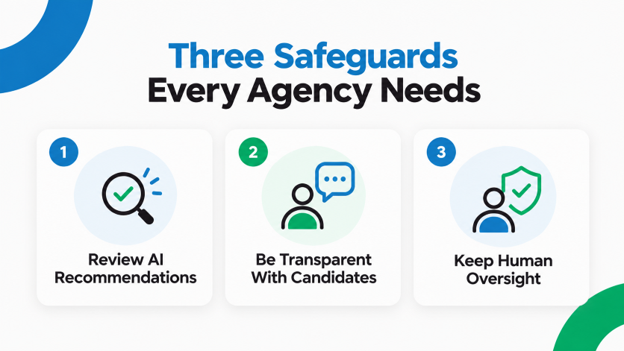
- Review AI recommendations: Check whether your AI tools are assessing candidates against relevant skills and experience. Look for qualified candidates who may have been overlooked.
- Be transparent with candidates: Explain how you use AI during sourcing and screening, particularly when it influences decisions about their applications.
- Keep human oversight: Make sure your recruiters review important AI-assisted recommendations and can explain why a candidate has been shortlisted or rejected.
By following these steps, you can make better use of AI while maintaining fairness, candidate trust and consistent recruitment quality across your teams.
How to Combine AI With Your Offshore Recruitment Team
To make these safeguards work, you need to be clear about who handles each recruitment task. When you combine AI with your offshore recruitment team, everyone should know their responsibilities and when human involvement is needed.
So, how can you make this work in your recruitment agency? Here are four practical steps.
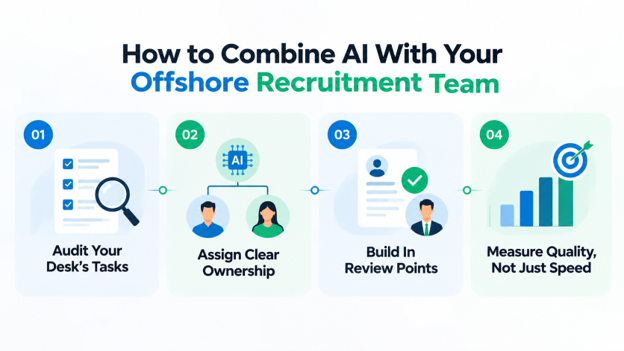
Step 1: Audit Your Desk’s Tasks
First, review what your UK consultants and offshore recruiters do each week. Identify which tasks are repetitive and which require human judgement.
Step 2: Assign Clear Ownership
Next, decide which tasks AI can handle and which need your offshore team or UK consultants. Make sure every task has a clear owner.
Step 3: Build In Review Points
Then, decide when your recruiters should check AI-generated results before sharing them with candidates or clients.
Step 4: Measure Quality, Not Just Speed
Finally, track recruiter productivity by checking how quickly you shortlist candidates and how many progress to interviews and offers. This helps you see whether AI recruitment automation is improving both speed and recruitment quality.
Explore these recruitment metrics to identify where your desk may be losing capacity.
Also Read: How Offshore Recruitment Teams Improve Recruiter Productivity
How IMS People Possible Can Support Your STEM Recruitment Delivery
AI can help you speed up repetitive recruitment tasks, but human expertise remains essential for assessing technical skills, understanding candidates and maintaining recruitment quality.
At IMS People Possible, we support UK STEM recruitment agencies with dedicated offshore teams across candidate sourcing, screening, database management and recruitment administration.
Our teams work within your existing recruitment systems and processes, helping you build stronger talent pipelines, increase delivery capacity and give your UK consultants more time to focus on clients and placements.
Whether you are exploring AI candidate sourcing or looking for experienced offshore recruitment partners for engineering and STEM, we can help you build a more scalable recruitment delivery model.
Ready to strengthen your STEM Recruitment Capacity?
Frequently Asked Questions
How is AI changing offshore STEM recruitment?
AI is helping offshore recruitment teams work faster by automating repetitive tasks such as AI candidate sourcing, CV parsing and database updates. This gives recruiters more time to assess technical skills, engage candidates and improve recruitment delivery.
Which recruitment tasks can STEM agencies automate safely?
STEM agencies can automate routine tasks such as CRM searches, interview scheduling and automated CV screening and matching, with appropriate checks in place. However, decisions involving technical suitability and candidate selection still need human judgement and oversight.
How can unconscious bias impact recruitment practices?
Unconscious bias in recruitment can influence which candidates get shortlisted based on assumptions rather than actual skills. When AI learns from biased hiring data, it may repeat these patterns, making regular checks and human oversight important.