

Summarize and analyze this article with:
You just got on a client call: your agency has been chosen to help with a bigger account. The distribution center needs pickers and forklift drivers, and the manufacturing facility needs assemblers and production workers for both shifts. The first round of hiring is coming up, and your team is already busy with current orders.
To handle the extra work, you look for offshore recruitment support. Many partners offer experienced recruiters, broad coverage, and a fast start. Their proposals all seem alike. But can their teams distinguish between reach-truck and regular forklift experience? Will they verify shift availability and commute options before sending candidates? Can they integrate with your ATS and the client’s VMS without creating additional work for your recruiters?
These questions are more important than just how many recruiters a partner offers. In light industrial staffing, extra help only matters if it meets the account’s needs and helps qualified candidates get started.
Choosing the right offshore recruitment partner means looking beyond price and headcount. It means evaluating sector experience, screening quality, coverage, system familiarity, and a realistic ramp-up plan before the next hiring surge puts those capabilities to the test.
How to Choose an Offshore Light Industrial Staffing Partner
A partner’s skill in handling ongoing hiring is more important than just promising to “scale immediately.” Before you decide, ask for proof in six areas: industry experience, screening quality, coverage, tech know-how, readiness to ramp up, and accountability for results.
1. Look for Light Industrial Experience, Not Just Recruitment Experience
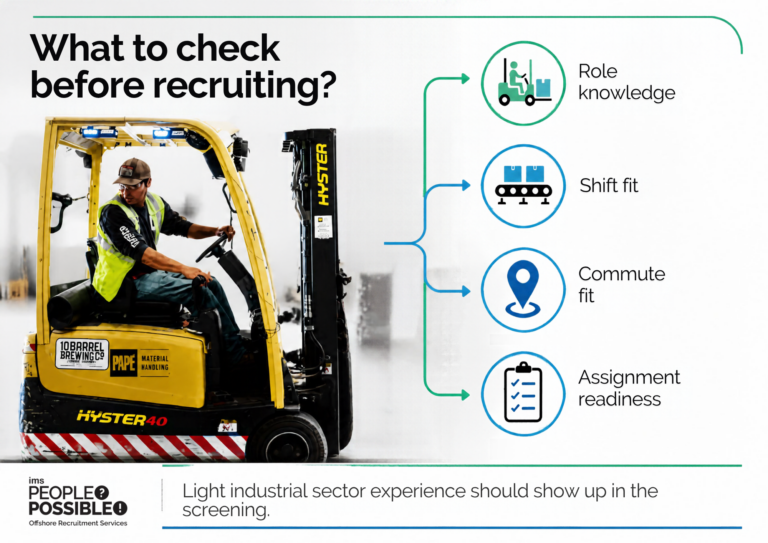
Hiring warehouse and production workers takes more than just matching job titles. Even if pickers, reach-truck operators, assemblers, and machine operators work in the same area, each role needs different experience and has its own job conditions.
The scale of that market is significant. Bureau of Labor Statistics data for May 2024 show that warehousing and storage employed 437,680 hand laborers and freight, stock, and material movers, alongside 322,590 industrial truck and tractor operators (Source: U.S. Bureau of Labor Statistics). These are warehouse-sector employment counts, not staffing-agency placements.
Ask potential partners which similar roles, facilities, shifts, and locations they have worked with before. Request references or examples (with names removed) that show what their team has actually done.
A useful evaluation exercise is to provide two sample requisitions:
- A second-shift forklift operator for a distribution center.
- A production associate for a manufacturing facility with weekend overtime.
Have the partner explain how they find candidates, what screening questions they use, what concerns candidates might have, and what criteria they use to submit candidates for each role. Real industry experience should show up in these details, not just in a slide deck.
For agencies comparing light industrial recruitment services, this exercise helps distinguish a team that understands assignment readiness from one that primarily sends resumes.
2. Test Screening Quality Before Increasing Volume
In high-volume recruiting, more candidates doesn’t always mean better candidates. Your recruiters should get profiles with clear qualifications and real interest, not ones that need the whole screening process done again.
Ask to review a screening scorecard covering:
- Relevant warehouse, equipment, assembly, or production experience.
- Shift availability and realistic start-date availability.
- Pay expectations and understanding of assignment terms.
- Commute feasibility and transportation plans.
- Ability to meet the role’s essential requirements.
- Candidate consent and account-specific screening steps.
Ask for sample screening notes and, if possible, listen to approved call recordings. See if the recruiter checks answers, explains job details clearly, and notes any uncertainty instead of just assuming a candidate is a good fit.
Safety-related role understanding deserves attention. In 2024, warehousing and storage recorded 4.8 nonfatal occupational injury and illness cases per 100 full-time-equivalent workers. Manufacturing recorded 2.7 cases per 100 full-time workers. These are industry-wide rates, not measures of staffing-provider performance, but they reinforce why screening should respect worksite requirements.bls+1
Screening candidates is not a substitute for employer training, worksite checks, or equipment-specific approvals. Make sure you know who is responsible for each requirement before starting.
IMS People Possible lists active and passive sourcing, pre-screening, and credential and compliance management among its recruitment services. When evaluating those capabilities, staffing firms should agree on account-specific scorecards and handoff standards rather than relying on a generic definition of “qualified.”
3. Match Coverage to Your Actual Hiring Workflow
Coverage should reflect when candidates respond and when your branches need support, not simply the partner’s location.
For warehouse staffing and manufacturing accounts, map the operating day:
- When are new orders released?
- When can first-, second-, and third-shift candidates answer calls?
- When does the client review submissions?
- Who follows up before orientation and first-day reporting?
- What happens when urgent requirements arrive outside agreed hours?
Ask for a written coverage schedule showing time zones, holidays, overlap hours, backup arrangements, and escalation contacts. Clarify whether weekend or extended coverage is included, optional, or unavailable.
Also, separate the times when candidates are sourced from when decisions are made. An offshore recruiter might find candidates overnight, but things can slow down if no one onshore is available to answer questions or approve next steps.
A strong high-volume recruiting strategy coordinates both sides of the operation. It does not assume that longer coverage alone produces faster starts.
4. Verify ATS and VMS Familiarity in Practice
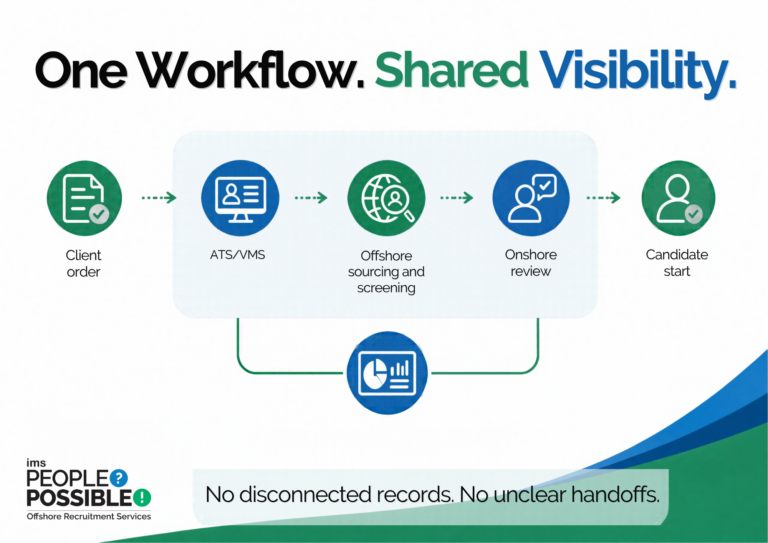
A partner should fit into your recruitment workflow rather than create a parallel spreadsheet operation.
Ask which applicant tracking systems (ATS) and vendor management systems (VMS) its proposed team has used. Then test practical familiarity through a demonstration or controlled exercise.
Can the team:
- Interpret requisition details and submission deadlines?
- Update candidate stages and document screening outcomes?
- Check for duplicate records and previous submissions?
- Apply role, shift, location, and availability tags?
- Follow client-specific formatting and submission rules?
- Maintain a traceable handoff to your recruiters?
Platform familiarity alone is insufficient. Your configuration, permissions, client rules, and reporting conventions still require training.
As part of setup, review how data is accessed, kept confidential, stored, and how incidents are reported. Decide which records the partner can see or edit, and who needs to approve any exceptions.
IMS People Possible’s published services include database management, requisition planning, candidate sourcing, VMS coordination, resume formatting, and onboarding and compliance support. These capabilities create relevant evaluation points for firms seeking integrated offshore recruitment support.
5. Demand a Realistic Ramp-Up Plan
Begin evaluating partners before the account becomes urgent. Signing a contract doesn’t mean you have a working recruitment team yet.
Getting started may include assigning recruiters, setting up system access, job board permissions, training, screening checks, reporting setup, and supervised delivery. The order and timing depend on what you need and the partner’s capacity.
Don’t accept a blanket promise that every project will be up and running in the same number of days. Instead, ask for a plan with clear milestones.
| Milestone | Evidence to request |
| Scope agreed | Roles, markets, workflows, coverage, and responsibilities documented |
| Access ready | Required systems and permissions tested |
| Team calibrated | Sample screens and submissions reviewed against your standards. |
| Pilot underway | A limited role or account segment producing measurable activity |
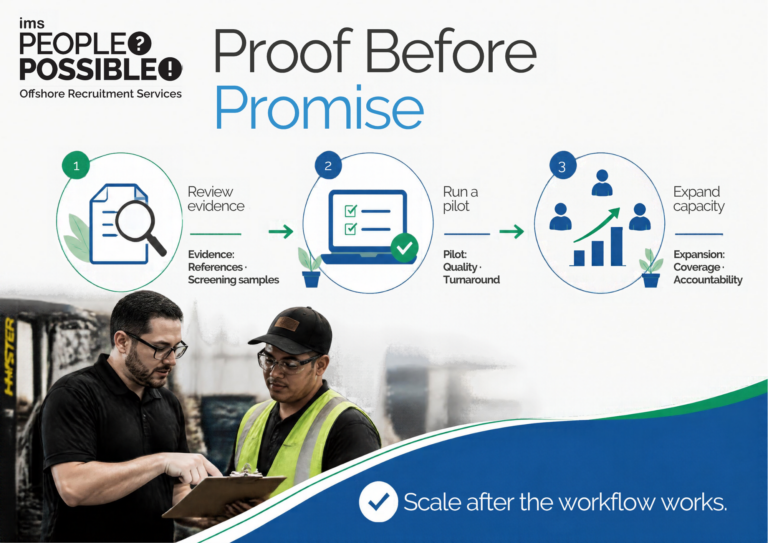
| Expansion approved | Quality, turnaround, and handoff requirements met. |
Ask what might delay the launch and what your agency needs to provide. Missing details, unclear roles, or slow access can slow things down just as much as the partner’s readiness.
For high-volume hiring, treat the initial launch and later expansion as separate steps. Make sure you know how extra recruiters are chosen, trained, supervised, and brought in when demand goes up.
IMS People Possible positions its offshore team as an extension of a staffing firm’s recruitment function. That partnership model is most useful when both teams agree on responsibilities and implementation dependencies before expanding delivery.
6. Evaluate Outcomes, Pricing, and Accountability Together
A low quoted cost can become expensive if internal recruiters spend hours correcting records, repeating screens, or chasing updates.
When comparing candidate sourcing services, make sure you’re looking at the same scope. Check if the price covers sourcing tools, supervision, quality checks, reporting, backup coverage, and extra hours. Write down minimum commitments, how to make changes, and exit terms.
Then agree on a balanced scorecard:
- Time to first qualified submission.
- Qualified submission acceptance rate.
- Interview-to-offer and offer-to-start conversion.
- Screening accuracy and submission rework.
- Candidate responsiveness and availability freshness.
- Recruiter capacity released for client-facing work.
Do not judge a partner solely on call counts or submitted resumes. Equally, do not attribute every placement outcome to the offshore team: pay, client response times, onboarding requirements, and worksite conditions also influence results.
Request case studies with context: account scope, period measured, starting conditions, team responsibilities, and calculation methods. IMS People Possible’s partner-evaluation guidance similarly emphasizes industry experience, sourcing methodology, technology, pricing transparency, communication, and documented performance evidence.
Choose a Partner You Can Integrate, Not Just Hire
The best offshore recruitment partner for light industrial staffing is the one whose skills fit your accounts, systems, and how you work.
Check sector knowledge with real job requests. Test their screening before you ramp up. Make sure coverage, platform access, reporting, and setup times are clear. Run a pilot to see if the partnership actually speeds up hiring without lowering candidate quality.
IMS People Possible can help with sourcing, pre-screening, database management, VMS coordination, and other recruitment tasks within a set scope. Your first conversation should be about your regular roles, expected hiring numbers, screening standards, and how ready you are to start, not just how many recruiters you need.