
Summarize and analyze this article with:
In 2026, the AI recruitment market is estimated at $752.09 million, with North America accounting for 38.6% of the global market share.
So, is AI right for your recruitment business? What AI recruiting tools do you need? What are some risks to consider?
To help you find out, this guide covers everything you need to know about AI in recruitment. By the end of the article, you’ll have a clear understanding of where AI fits into your recruitment process, where it doesn’t, and how to choose the right AI hiring tool.
But first, let’s start with the basics.
What is AI Recruiting?
AI recruiting is the use of artificial intelligence and automation to optimize your hiring process by supporting recruitment tasks.
The most common use cases of AI in recruiting are:
- writing job descriptions
- searching for candidates
- parsing resumes
- screening candidates
- scheduling interviews
- analyzing recruitment data
So, your recruiters can spend their time focusing on people rather than on repetitive work.
Common Types of AI Recruitment Tools Available for Staffing Firms
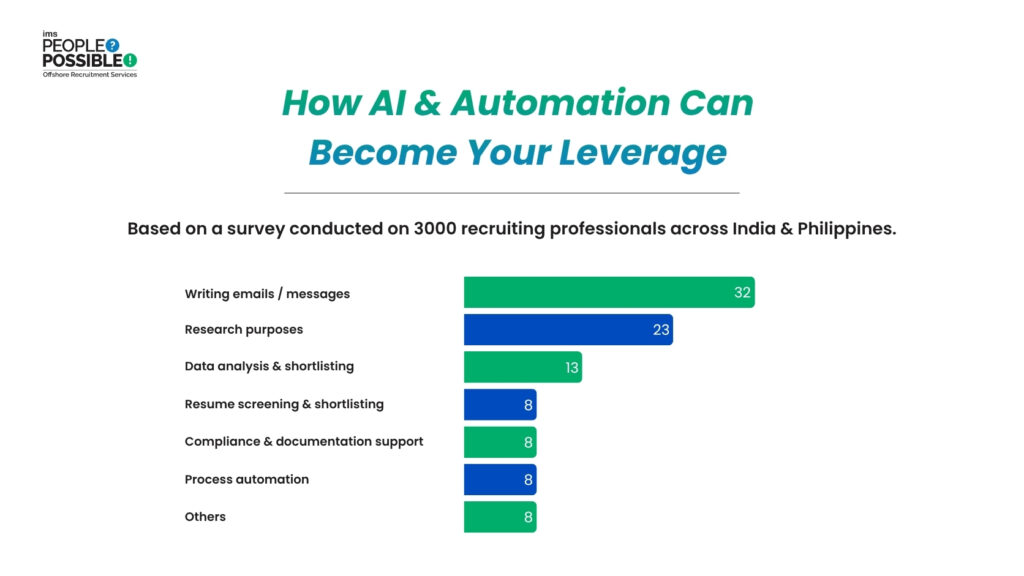
32% used AI for emails, 23% for research, 13% for data analysis and reporting, 8% for resume screening, 8% for compliance tasks, 8% for process automation while the rest 8% used it for something else.
Since each recruitment task requires a different capability, staffing firms can choose from several types of AI tools such as:
AI Sourcing Tools
An AI sourcing tool typically helps automate candidate discovery and engagement across the open internet (e.g. job boards, professional network) and your internal ATS database.
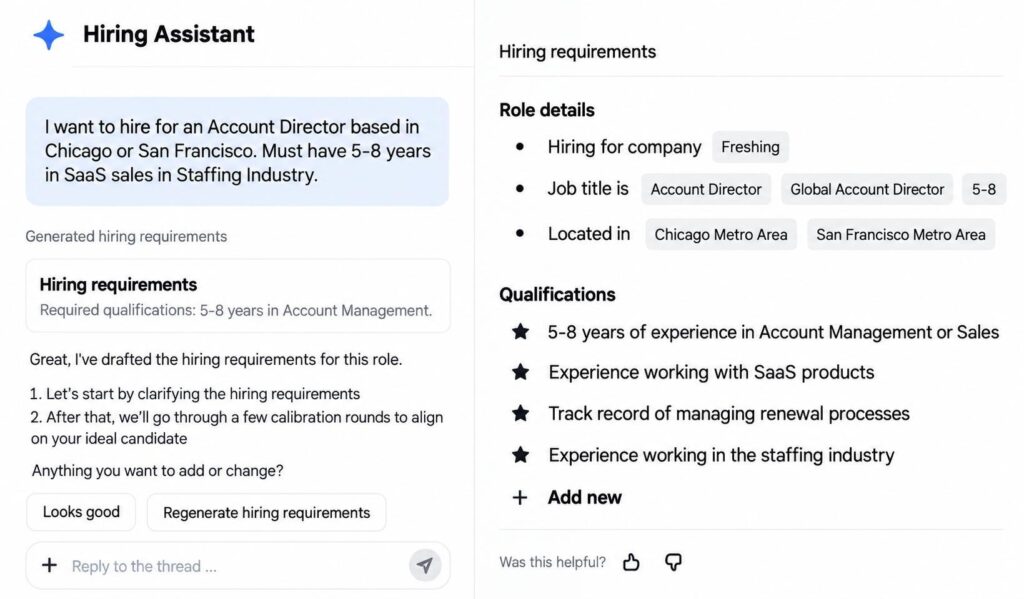
For example, LinkedIn has recently launched an AI recruiting agent that lets your recruiters source candidates from the platform while reviewing 81% fewer profiles.
Their AI recruiting agent works by taking instructions from a human recruiter to understand the job requirements, then scan LinkedIn profiles and your ATS to find the best match.
AI Resume Parsing & Screening Tools
AI resume parsing tools extract information from resumes and organize it into fields such as skills, employment history, education, certifications, and location.
It then compares that information with the job requirements, identifying matched and missing skills, and assigning a relevance score.
This allows recruiters to turn hundreds of differently formatted resumes into comparable candidate profiles and screen faster.
However, AI bias is a true risk here as the tools may not be able to parse certain non-standard formats and reject qualified candidates. So, it’s best to involve a recruiter to overlook the entire process.
AI Conversational Chatbots
AI chatbots automate the candidate’s outreach process 24/7 by:
- Sending the first outreach message
- Asking candidates predefined questions
- Collect details such as their availability
- Answer common queries
- Send reminders or schedule interviews
For high-volume roles, this removes the back-and-forth involved in collecting basic information and arranging interviews. Chatbots can also respond outside recruiters’ working hours, which is useful when global candidates apply across time zones.
However, more sensitive conversations like salary negotiations, accommodation requests, complaints, and sensitive candidate situations must always include a human expert in the loop.
AI Interview Assessment Tools
Nearly 63% of U.S. candidates say they have been interviewed by AI.
These tools leverage artificial intelligence, natural language processing, and automated scoring algorithms to assess a candidate in real-time. They do so by generating role-specific questions, transcribe interviews, summarize responses, and compare answers with predefined competencies.
Some advanced tools also assess video, voice, language, or behavioral signals to produce candidate scores.
However, it’s worth noting that 38% of candidates have already withdrawn from hiring processes because it included an AI interview without proper transparency.
Automated interview scores also carry regulatory risk. For example, in New York City, automated employment decision tools must undergo an independent bias audit within one year of use, and employers or agencies must publish audit information and notify candidates.
So, consider all aspects before choosing an AI interview assessment tool for your hiring process. You can use an AI tool to create interview questions or screen candidates but keep the final decision with a recruiter or hiring manager who can review the evidence behind AI recommendation.
AI-powered ATS & CRM
An AI-powered ATS or CRM works with the candidate information already stored in your internal system. It can identify duplicate records, update profiles, while recommending candidates for new roles, and follow up with them actively.
This is particularly useful for hard-to-fill roles or staffing firms with large databases, but low candidate redeployment or re-engagement rates.
However, it’s important to refresh candidate pipelines frequently, so their information’s up-to-date and make sure the AI doesn’t repeatedly prioritize the same profile types.
AI-powered VMS
MSPs can use AI-powered VMS to automate job information standardization when new requisitions come in. The tools can then distribute requirements to suppliers, track submissions, and measure supplier performance.
It can also prioritize open roles using deadlines, client importance, historical fill rates, submission activity, or predicted likelihood of placement.
For staffing firms working through several MSPs or VMS programs, this tool can help your recruitment team decide which requisitions need immediate attention.
It can also flag duplicate submissions, missing documents, delayed responses, and roles that have received little activity, so you spend less time to admin tasks.
The Top Advantages of Using AI for Recruiting
While there are several advantages to using AI in recruitment processes, let’s look at the top 4 benefits.
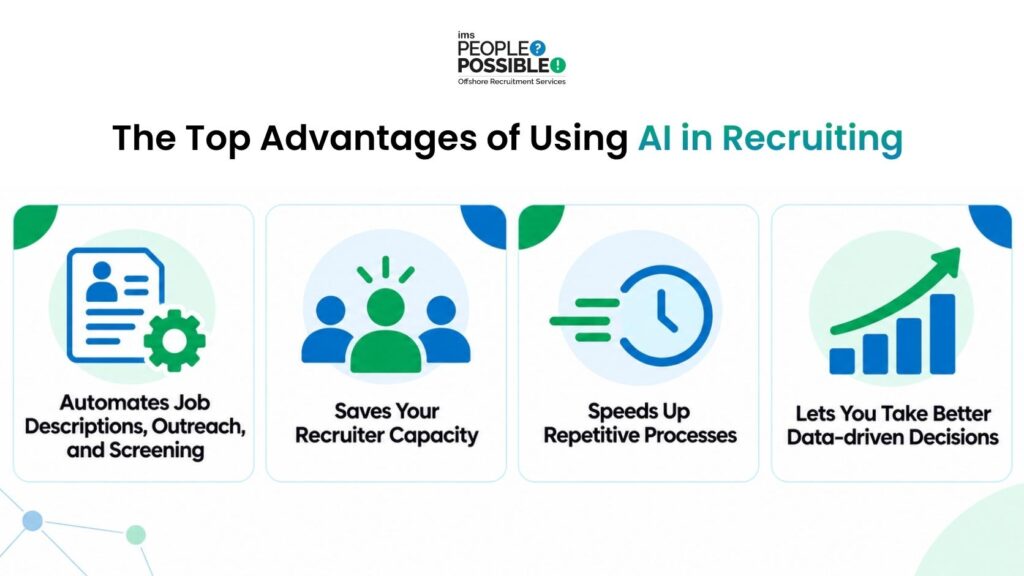
#1 Automates Job Descriptions, Outreach, and Screening
Recruitment automation tools can understand your requirements and then draft job descriptions, outreach messages, screening questions, and resume summaries in minutes.
This removes the need to write every document and message from scratch. Recruiters can open roles sooner, contact more relevant candidates, or even use the tools to automate the initial screening process.
#2 Saves Your Recruiter Capacity
AI recruiting tools can save recruiters 3-4hours per day, so they focus on building candidate relationships. This especially matters since recruiters are now managing 56%+ more requisitions and 2.7x applications than three years ago.
This also lets you respond fast to sudden demand surges without burning out your recruiters.
You can choose standalone tools or a full recruitment toolkit depending on the hiring stages you’re looking to optimize.
#3 Speeds Up Repetitive Processes
The biggest advantage of using AI recruiting software is to speed up your repetitive tasks.
When your AI has completed the initial steps, your recruiters can begin reviewing a structured shortlist sooner, submit qualified candidates faster, and manage requisition volume without administrative overload.
#4 Lets You Take Better Data-driven Decisions
The right recruitment AI engine connects job descriptions, skill matrix, candidate profile, match score and supporting evidence, all in one intelligence layer.
This allows you to see why the system recommended a candidate, which requirements they meet, and what steps need you to step in.
It’s important to note that AI can project certain hiring biases, so the final decision must remain with you.
What are the Major Concerns of Using AI in Recruitment?
While using AI in recruitment has several advantages, there are a few concerns that you must consider.
#1 AI Bias in Recruitment
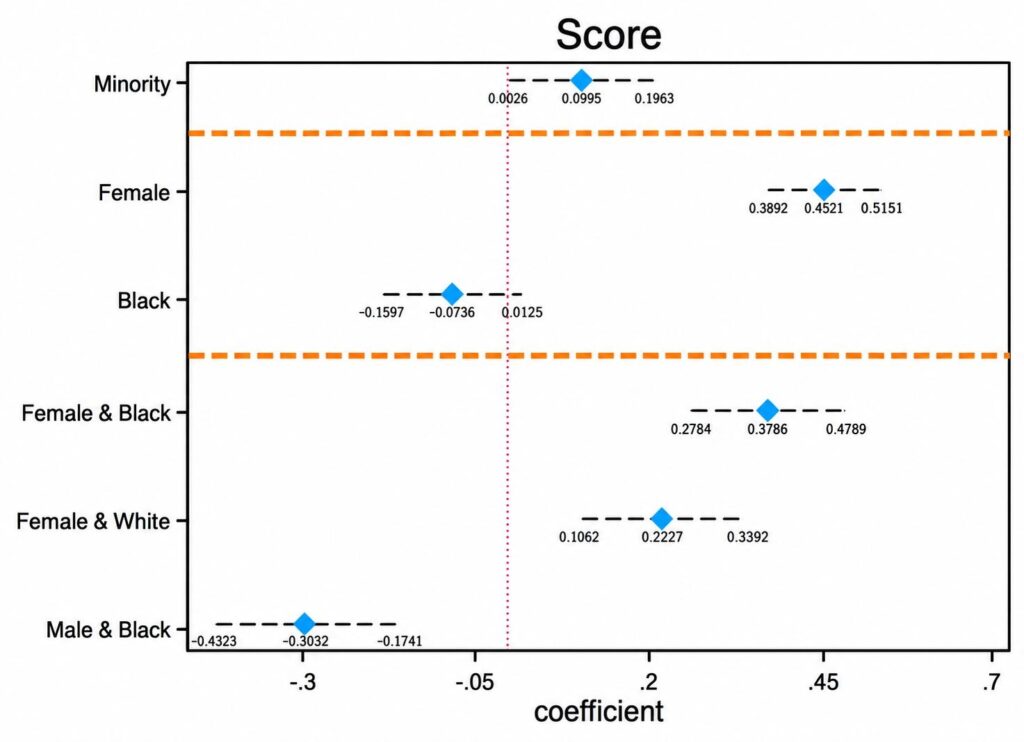
AI recruiting tools may screen resumes before a human ever sees it. However, AI may pick up biases present in their training data based on gender, race, demographics, or historical hiring patterns for a role.
In fact, newer studies show that LLMs may form their own new unseen biases based on their multi-step interaction with the real world.
For example, here’s a GPT-3.5 Turbo score differences across social groups.
It may also show self-preferencing bias in hiring where it favors candidate resumes created by the same AI model.
So, do not automatically reject a candidate based only on an AI-generated score. Instead, document the recommendations and related evidence to flag any inconsistencies early.
#2 Team Learning Curve
Assign a use case, tool owner, approval process, and escalation route. Then, train recruiters to verify outputs, protect confidential information, and report errors.
Begin with a small user group and one workflow. Expand access only after the team reaches agreed targets for accuracy, completion time, and compliance.
#3 Data Sent to Public AI Models
Nearly 90% AI tools in the market are wrappers around public AI models. And when your recruiters upload recruitment data to the tool, it may route them to external servers.
This can cause serious data privacy or regulatory issues, especially if the roles are highly classified.
How to Choose the Right AI Hiring Tool for Your Staffing Firm
Now that you’re aware of both the pros and cons of AI recruiting tools, let’s look into how to choose the right one for your staffing firm.
Focus on the Task You Want to Improve
Start by asking: “Where does my team spend most of the time today?”
Is it writing job descriptions or emails? Finding or reaching out to talent? Screening resumes? Following up with candidates?
Then, pick the most critical tasks and decide what success looks like. For example, if resume screening is slowing your team down, see whether the tool helps recruiters shortlist candidates faster.
See How the Tool Handles Your Data
Before uploading sensitive candidate or client information, ask the provider where your data is stored, whether it is sent to any public AI models, and if it is used for training purposes.
Also, check whether the tool keeps a record of its actions and how. Your team should be able to review what happened if a recommendation is wrong.
Consider Your Budget
If you’re just starting with AI, you may not want to commit to a large contract. So, shortlist the tools that address your specific bottlenecks and compare their pricing to find the best package.
If a trial is available, use it with a few recruiters to see whether the tool actually delivers what it claims, before making a longer commitment.
Ensure It Fits Your Workflow
When you’re investing in a new AI tool, the last thing you want is more admin work.
Check whether the tool integrates smoothly with your existing ATS, CRM, and other systems your recruiters use every day. If your team needs to copy all the information between platforms, it may create more burden than it removes.
Your team must also be clear about which tasks to automate, when to review AI outputs, and which decisions must stay with a human recruiter to make the most out of the tool.
Want us to Help Scale Your Recruitment Operations?
The IMS team is coming to the SIA CollaborationX in Dallas from September 29-October 1 as the Platinum Sponsors.
We’re meeting US staffing leaders to discuss AI, recruitment, and everything in between.
Meet us at Booth #100 to explore how you can scale your recruitment operations (without increasing overheads) by combining AI and the right offshore support.
If you prefer to talk virtually, share your thoughts with us now and we’ll get in touch.