

Summarize and analyze this article with:
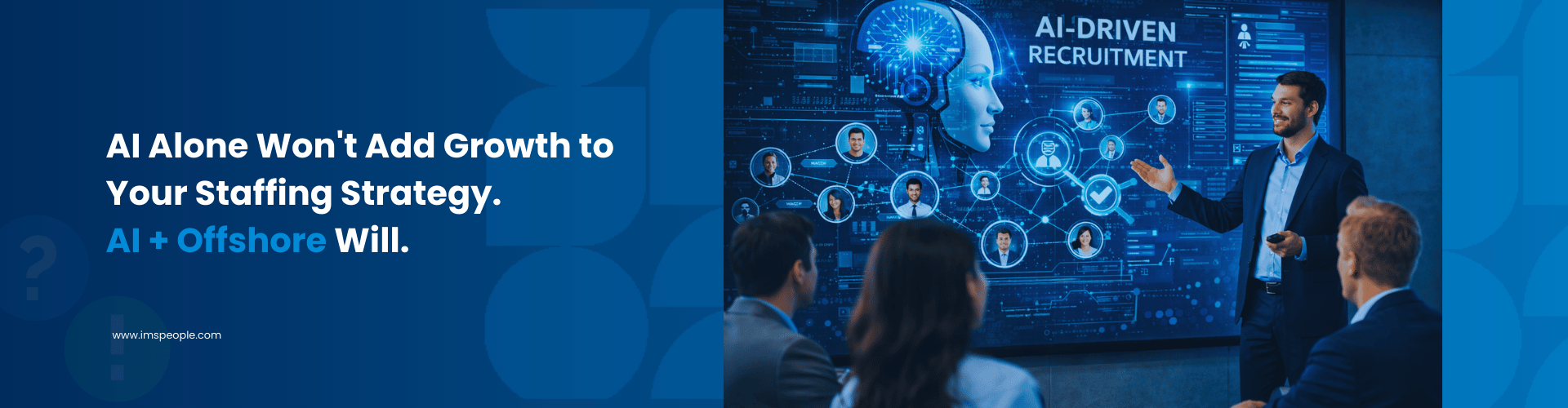
The staffing firms winning in 2026 aren’t choosing between AI and people. 87% of companies already use AI to recruit (Source: DemandSage). But the staffing firms actually growing in 2026 aren’t betting on technology alone – they’re pairing it with offshore recruitment teams to outpace the competition.
While 89% of senior HR executives expect AI to fundamentally impact jobs at their firms this year (CNBC Workforce Executive Council, 2025), the $650+ billion global staffing industry is under pressure.
The Threat Is Real – And It’s Dual-Sided
On one side, your clients are using AI to bring recruitment in-house. Bloomberg reports that generative AI is empowering internal HR teams to automate 80% of sourcing and screening talent (Source: FNLondon) at a scale no human team can match, eroding the case for 15–30% placement fees.
On the other, AI is transforming the work your own recruiters do every day. Sourcing alone consumes roughly 13 hours per week per role(Source: Maayu.AI). Resume screening for 200 applicants can take 5 to 15 hours. Interview scheduling eats 35% of recruiter time. Deloitte‘s research shows AI can save up to 23 hours per hire on screening and scheduling alone.
But The Misrepresentation Ends Here
AI doesn’t eliminate the need for people. It changes which people you need, where they sit, and what they do.
Only 26% of applicants trust AI to evaluate them fairly (Gartner, 2025) and 66% of U.S. adults say they’d avoid applying for jobs that use AI in hiring decisions (Pew Research Center). Every AI-driven process still needs human touchpoints to maintain candidate trust and employer brand integrity.
That’s exactly where offshoring becomes the most undervalued growth lever in the industry.
AI Handles Speed. Offshore Delivers Depth.
Most staffing firms treat AI and offshoring as separate conversations – one a technology decision, the other a cost decision. In reality, the two are most powerful together.
AI is exceptional at the mechanical: scanning thousands of profiles, ranking candidates by match probability, automating scheduling, generating outreach. Organisations using AI report 30% reductions in cost-per-hire (SHRM) and 86% of recruiters say it makes hiring faster.
But AI can’t assess genuine motivation in a conversation. It can’t interpret a career trajectory that doesn’t fit a neat keyword match. It can’t turn a passive candidate’s “not looking” into “tell me more.”
Skilled offshore recruitment professionals deliver that depth, context, and human judgement – at a cost structure that transforms your unit economics.
The Three-Tier Model That’s Actually Working
The fastest-growing staffing firms we work with at IMS People Possible operate with a three-tier delivery model:
Tier 1 – AI and Automation handles the high-speed, high-volume tasks
This layer eliminates 60–80% of repetitive admin and frees recruiter time for revenue-generating work such as:
- Screening
- Scheduling
- Job ad optimisation
- Chatbot engagement
- Data hygiene
Tier 2 – Offshore Delivery Teams provide skilled human capacity
Trained professionals working in your ATS, on your brand, to your standards — from India and the Philippines at 40–60% lower cost.
- Sourcing
- Market mapping
- Database enrichment
- Credential management
- Onboarding
- Full-cycle delivery
Tier 3 – Onshore Leadership focuses on what can’t be automated or offshored
This is where your senior talent creates the most value:
- Client relationships
- Offer negotiation
- Strategic advisory
- Complex candidate assessment
A mid-size firm with 15 onshore recruiters each spending 20+ hours per week on offshorable tasks is burning over 300 hours of weekly capacity on process, not revenue. Reclaim even half and the impact on placements, margins, and client satisfaction is transformative.
AI’s Growth Roles Are Offshoring’s Sweet Spot
Here’s a powerful insight: AI and offshoring don’t compete. They complement.
As AI automates basic screening and scheduling, the roles growing in importance are exactly what offshore delivery centres excel at: strategic sourcers who engage passive candidates with context and credibility. Compliance professionals managing verification cycles for regulated industries. Candidate experience managers providing human touchpoints that build trust. Onboarding specialists ensuring placements stick.
These aren’t entry-level tasks offshored to save money. They’re skilled, high-value functions delivered by trained professionals with sector expertise in healthcare, IT, engineering, and finance – at a scale most onshore teams can’t match alone.
Governance Builds Trust on Both Sides
Firms that offshore successfully build governance that gives clients confidence: GDPR and ISO 27001 for data protection, SOC 2 and Cyber Essentials for information security, HIPAA for healthcare, plus clear contractual structures covering IP, SLAs, and escalation paths.
AI governance matters equally. The EU AI Act classifies hiring technology as “high-risk,” with obligations taking effect August 2026. NYC’s Local Law 144 already requires annual bias audits for automated hiring tools. Firms that get ahead – with human-in-the-loop processes and transparent candidate communication – will win the trust others lose.
How IMS People Possible Can Help
Building a blended AI + offshore recruitment model sounds straightforward on paper. In practice, it requires the right partner — one that understands the staffing industry from the inside, has the infrastructure to scale with you, and operates with the compliance standards your clients expect.
When your clients ask who’s handling their candidate data offshore, you want an answer that builds confidence, not concern. IMS People Possible is the answer.
We don’t provide generic outsourcing. We build dedicated offshore recruitment teams that work exclusively on your desks, in your ATS, under your brand. Our service lines are designed to slot directly into the blended workforce model: sourcing, screening, database management, market mapping, credential and compliance management, onboarding and consultant care, lead generation, and full-cycle recruitment delivery. Whether you need to offshore one function or ten, we scale with you.
Conclusion
The staffing industry in 2026 is being shaped by two forces that aren’t slowing down: artificial intelligence and the globalisation of talent. Firms that rely on AI alone will find that technology solves for speed but not for depth, trust, or candidate experience. Firms that offshore without AI will compete on cost but miss the efficiency gains that the market now demands.
The firms that win will be those that combine both — using AI to eliminate repetitive work, offshore teams to deliver skilled, high-value recruitment at scale, and onshore leaders to own the client relationships and strategic decisions that drive revenue.
This isn’t a future trend. It’s the operating model of the staffing firms that are already pulling ahead.
The only question left is whether your firm will be one of them.
AI handles the speed. We handle the soul