Recruiter database management determines how quickly a staffing firm can find, engage, submit, and redeploy talent. In 2026, the recruitment database must operate like an engine, not a storage cupboard. When data is inconsistent, duplicated, or disconnected from the daily workflow, recruiters lose hours to searching and rework. Placements slow down, redeployment opportunities are missed, and reporting becomes unreliable.
The most effective approach is to implement a small set of rational fixes that address the root causes: data quality, searchability, workflow adoption, and database management governance. Below are seven changes that are genuinely necessary for recruitment process optimisation and recruitment automation to deliver measurable results.
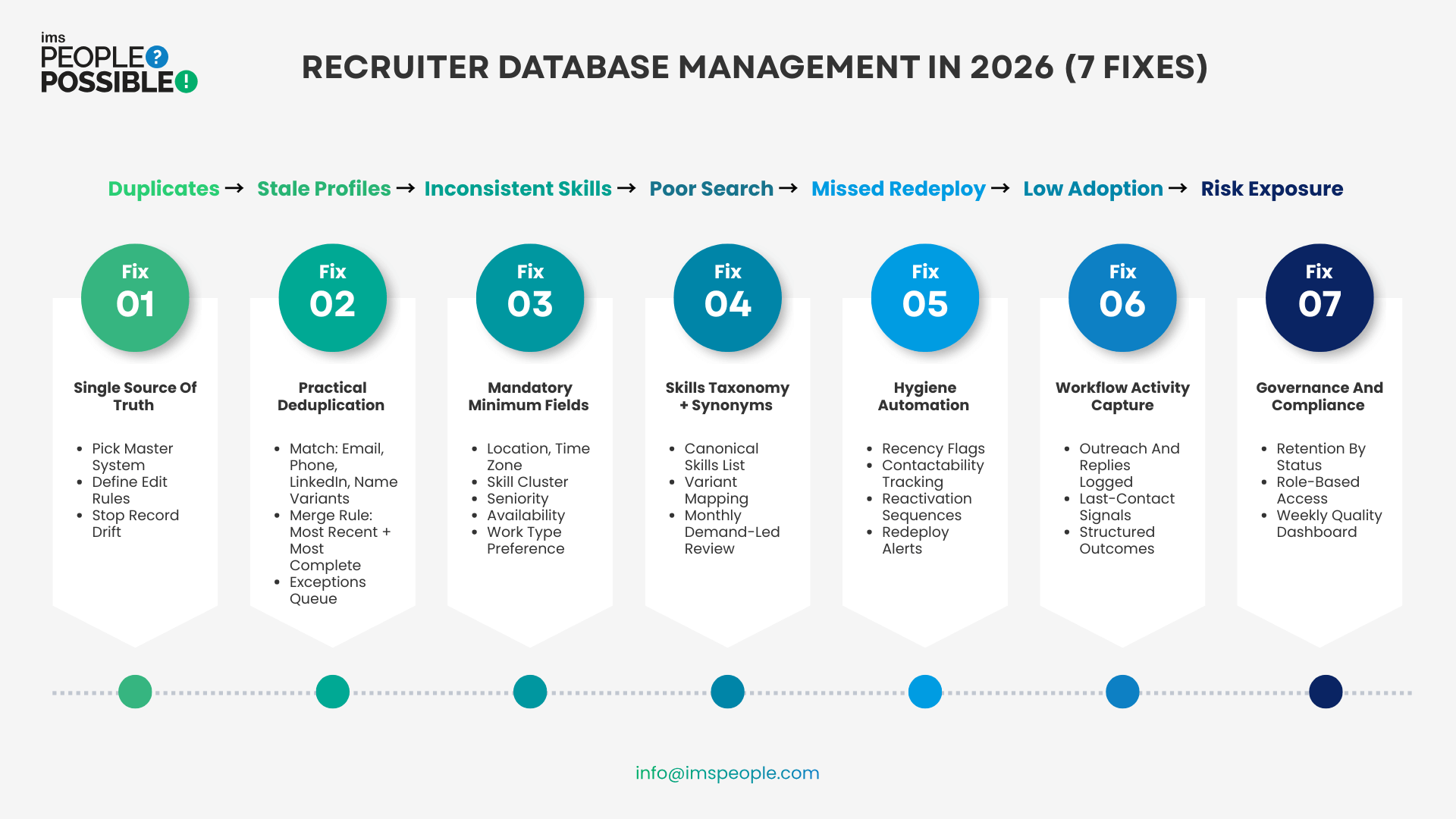
7 Necessary Fixes for Recruiter Database Management
1) Define A Single Source of Truth and Stop Record Drift
Most staffing firms run an ATS, CRM, email, and sourcing tools that store overlapping candidate data. If ownership is unclear, updates conflict and trust collapses.
What To Do
- Choose one system as the master candidate record.
- Document what can be edited in each tool.
- Apply a simple change policy: profile updates happen in the system of record first, then sync.
Why It Unlocks Placements
Recruiters waste less time reconciling data and can move faster from search to submission.
2) Implement Deduplication That Works in Real Recruitment Conditions
Duplicate profiles cause double outreach, poor candidate experience, inaccurate pipelines, and unreliable redeployment lists. Deduplication must use practical matching, not only exact names.
What To Do
- Match on email, phone, LinkedIn URL, and normalised name variants.
- Set a merging rule for “primary record” (most recent activity plus most complete fields).
- Create an exception queue for uncertain matches.
Why It Unlocks Placements
A cleaner database for recruitment increases response rates and improves redeployment hit-rate.
3) Standardise The Minimum Dataset Required For Search And Segmentation
Recruiters search, not browse. If key fields are missing or free-text only, searches underperform and shortlist quality drops.
Minimum Fields That Should Be Mandatory
- Location and time zone
- Core skill cluster (controlled list)
- Seniority level (controlled list)
- Availability window
- Work type preference (perm, contract, hybrid, remote)
Why It Unlocks Placements
Shortlists become consistent across recruiters and offices, which reduces time-to-submit.
4) Replace Uncontrolled Tagging with a Skills Taxonomy and Synonyms Map
Skills entered as free-text create fragmentation. A taxonomy with synonym mapping is the simplest way to make database management searchable at scale.
What To Do
- Create skill families (for example: Data Engineering, Cloud, Contact Centre, Finance Shared Services).
- Map common variants to one canonical term (for example: “JS” and “JavaScript”).
- Review monthly based on live job demand and placement outcomes.
Why It Unlocks Placements
Search coverage increases without expanding the database. Recruiters find better-fit candidates faster.
5) Build Database Hygiene Automation For Recency And Contactability
Stale records are the hidden cost of most recruitment databases. Hygiene should be automated so recruiters only handle exceptions.
What To Automate
- Recency flags based on last meaningful interaction
- Contactability tracking (bounces, opt-outs, invalid numbers where permitted)
- Reactivation workflows for dormant but valuable segments
- “Ready for redeploy” alerts for near-end-of-assignment contractors
Why It Unlocks Placements
Recruitment automation increases usable supply without increasing sourcing spend.
6) Connect Workflow Activity to The Record So Adoption Becomes Automatic
If recruiter activity remains in inboxes and calendars, the database stops reflecting reality. The goal is to capture signals without adding admin work.
What To Do
- Log outreach and replies to the candidate record.
- Store last-contact date, channel, and status (engaged, no response, do not contact).
- Use templates for consistent notes and outcomes.
Why It Unlocks Placements
Handover improves, team collaboration increases, and reporting becomes accurate enough to optimise performance.
7) Apply Governance That Protects Compliance And Makes The Data Dependable
Governance is not bureaucracy. It is the mechanism that keeps data reliable, reduces risk, and improves performance over time.
What To Implement
- Retention rules by candidate status (active, dormant, placed, rejected)
- Access control aligned to role (least privilege)
- A weekly quality dashboard: duplicates, missing mandatory fields, stale records
- Named ownership for database standards and exception handling
Why It Unlocks Placements
Recruiters trust the database, managers trust reporting, and database management becomes a competitive advantage.
How IMS People Possible Helps Staffing Firms Operationalise These Fixes
Implementing these seven fixes requires consistent execution, not one-off clean-up. Staffing firms often struggle to maintain database management discipline because recruiters prioritise live roles, client calls, and submissions. That is where offshore recruitment services create leverage.
IMS People Possible supports staffing firms by providing dedicated offshore recruitment services teams that can run database maintenance and optimisation as an ongoing operational function. This model helps staffing firms protect recruiter time while improving database quality and placement velocity.
When Offshore Recruitment Services Are The Best Fit
- High duplicate rates and low trust in the CRM or ATS
- Recruiters spending significant time searching and formatting data
- Poor redeployment performance and weak reactivation outcomes
- Expansion into new markets where database consistency matters
- A need to scale operations without increasing onshore overhead
Optimise Recruiter Database Management With IMS People Possible
Conclusion
Recruiter database management in 2026 focuses on removing friction across search, outreach, redeployment, and reporting. The seven fixes above are the minimum necessary changes that consistently unlock more placements: one source of truth, practical deduplication, standard fields, a skills taxonomy, automated hygiene, workflow-linked activity capture, and firm governance. With the right offshore recruitment services, staffing firms can sustain these improvements and translate database performance into predictable placement outcomes.