
Summarize and analyze this article with:
If you run a healthcare staffing agency, you already know the calculus: the faster you credential a provider, the faster they bill, the faster you get paid. What you may not have fully priced in is the cost of the gap between “candidate placed” and “provider credentialed” to your firm each month.
$30,000–$50,000 is the average monthly revenue lost per uncredentialed physician due to delayed billing cycles (Source: National Association Medical Staff Services (NAMSS), 2022)
The traditional credentialing process typically takes 90 to 120 days, according to the Medical Group Management Association. For a staffing firm placing five to ten providers per quarter, that lag is not a back-office inconvenience; it is a cash flow problem.
Inclusion of AI in Credentialing
In early 2024, artificial intelligence arrived, promising to fix it all. And it has for the structured, repetitive, rules-based parts of credentialing. But the firms that replaced their credentialing specialists with AI platforms have discovered something the vendor demos don’t mention:
AI has a confidence problem.
It does not know when it is wrong, and in a compliance-heavy process, that can lead to serious ramifications.
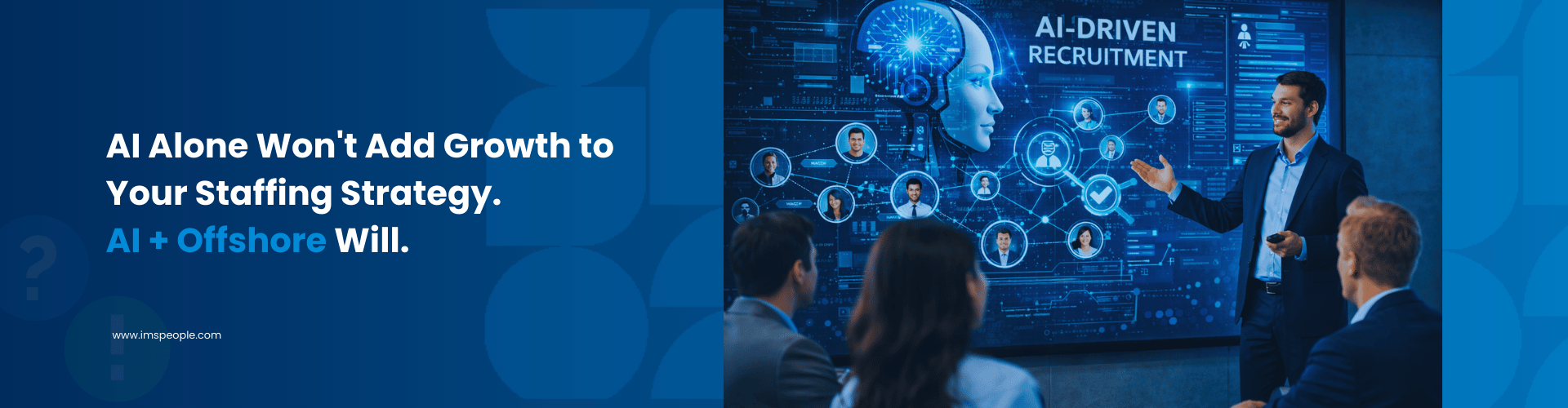
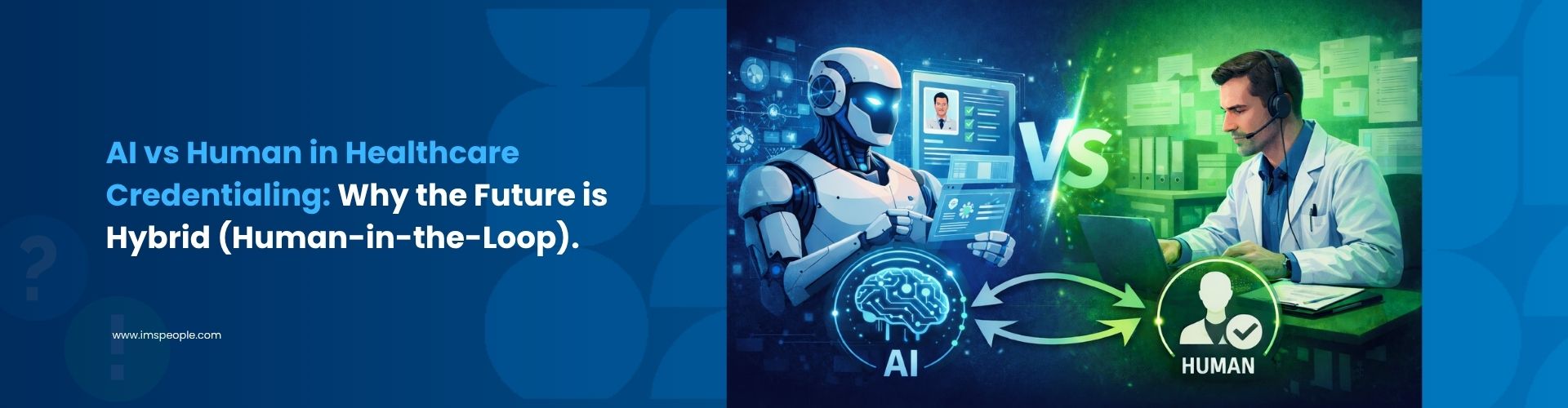
The firms performing best in 2025 are not betting on AI or humans. They are running a human-in-the-loop (HITL) hybrid model. It is a model in which AI handles the volume and humans handle the judgment. Here is what that looks like in practice, why it matters, and how offshore credentialing support makes it operationally possible.
Where AI Actually Earns Its Keep in Credentialing
Let’s be specific, because the AI hype in healthcare administration tends to blur into abstraction.
The most time-consuming parts of provider credentialing are document intake, data extraction, and primary source verification (PSV). A credentialing specialist must manually retrieve a physician’s education history, state licenses, DEA registration, board certifications, NPDB query, and malpractice history. They then cross-reference all of that against multiple source databases, which takes three to four hours per provider file. For a staffing firm onboarding twenty providers in a quarter, that is a significant chunk of headcount just for verification.
AI compresses that to minutes. NLP tools parse unstructured documents, i.e., scanned certificates, PDFs, faxed forms, to extract relevant fields, and flag inconsistencies against primary sources like the masterfiles, state medical boards, and the OIG exclusion list. Platforms like Medallion, VerityStream, and Symplr report processing speeds 3 to 5 times faster than fully manual workflows (Fierce Healthcare, 2023).
📊 AI vs Human vs Hybrid: Credentialing Performance at a Glance
Sources: NAMSS, CAQH Index 2023, McKinsey & Company, Fierce Healthcare
63%
Reduction in credentialing cycle time when AI assists PSV vs manual-only processes
KLAS Research, 2024
3–5x
Faster document processing speed with AIassisted credentialing platforms
Fierce Healthcare, 2023
38%
By 2024, US health systems had adopted AIassisted credentialing tools by 2024
KLAS Research, 2024
The tasks AI handles reliably in a credentialing workflow:
- Automated PSV against NPDB, CAQH, state licensing boards, and OIG exclusion
lists - Expiration date tracking and re-credentialing alerts across a provider roster
- Payer enrollment status monitoring across multiple health plans simultaneously
- Duplicate provider record detection and data normalization
- Document completeness checks before committee submission
- Initial application intake and structured data population
Where AI Falls Short — and Why the Stakes Are High
This is the part that the vendor pitch skips.
AI credentialing systems are trained on historical patterns. When a file falls within those patterns, performance is excellent. When it does not, and in healthcare credentialing, where edge cases are not rare, the model either flags it for human review (the right move) or makes a confident inference based on the nearest training match (the risky move).
Any of the following can fall outside a standard pattern.
-
- A physician trained internationally with partial US board equivalency.
- A license that lapsed during documented medical leave and was reinstated under a state-specific exception.
- A malpractice settlement that looks alarming in a database query, but was a
dismissed suit that never reached trial.
These cases require a trained specialist to make a call — sometimes after picking up the phone, pulling a full file history, or checking with the state board directly.
The financial aftermath is real. The HHS Office of Inspector General (OIG) estimates
that credentialing and enrollment failures contribute to more than $60 billion in annual Medicare and Medicaid improper payments. The CAQH Index 2023 found that data quality issues remain the leading cause of payer enrollment delays, and many of those data quality issues trace back to AI extraction errors on non-standard documents.
The three failure modes staffing firms need to watch
1. Unverified contextual nuances
AI cannot assess gaps in a provider’s training history, behavioral red flags buried in reference checks, or nuanced licensing discrepancies across multi-state practitioners. These require human pattern recognition, not database lookups.
2. Regulatory blind spots
NCQA, TJC, URAC, and CMS credentialing standards are updated regularly. An AI model trained on last year’s rule set may not reflect current state-specific requirements — and a credentialing specialist who works these standards daily does.
3. False-positive verifications
LLM-based document parsing tools have reported false positive matches — confirming credentials that do not actually align. In a compliance audit, a single undetected verification error can trigger payer contract reviews or accreditation findings.
The Human-in-the-Loop Model: What It Looks Like Operationally
The hybrid model is not a compromise. It is a deliberate division of labor based on what each party actually does well.
AI reliably handles everything at scale: document ingestion, extraction, database verification, expiry tracking, and completeness checks. A confidence score is assigned to each provider record. Files above the threshold move forward automatically. Files below it are flagged for missing documentation, inconsistencies, or unusual histories and routed to a human specialist queue.
The specialist reviews only flagged cases, applies judgment, contacts primary sources where needed, and resolves the record. Clean, the file re-enters the automated pipeline. Compliance mapping for NCQA, TJC, or URAC standards happens at the human layer, not the AI layer.
AI vs Human vs Hybrid: Task-by-Task Breakdown
| Credentialing Task | AI-Only | Human-Only | Hybrid HITL |
|---|---|---|---|
| Document intake & data extraction | Excellent — fast, scalable | Slow, labor-intensive | AI handles; human QA exceptions |
| Primary source verification | Good for standard sources | Reliable but slow | AI automates; human resolves edge cases |
| Complex provider history review | High error risk | Reliable, contextual | Human-only — flagged by AI |
| NCQA / TJC compliance mapping | Unreliable on recent updates | Reliable | Human-led, AI-assisted formatting |
| Re-credentialing alerts & tracking | Excellent — automated triggers | Depends on manual tracking | AI monitors; human manages outreach |
| Payer enrollment & follow-up | Limited — requires correspondence | Reliable but time-intensive | Human-led with AI status tracking |
| Avg. cycle time (clean files) | ~33 days | 90–120 days | ~20 days (with offshore support) |
A 2023 McKinsey Health Systems analysis found that organizations using AI-assisted credentialing with human oversight reduced average cycle times from 90+ days to approximately 33 days. Those incorporating offshore credentialing specialists with extended processing hours cut that further, to around 20 days.
KLAS Research’s 2024 credentialing report found that satisfaction scores were significantly higher among organizations pairing AI with dedicated human review teams versus those running AI in a standalone capacity (KLAS Research, 2024). The implication for staffing firms is direct: the technology investment only pays off when the human oversight layer is properly resourced.
IMS People Possible — The Middle Path Combining Human and AI Capabilities
Most healthcare staffing firms are caught in the same bind: desire the efficiency of AI assisted credentialing, but cannot absorb the compliance exposure of removing trained human judgment from the loop. Building an internal credentialing team large enough to handle both functions at scale, with extended hours, is not a realistic hire plan for most agencies.
This is exactly the problem IMS People Possible was built to solve.
We partner with healthcare staffing agencies, physician groups, and hospital systems across the US to provide offshore credentialing support services designed specifically around the human-in-the-loop model. Our credentialing teams work as a functional extension of your medical staff office, handling the judgment-layer tasks that your AI platform cannot manage independently.
In practice, this means your team continues doing what it does well. Our team handles the flagged records, complex cases, follow-ups, and compliance mapping. Operating across time zones, your credentialing pipeline does not stop when your onshore office closes.
What the IMS offshore credentialing model delivers:
-
-
- Review and resolution of AI-flagged provider records requiring contextual judgment
- NCQA, TJC, and URAC compliance mapping for committee-ready credentialing packets
- Payer enrollment tracking, status follow-up, and resubmission management
- Primary source outreach for non-standard or incomplete provider documentation
- Re-credentialing management across large provider rosters
- Audit-ready documentation and process logging for every decision point
- 40–60% cost reduction versus equivalent onshore headcount for the same scope
-
For staffing firms scaling a provider network, through new client acquisitions, service line expansion, or high-volume locum tenens onboarding, the offshore HITL model gives you the capacity headroom to grow without a proportional increase in your credentialing overhead.
Explore our healthcare credentialing support services or see how our broader offshore staffing model applies across your back-office operations.
Conclusion
There is no version of modern provider credentialing where AI is irrelevant. It is faster, more consistent on structured tasks, and more cost-efficient at volume than manual-only processes. That is settled.
But there is also no version of compliant, audit-ready credentialing where trained human judgment is optional. The regulatory complexity, the edge cases, the payer-specific requirements — these are not problems that pattern-matching alone solves.
For healthcare staffing firms, the question is not whether to use AI in credentialing, but rather how to do so. The question is whether you have the human oversight layer in place to make the AI investment pay off without creating compliance exposure.
If your credentialing cycle is running longer than 45 days, your denial rates are climbing, or you are scaling a provider network faster than your internal team can absorb — that is precisely the gap an offshore HITL credentialing partner closes.