

Summarize and analyze this article with:
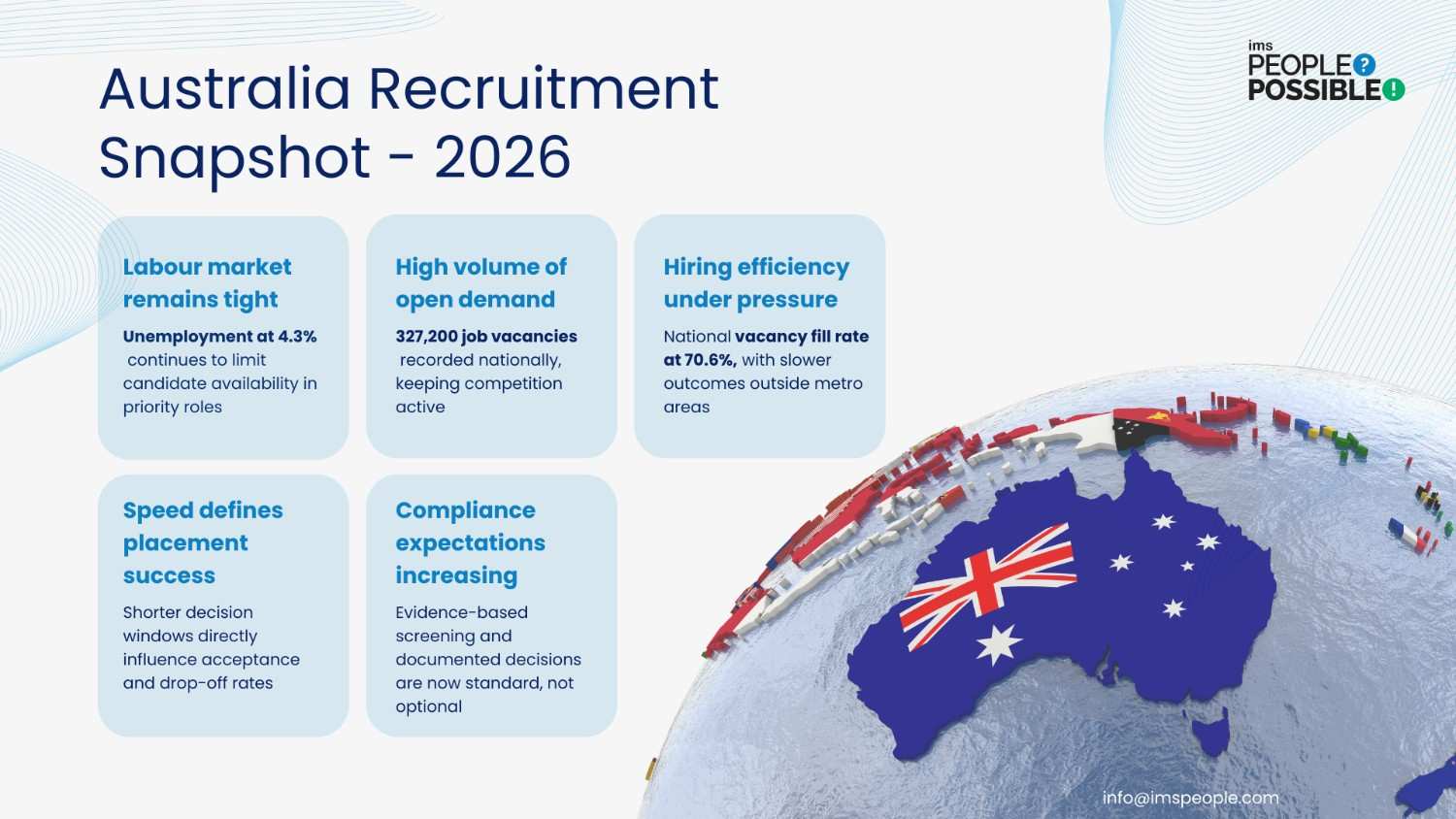
Australian recruitment in 2026 sits in a market where labour demand remains meaningful even as conditions soften from peak tightness. The unemployment rate held at 4.3% in November 2025, signalling limited slack in many skill segments. At the same time, Australia still recorded 327,200 job vacancies in August 2025, which is a large volume of open roles to service. Jobs and Skills Australia also reported a 70.6% vacancy fill rate (June 2025), with regional fill rates continuing to trail metro outcomes.
The implication for Australia’s recruitment teams is clear. Delivery expectations are rising, compliance tolerance is shrinking, and shortlist quality is increasingly judged by evidence rather than volume.
The Current State of Recruitment Australia
Recruitment in Australia for 2026 is shaped by three realities that influence placement outcomes.
1) Shorter decision windows
Candidates often progress through multiple processes at once. Delays in screening, shortlisting, interview scheduling, or feedback can translate into lost placements. Recruitment functions that build disciplined service-level expectations across each stage reduce drop-off and improve acceptance rates.
2) Ongoing shortage pressure in priority occupations
Even as shortages ease in aggregate, the impact remains uneven across sectors and geographies. The practical outcome for recruitment teams is a higher reliance on proactive sourcing, warmer talent pools, and structured assessments that help decision-makers move faster with confidence.
3) Stronger emphasis on compliance and audit readiness
Regulated hiring, especially in care-related roles, continues to require evidence-based processes. Recruitment delivery in 2026 benefits from standardised checklists, documented decision-making, and consistent candidate communication.
Healthcare Staffing Australia: A Critical Focus Area
Healthcare recruitment in Australia remains a priority in 2026 because long-term structural drivers underpin demand. Jobs and Skills Australia notes that Health Care and Social Assistance is the largest employing industry, with 2,391,600 employed and a 16.2% workforce share.
Aged care reform adds further operational complexity. The Australian Government states the new Aged Care Act started on 1 November 2025 and aligns with the launch of the Support at Home program. In 2026, healthcare recruitment success increasingly depends on process discipline across credential checks, documentation control, and fit-for-purpose matching.
What does a stronger healthcare recruitment look like in 2026?
- Credential-led screening aligned to role risk, registration needs and required checks
- Availability and roster fit are assessed early, not after a preferred candidate is selected
- Candidate care that reduces no-shows and improves onboarding completion
- Quality assurance for documentation accuracy and audit readiness.
This is also where the keyword phrase “Healthcare Staffing Australia” is often used in market searches. In practice, the highest-performing providers treat it as a specialist recruitment operating model with strict compliance controls.
Technology’s Transformative Role in Staffing Australia Recruitment
Technology is reshaping recruitment operations, particularly across sourcing, screening, and workflow governance. In parallel, expectations for responsible AI are tightening. The Digital Transformation Agency stated that a new mandatory requirement begins on 15 June 2026, with remaining requirements commencing in December 2026 for government contexts. This is a strong indicator of the broader governance direction for AI-enabled decision support.
In 2026, the strongest technology outcomes in recruitment typically come from practical workflow improvements:
- Structured intake and role calibration to improve shortlist relevance
- Automated workflow steps for scheduling, reminders and status updates
- Data hygiene and skills tagging to improve candidate rediscovery
- Operational reporting tied to funnel conversion and ageing
- Compliance task orchestration for regulated hiring, including healthcare recruitment in Australia
Technology becomes a competitive advantage when it reduces cycle time without weakening screening quality or fairness.
Shifting Workforce Expectations and Talent Strategies
Recruitment strategies in 2026 reflect changing workforce expectations across flexibility, transparency and progress visibility.
Flexibility and predictability
For many job families, flexibility remains a core preference. Where flexibility is limited, predictability often becomes the differentiator, such as clearer roster patterns, faster confirmation, and realistic start dates.
Skills-based evaluation
When shortages are present, a skills-first lens can expand the pool of viable candidates. Structured interviews, scenario-based screening, and consistent scorecards help decision-makers compare candidates fairly and quickly.
Speed with clarity
In tight segments, a process that lacks pay, timeline, or role clarity can underperform even with strong sourcing. In 2026, recruitment teams increasingly win by defining non-negotiables early and maintaining candidate momentum.
Staffing Solutions Australia: Meeting Diverse Industry Needs
Many organisations search online for “staffing solutions Australia” when they need workforce coverage, not only permanent hires. In the Australian market language, this typically translates to recruitment delivered across multiple engagement types.
Common recruitment delivery models in 2026 include:
- Permanent recruitment for capability building and leadership continuity
- Contract recruitment for projects and specialist delivery
- Temporary recruitment for peak demand and short-term coverage
- Volume recruitment for multi-role hiring surges
- Recruitment process outsourcing support for scalable execution
The most dependable recruitment outcomes come from measurable control points, including time-to-shortlist, submission-to-interview ratio, interview-to-offer ratio, and first-90-day attrition.
Healthcare and Staffing Solutions Australia: Integrated Approaches
Healthcare and staffing solutions in Australia are increasingly delivered as integrated recruitment operations because healthcare hiring combines urgency, compliance, and variable demand.
With aged care reform and Support at Home now in effect, recruitment workflows in care settings benefit from stronger documentation governance and clearer onboarding pathways. Integrated delivery generally includes:
- Credential and compliance coordination
- Centralised onboarding administration
- Candidate communications and scheduling support
- Talent pooling for recurring roles
- Reporting that supports audit readiness and continuous improvement
This approach reduces risk for clients while supporting faster mobilisation during demand spikes.
IMS People Possible: Your Offshore Recruitment Services Provider
In 2026, recruitment teams are increasingly looking for scalable delivery capacity that does not compromise quality. IMS People Possible supports recruitment delivery through offshore recruitment services designed to strengthen operational throughput and consistency.
This delivery model helps recruitment teams protect speed and quality during peak demand, persistent shortages, or internal capacity constraints. It also enables onshore teams to focus on higher-value work such as client advisory, role scoping, stakeholder management, and final-stage selection.
Conclusion
Recruitment Australia in 2026 remains shaped by a competitive labour market and ongoing occupation shortages, even as pressure eases in aggregate. Healthcare recruitment in Australia remains a critical focus due to its scale and complexity, with aged care reforms elevating the importance of compliance-led delivery.
The recruitment providers that perform best in 2026 are those that combine disciplined processes, responsible technology use, and scalable delivery models. For teams needing additional execution capacity without sacrificing governance, offshore recruitment support through IMS People Possible can provide a practical path to stronger throughput, improved consistency, and better candidate experience.