
Summarize and analyze this article with:
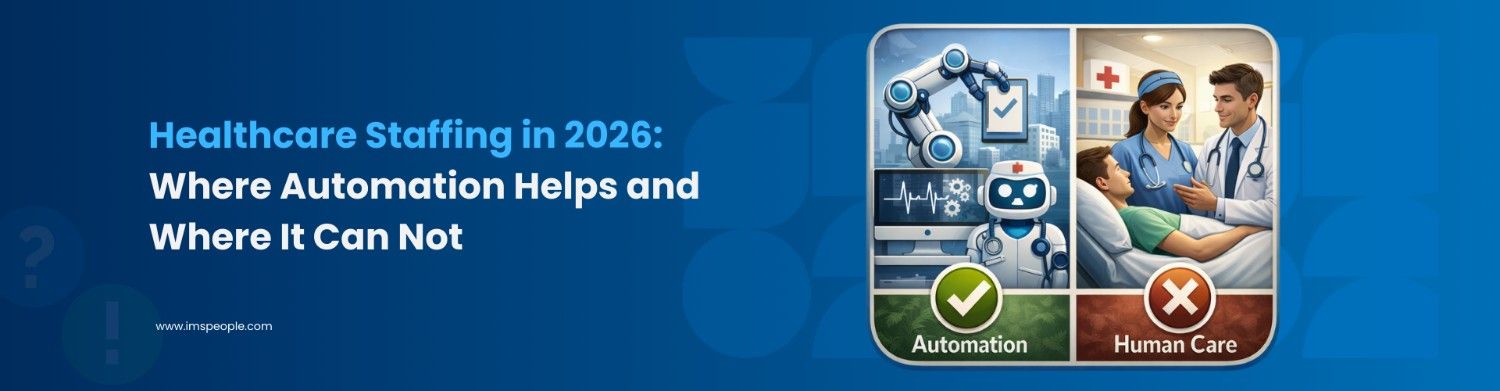
Healthcare staffing in 2026 sits at the intersection of rising demand and limited supply. The U.S. Bureau of Labor Statistics projects about 1.9 million healthcare occupation openings each year from 2024 to 2034, driven by both growth and replacement needs. That scale makes automation essential for high-volume, repeatable work such as sourcing, screening, scheduling, and credential tracking. At the same time, human expertise remains critical for clinical judgement, relationship management, negotiation, and rapid response under pressure.
While the ideal scenario defines maintaining a balance between both, it is not as simple as flipping a switch and sitting back.
Why Automation Matters in Healthcare Staffing
Automation is no longer a fringe concept. It is an operational imperative for healthcare staffing firms that want to:
- Accelerate candidate sourcing and screening
- Improve quality of hire
- Reduce time-to-fill critical clinical roles
- Streamline compliance and credential verification
- Manage large volumes of requisitions without scaling internal headcount
Current State of Automation Adoption
As of 2026, technology adoption in healthcare hiring has matured from simple job distribution tools to AI-driven talent acquisition systems that:
- Analyse candidate profiles
- Predict role fit
- Automate repetitive tasks
- Remediate compliance issues
- Integrate seamlessly with HRIS and payroll systems
The result: faster recruiting cycles, higher retention rates, and lower gross margins on contingent labor.
Where Automation Helps: High-Value Use Cases
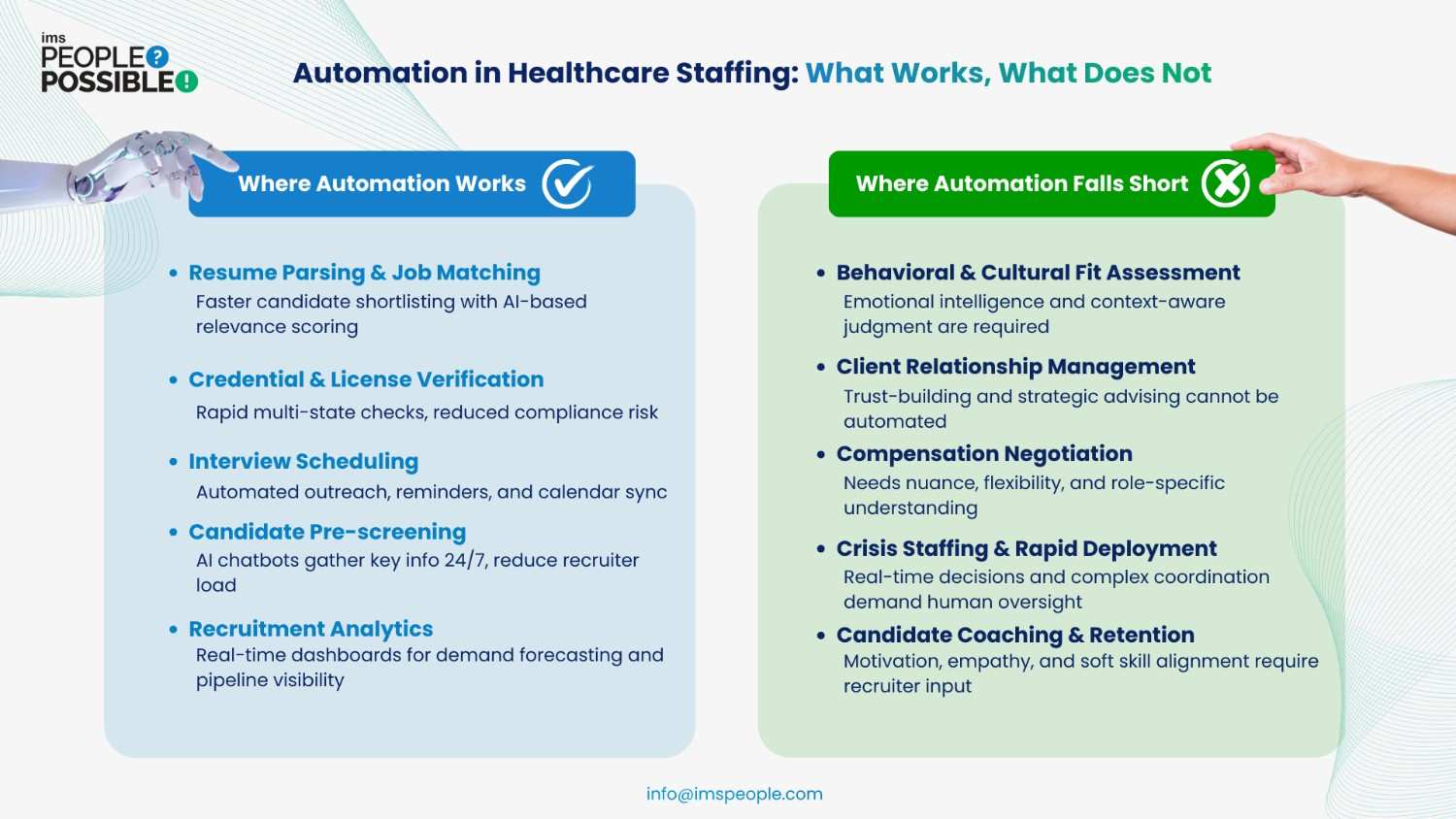
Below are the primary areas where automation delivers measurable impact in healthcare staffing:
1. Candidate Sourcing and Job Matching
Automation platforms improve the effectiveness of candidate sourcing by:
- Parsing resumes and credentials at scale
- Matching talent to job specifications using semantic algorithms
- Reducing bias through objective scoring mechanisms
This dramatically lowers manual screening effort and increases placement accuracy.
Benefits for Staffing Firms
- Increased talent pool screening velocity
- Reduced recruiter workload
- Better job candidate engagement
2. Credentialing and Compliance
Healthcare staffing requires rigorous credential verification — a time-consuming, high-risk process. Automation accelerates:
- License validation across states
- Background checks
- Training and certification tracking
Compliance automation reduces risk exposure while maintaining quality standards.
3. Interview Scheduling and Candidate Outreach
Administrative tasks such as interview coordination distract recruiters from strategic work. Automated scheduling systems now:
- Sync calendars
- Send reminders
- Reduce no-shows
- Track engagement metrics
This improves the overall candidate experience and saves recruiter time.
4. Predictive Analytics for Demand Forecasting
Modern staffing firms leverage data science to forecast future hiring needs based on:
- Seasonal demand
- Patient census trends
- Facility expansions
Predictive models help firms allocate resources efficiently while minimizing cost per hire.
Where Automation Can Not Replace Human Expertise
While automation optimizes many processes, healthcare staffing remains a relationship-driven industry where human judgment is irreplaceable in several key areas:
1. Human-Led Candidate Assessment
Technology can score resumes and predict fit, but actual clinical competency, soft skills, and cultural alignment must be evaluated by experienced recruiters who understand:
- Behavioral signals
- Emotional intelligence
- Team dynamics
These human-centric judgments are crucial for placements that lead to long-term retention.
2. Client Relationship Management
Healthcare staffing is built on trust. Knowing client preferences, institutional culture, and operational needs requires:
- Consultative dialogue
- Empathy
- Industry expertise
Automation tools cannot replicate the strategic insight of a seasoned account executive who understands how staffing impacts patient care outcomes.
3. Negotiation and Offer Customization
Every staffing engagement can be unique. Recruiters must often tailor offers to:
- Specialty pay differentials
- Contract terms
- Candidate expectations
These specialised negotiations demand human creativity and contextual awareness beyond algorithmic outputs.
4. Crisis Response and Rapid Deployment
In times of sudden demand (for example, pandemic surges or natural disasters), human teams excel at:
- Prioritizing urgent needs
- Making real-time adjustments
- Mobilizing complex assignments
Automation supports efficiency, but rapid crisis response still depends on human coordination and judgment.
Strategic Balance: Automation + Offshoring
The future of staffing in healthcare belongs to firms that strike an optimal balance between:
- Automation technologies (for efficiency)
- Human judgment (for quality)
- Offshore staffing partnerships (for scalability and cost-efficiency)
Why Offshore Staffing Is a Competitive Advantage
Offshoring functions such as:
- Candidate sourcing
- Talent engagement
- Screening and qualification
- Administrative coordination
Enables US staffing firms to focus internal resources on client relationships, key accounts, and clinical decision-making.
IMS People Possible, positioned as a leading offshore staffing services provider, enables healthcare staffing firms to:
- Scale teams rapidly without fixed wage overhead
- Maintain continuity during demand spikes
- Reduce recruiting cost per placement
- Leverage global talent workflows optimized for healthcare hiring
This hybrid model preserves service quality while driving operational agility.
IMS People Possible: Scalable Offshore Staffing Services Built for the Future
IMS People Possible is an experienced partner to US healthcare staffing firms, delivering offshore solutions purpose-built for the demands of 2026. As automation reshapes the staffing value chain, the organization enables healthcare recruiters to:
- Operate with 24/7 sourcing and screening support
- Expand candidate reach without additional domestic overhead
- Access recruiters trained in healthcare staffing protocols
- Stay compliant with evolving healthcare regulations
Through customized offshore delivery models, IMS People Possible delivers measurable impact across speed, quality, and scalability. Firms partnering with IMS benefit from:
- Dedicated teams aligned to specific client goals
- Rapid scale-up capacity during peak demand
- Transparent performance metrics and governance
With a proven track record and deep domain expertise, IMS People Possible empowers healthcare staffing firms to grow faster, hire smarter, and stay competitive in a technology-driven market.
Best Practices for Healthcare Staffing Firms in 2026
Below are practical steps for firms looking to lead the market:
1 Adopt Intelligent Recruitment Platforms
Integrate systems that support:
- AI-assisted candidate screening
- Automated compliance workflows
- Real-time analytics dashboards
Prioritize platforms that are HIPAA compliant and secure by design.
2 Invest in Recruiter Upskilling
- Equip internal teams to:
- Interpret analytics outputs
- Coach candidates
- Manage strategic client partnerships
Human expertise remains your differentiator.
3 Partner with Offshore Specialists
Offshore staffing teams can augment internal capabilities without large fixed costs. Evaluate partners based on:
- Domain expertise in healthcare staffing
- Proven global recruiting frameworks
- Data security and compliance safeguards
4 Focus on Candidate Experience
Automation should enhance, not hinder the candidate journey. Best practices include:
- Transparent communications
- Fast response times
- Personalized interactions
Strong candidate experience increases retention and referral rates.
Conclusion
Automation in healthcare staffing is a powerful tool, not a replacement for human expertise. The firms that win in 2026 will combine:
- AI-enhanced recruiting workflows
- Strategic offshore support
- Recruiter expertise
- Client-centric service models
Healthcare remains a profoundly human industry. Staffing solutions must reflect that reality by using automation to amplify, not replace, the value that human professionals deliver.
For US healthcare staffing firms seeking scalable, efficient, and high-quality solutions, IMS People Possible offers a blend of offshore staffing excellence and advanced workflow support designed for the challenges of 2026 and beyond.